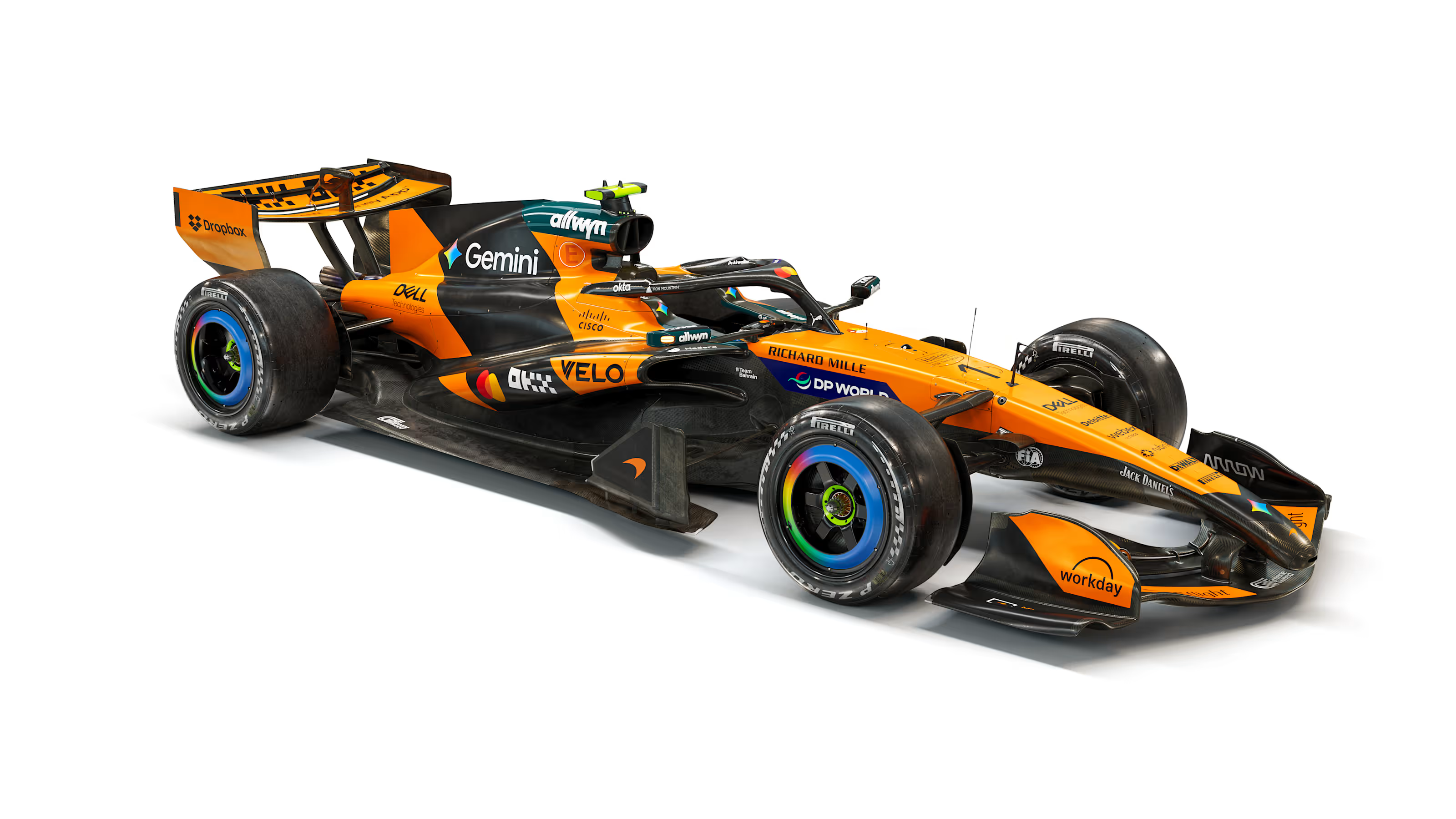
↔ Przeciągnij lub przewiń, aby zobaczyć inne Grand Prix
Runda 20 · 2026 · McLaren
Grand Prix São Paulo
04Zmiany
04Obszary
W skrócie
Ostatnie poprawki
+2 więcej na bolidzie poniżej
Ostatnia duża poprawka na zdjęciu · Brazylia
Zdjęcia i analizy
nicolas carpentiers@carpentiers_f1November 9, 2026
McLaren also revised its rear wing in Brazil 🇧🇷Compared with Mexico, the upper flap has a shorter central section, revised curvature and 2 additional supports along its upper edgeThe new assembly works with a revised beam wing to improve aerodynamic load and airflow interaction
Przednie skrzydło jako pierwsze spotyka się z powietrzem. Samo wytwarza docisk na przedniej osi, a do tego kształtuje przepływ, z którego korzysta wszystko za nim, zwłaszcza turbulencje za przednimi oponami. To podwójne zadanie oraz rola w ustalaniu balansu aerodynamicznego między przodem a tyłem sprawiają, że zespoły zmieniają je tak często.
Co zmieniło się w 2026
Przednie skrzydło 2026 jest węższe (według FIA o 100 mm) i prostsze, a do tego stanowi część aktywnej aerodynamiki: jego klapy przełączają się między trybem zakrętowym (Corner Mode) o wysokim docisku a trybem prostej (Straight Mode) o mniejszym oporze aerodynamicznym, sterowane przez standardowe ECU FIA i dozwolone tylko w wyznaczonych strefach aktywacji. W razie awarii systemu klapy muszą wrócić do trybu zakrętowego. Celem FIA było zmniejszenie oporu i ograniczenie outwashu turbulentnego powietrza, by bolidy mogły jechać bliżej siebie.
Przepisy techniczne FIASekcja C · Art. C3.10.1Wydanie 21 · 2026-10-19
C3.10.1 · Front Wing Profiles
Podświetlone: przestrzeń, na którą przepisy pozwalają w tym obszarze (Załącznik C2 FIA). Przeciągnij, aby obrócić. RV-FW-PROFILES · RV-FW-STRAKE · RV-FW-PYLON · RV-FW-SM-CL-FAIRING · RV-FW-SM-MID
Prostymi słowami
Reguluje profile przedniego skrzydła. Muszą mieścić się w RV-FW-PROFILES (przestrzeni 3D, w której muszą się zmieścić), może ich być najwyżej trzy, a szczeliny między nimi muszą mieć od 5 do 15 mm. Każdy przekrój podlega ścisłym zasadom kształtu i krzywizny, a do krawędzi spływu ostatniego profilu można dodać Gurney (małą listwę) o wysokości do 10 mm.
“” is exempt from C3.2.4 (b) but must:
a. lie in its entirety within RV-FW-PROFILES.
b. comprise of up to three, non-intersecting, simply connected volumes.
c. have up to three sections in any .
d. when viewed from above, fully obscure RS-FW-PROFILES.
In any Y-Plane:
e. the rearmost point of every section must be visible when viewed from below.
f. except for the rearmost section, the rearmost point of every section must not be visible when viewed from above.
g. assessing each section independently, within 40mm of the rearmost point of each section:
i. a line tangent to any part of the section visible from below must have a positive slope. The slope of this line will be considered in the Y-Plane.
ii. no part of the section visible from above may be more than 10mm distant from the section visible from below, if outboard of Y = 400, or 15mm if inboard of Y = 400.
h. contain:
i. no concave radius of curvature visible from below.
ii. no concave radius of curvature less than 50mm visible from above.
Furthermore:
i. when measured against a vertical plane normal to RS-FW-SECTION, contain no normal to any point on the surface that subtends an angle greater than 30°. For volumes thicker than 0.5mm in their entirety (measured normal to the surface on any Y-Plane), compliance with this Article may be determined prior to application of any necessary to demonstrate compliance with C3.3.1 (a).
j. compliance with (i) is not required for surfaces that lie exactly on or Y = 675.
k. At all points along the span, the minimum distance between adjacent Front Wing Profiles volumes must be between 5mm and 15mm when measured with a spherical gauge.
l. The rearmost point of every individual Y-section, when projected in Z onto a plane through , must produce a single tangent continuous curve with no radius of curvature less than 200mm.
Once the Front Wing Profiles bodywork is fully defined, up to 10mm in height may be fitted to the trailing edge of the upper surface of the rearmost section. These Gurneys are considered to be part of the Front Wing Profiles and must satisfy the provisions of this Article except for (g) and (h) and, for the inner extremity of the innermost Gurney and outer extremity of the outermost Gurney, (i).
C3.10.10 · Front Wing Adjuster SystemPowiązane artykuły
Prostymi słowami
Określa ruchome przednie skrzydło. Klapa główna i klapa pomocnicza obracają się wokół stałych osi. Pod kontrolą ECU FIA przełączają się w ciągu 400 ms między dwoma ustalonymi położeniami: trybem zakrętowym (Corner Mode) i trybem prostej (Straight Mode) o mniejszym kącie natarcia, za pomocą maksymalnie dwóch siłowników z czujnikami położenia. Tryb prostej jest dozwolony tylko na postoju lub w strefie aktywacji, a w razie awarii skrzydło wraca do trybu zakrętowego.
The “” is defined as follows:
a. “FW Primary Flap”, if fitted, must:
i. be a continuous portion of , excluding the forwardmost volume.
ii. rotate about the “Primary Axis”, which must pass through Point A and Point B and be fixed relative to the forwardmost volume of Front Wing Profiles.
b. “”, if fitted, must:
i. be a continuous portion of only the rearmost volume of Front Wing Profiles.
ii. rotate about the “”, which must pass through Point C and Point D and be fixed relative to either the Primary Flap if fitted, or the forwardmost volume of Front Wing Profiles.
c. Both FW Primary Flap and FW Secondary Flap must include any fitted and any parts of Front Wing Auxiliary Components that are rigidly attached to the respective volumes.
d. “Point A” and ”Point B” must lie:
i. within the volume of FW Primary Flap.
ii. no more than 25mm from the forwardmost point of FW Primary Flap at their respective Y positions.
e. “Point C” and ”Point D” must lie:
i. within the volume of FW Secondary Flap.
ii. no more than 25mm from the forwardmost point of FW Secondary Flap at their respective Y positions.
f. Point A and Point C must lie inboard of Y = 150.
g. Point B and Point D must lie between Y = 475 and Y = 675.
With Front Wing Profiles positioned to comply with Article C3.10.1, up to two pairs of rotation surfaces (four in total) must be defined as follows:
h. “Primary Rotation Surfaces”, which must:
i. use the Primary Axis as their axis of revolution.
ii. pass through Point A for the first surface and Point B for the second surface.
iii. extend over the complete chord of FW Primary Flap.
i. “Secondary Rotation Surfaces”, which must:
i. use the Secondary Axis as their axis of revolution.
ii. pass through Point C for the third surface and Point D for the fourth surface.
iii. extend over the complete chord of FW Secondary Flap.
j. Over their intersection with the FW Primary and Secondary Flaps at their original design position (defined in accordance with Article C3.10.1), no surface of rotation may have a normal which forms an angle greater than 30 degrees to the Y-Axis.
Compared to the position of Front Wing Profiles defined in Article C3.10.1, adjustment not controlled by the is only allowed when the car is stationary and by the use of a tool, and in accordance with the Sporting Regulation and must:
k. not result in a decrease in incidence of the tangent lines defined in Article C3.10.1 (g) (i).
l. result in a maximum deviation for any point of Front Wing Profiles no greater than:
i. 30mm for FW Primary Flap.
ii. 60mm for FW Secondary Flap.
Any adjustment of Front Wing Profiles controlled by the FIA Standard ECU must:
m. be about one of the Primary Axis or Secondary Axis only.
n. when commanded, switch to one of two fixed positions defined as follows:
i. a “” position, that conforms to a position defined in (k) and that remains identical following any operation to its position beforehand.
ii. a “Straight Mode” position that, when compared to the Corner Mode position, results in a decrease in incidence of FW Primary Flap and/or FW Secondary Flap. Furthermore, except when limited by a physical stop defined in (u), the magnitude of decrease must remain constant.
o. have a maximum transition time between the two fixed positions that does not exceed 400ms, measured from the instant at which the command to change mode is issued by the FIA Standard ECU until the position sensor(s), connected to the FIA Standard ECU, confirm that the commanded fixed position has been reached.
p. be driven by up to two actuators, across both sides of the car.
q. be measured by position sensors, one for each of the actuators defined in (p), which:
i. are mechanically linked to Front Wing Profiles.
ii. output analogue signals calibrated over the actuator travel.
iii. are connected to the FIA Standard ECU as specified by the FIA.
r. be symmetrical about .
Furthermore:
s. Irrespective of whether the adjustment is controlled by the FIA Standard ECU, any fitted FW Primary Flap and FW Secondary Flap must:
i. except for Front Wing Fishplates, Front Wing Adjuster Fairing and any fitted Gurneys, remain in their entirety within RV-FW-PROFILES.
ii. retain the geometric relationship between all elements of FW Primary Flap, except when adjusting about the Secondary Axis only.
iii. retain the geometric relationship between all elements of FW Secondary Flap.
iv. conform with all bodywork regulations except for Article C3.2.4 (b), Article C3.10.11 (g) (i) and sub-clauses (b) to (l) of Article C3.10.1.
t. Except for a failure of the Front Wing Adjuster System, or during the transition between Corner Mode and Straight Mode, FW Primary Flap and FW Secondary Flap can only have the two positions defined in (n).
u. Physical Stops must be provided to prevent both FW Primary Flap and FW Secondary Flap from being rotated external to RV-FW-PROFILES.
v. The design is such that failure of the system will result in it returning to its Corner Mode position.
w. FW Primary Flap and FW Secondary Flap may only be in a when the car is stationary or fully inside an as defined by Article B7.1.1 (d).
Łączy profile przedniego skrzydła, płytę końcową, pylon i opcjonalną listwę w zespół przedniego skrzydła (Front Wing Assembly), najpierw usuwając wystające pozostałości, z zaokrągleniami przejściowymi do 10 mm. Całość musi być jedną bryłą, pylon musi być niewidoczny od dołu, a każda listwa położona ponad 715 mm przed linią przedniej osi musi być niewidoczna od góry.
“Front Wing Assembly” results from the of the following components:
a. .
b. Front Wing Endplate.
c. Front Wing Pylon.
d. Front Wing Strake, if fitted.
Before trimming is applied, any Front Wing Profiles remaining outboard of Front Wing Endplate and any Front Wing Pylon remaining below Front Wing Profiles must be discarded.
A , no greater than 10mm, may be applied along the intersections between the remaining component parts.
Once fully defined, Front Wing Assembly must:
e. be a single volume, with no overlapping regions.
f. when viewed from below, fully obscure Front Wing Pylon.
g. when viewed from above, fully obscure Front Wing Strake forward of = −715, if fitted.
“A completely new front wing design, aimed at improved flow conditioning towards the floor and bodywork resulting in improved aerodynamic performance.”
McLaren's new development wing, mounted from the middle element, SLM only on the rear element & lower profile where it meets the endplate.📸 Spacesuit media- Craig Evans#F1 #F1tech #BrazilianGP
🔎 McLaren’s new front wing, which will be the same concept it launches its 2027 F1 car with, has been revealed in Brazil.The front wing is a change of concept for the team as it features many revisions - including to the mainplane, movable front wing elements and endplates.
nicolas carpentiers@carpentiers_f1November 6, 2026
A significant change to #McLarenF1 front wing at the #BrazilGP🇧🇷 The nose now attaches to the 2nd element rather than the mainplane, freeing up the latter for a different aero profile, but leaving only upper flap movable in SM. A trade-off between downforce, drag & stiffness. #F1
nicolas carpentiers@carpentiers_f1November 9, 2026
McLaren’s front wing evolution in 2026 After updates in Canada and Barcelona, Interlagos brought a much more radical redesign: a shorter mainplane, revised flaps and a nose now attached to the 2nd element.McLaren expects to carry this concept into its 2027 car.#F1 #TechF1
nicolas carpentiers@carpentiers_f1November 5, 2026
#McLarenF1’s new front wing at the #BrazilGPCompared with the old spec, mainplane is much shorter, nose supports now attach to the 2nd element,, uppermost flap is much largerA major redistribution of the wing’s surfaces, with the concept set to carry over to '27 car#F1 #TechF1
nicolas carpentiers@carpentiers_f1November 5, 2026
⚡️#McLaren’s new front wing for the #BrazilGP 🇧🇷, compared with the previous specification.Revised flap geometry and adjuster, reshaped endplate junction.According to Peter Prodromou, McLaren expects to carry over this front wing concept to its 2027 car.#F1 #TechF1
nicolas carpentiers@carpentiers_f1November 28, 2026
🇶🇦 Nothing new here, but McLaren has brought both front wing specs to Qatar, the previous one presumably as a spare.Seeing them together in a single shot from this unusual angle highlights the changes introduced in Brazil🔽 #TechF1 #McLarenF1 #QatarGP
Previous and Brazil-spec front wings side by side (photo from Qatar)
“The front wing endplate has been modified, resulting in an improvement of aerodynamic flow conditioning and subsequently enhanced aerodynamic overall performance.”
Further updates to the 'new' Mclaren front wing being tested by #OP81.Mcl say "The front wing endplate has been modified, resulting in an improvement of aerodynamic flow conditioning and subsequently enhanced aerodynamic overall performance"📸 McLaren #F1 #F1tech #BarcelonaGP
1) After bringing significant upgrades to Miami last time out, McLaren introduce the second half of the package in Montréal with a new front wing, a revised engine cover and cooling louvres, a new halo winglet, revised rear wing endplates, updated rear suspension fairings and new…
#McLarenF1 brought a new front wing to #CanadianGP🇨🇦 — designed to improve flow conditioning across a wider operating range and deliver more aero load.But after sprint qualifying, the team removed it after the expected performance gains failed to materialise 👀#F1 #TechF1
Pełna lista zmian, które McLaren wdrożył w swoim przednim skrzydle na GP Kanady. Warto podkreślić, że papajowi po FP1 wrócili do używania egzemplarza z Miami.#F1PL #ElevenF1 #F1
🔎 A closer look at McLaren's new front wingIt features a new approach in many areas, including a revised profile of the flap elements as well as changes to the footplate area, which has been narrowed.
Płyty końcowe zamykają zewnętrzne końce przedniego skrzydła i decydują o tym, jak prowadzone jest powietrze w pobliżu przednich opon. To kluczowe narzędzie do kontrolowania turbulencji za przednimi oponami, które wpływają na podłogę, sidepody i tył bolidu.
Co zmieniło się w 2026
Przy węższym przednim skrzydle płyta końcowa 2026 jest zdefiniowana jako połączenie korpusu płyty, zewnętrznej i wewnętrznej stopki oraz opcjonalnego diveplane'a, każdego w osobnej objętości referencyjnej. Zmienił się ogólny zamysł przepisów: jak wyjaśnia formula1.com, nowe przednie skrzydła i deski podłogowe mają powstrzymać wypychanie powietrza na zewnątrz wokół przednich kół, które tworzy turbulencje dla jadącego z tyłu bolidu.
Przepisy techniczne FIASekcja C · Art. C3.10.6Wydanie 21 · 2026-10-19
C3.10.6 · Front Wing Endplate
Podświetlone: przestrzeń, na którą przepisy pozwalają w tym obszarze (Załącznik C2 FIA). Przeciągnij, aby obrócić. RV-FWEP-BODY · RV-FWEP-OFP · RV-FWEP-IFP · RV-FWEP-DIVEPLANE
Prostymi słowami
Płyta końcowa przedniego skrzydła to korpus płyty, obie stopki i opcjonalny diveplane połączone razem, z zaokrągleniami przejściowymi do 40 mm między korpusem a diveplane'em i do 10 mm w pozostałych miejscach. Musi być jedną bryłą, mieć co najmniej 10 mm grubości tam, gdzie jest widoczna z boku, i zakrywać powierzchnie referencyjne RS-FWEP-TOP i RS-FWEP-SIDE.
“Front Wing Endplate” results from the of the following components:
a. Front Wing Endplate Body.
b. Front Wing Outboard Footplate.
c. Front Wing Inboard Footplate.
d. Front Wing Endplate Diveplane, if fitted.
Before trimming, any Front Wing Endplate Body remaining below Front Wing Inboard Footplate must be discarded.
A , no greater than 40mm, may be applied along the intersections between Front Wing Endplate Body and Front Wing Diveplane. A Fillet Radius, no greater than 10mm, may be applied along the intersections between the remaining component parts.
Once fully defined, Front Wing Endplate must:
e. be a single, simply connected volume, with no overlapping regions.
f. be no less than 10mm thick (being the minimum distance when measured normal to the surface), if visible from the side.
g. when viewed from above, fully obscure RS-FWEP-TOP:
h. when viewed parallel to the Y-Axis from inboard, fully obscure RS-FWEP-SIDE and Front Wing Endplate Diveplane.
C3.10.2 · Front Wing Endplate BodyPowiązane artykuły
Prostymi słowami
Korpus płyty końcowej przedniego skrzydła (Front Wing Endplate Body) musi mieścić się w RV-FWEP-BODY (przestrzeni 3D, w której musi się zmieścić), z maksymalnie dwoma fragmentami w każdym pionowym przekroju wzdłużnym. Jego krzywizny wypukłe muszą mieć promień co najmniej 5 mm, a wklęsłe co najmniej 100 mm.
“Front Wing Endplate Body” must:
a. lie in its entirety within RV-FWEP-BODY.
b. have up to two sections in any .
Front Wing Endplate Body must contain:
c. no convex radius of curvature less than 5mm.
d. no concave radius of curvature less than 100mm.
C3.10.3 · Front Wing Outboard FootplatePowiązane artykuły
Prostymi słowami
Zewnętrzna stopka płyty końcowej przedniego skrzydła (Front Wing Outboard Footplate) musi mieścić się w RV-FWEP-OFP (przestrzeni 3D, w której musi się zmieścić), z maksymalnie dwoma fragmentami w przekrojach poziomych poniżej 160 mm wysokości oraz w przekrojach poprzecznych położonych dalej z tyłu. Żadna krzywizna nie może mieć promienia mniejszego niż 5 mm, a krzywizny wklęsłe widoczne od dołu lub położone ponad 825 mm od osi symetrii muszą mieć co najmniej 50 mm.
“Front Wing Outboard Footplate” must:
a. lie in its entirety within RV-FWEP-OFP.
b. below Z = 160, have up to two sections in any Z-Plane.
c. rearwards of = −425, have up to two sections in any .
Front Wing Outboard Footplate must contain:
d. no radius of curvature less than 5mm.
e. no concave radius of curvature less than 50mm visible from below.
f. no concave radius of curvature less than 50mm outboard of Y = 825mm.
C3.10.5 · Front Wing Endplate DiveplanePowiązane artykuły
Prostymi słowami
Opcjonalna płetwa (diveplane) płyty końcowej przedniego skrzydła musi mieścić się zarówno w prostopadłościanie 300 x 325 x 50 mm, jak i w RV-FWEP-DIVEPLANE (przestrzeni 3D, w której musi się zmieścić). Jej krzywizny wypukłe muszą mieć promień co najmniej 5 mm, a wklęsłe co najmniej 50 mm.
“Front Wing Endplate Diveplane” must:
a. lie in its entirety within:
i. an axis aligned cuboid of the following dimensions [X, Y, Z] = [300, 325, 50].
ii. RV-FWEP-DIVEPLANE.
Front Wing Endplate Diveplane must contain:
b. no convex radius of curvature less than 5mm.
c. no concave radius of curvature less than 50mm.
Brak zmian dla tego elementu do wybranego wydarzenia.
Element 03 / 22
Nos
Dlaczego zespoły to rozwijają
Nos podtrzymuje przednie skrzydło i mieści przednią strukturę zderzeniową. Jego kształt decyduje też o tym, ile powietrza przepływa pod nim w stronę podłogi, więc nawet niewielkie zmiany jego szerokości i spodu mogą wpłynąć na cały bolid.
Co zmieniło się w 2026
Główna zmiana na 2026 dotyczy bezpieczeństwa: FIA wprowadziła dwuetapową przednią strukturę zderzeniową, by nos rzadziej odpadał przy pierwszym uderzeniu i nie zostawiał bolidu bez ochrony przy drugim. Nos musi pozostać w swojej objętości referencyjnej i spełniać zasady krzywizny, które zapewniają gładkie boki.
Przepisy techniczne FIASekcja C · Art. C3.7.1Wydanie 21 · 2026-10-19
C3.7.1 · Nose
Podświetlone: przestrzeń, na którą przepisy pozwalają w tym obszarze (Załącznik C2 FIA). Przeciągnij, aby obrócić. RV-NOSE · RV-CAMERA-2
Prostymi słowami
Nos musi mieścić się w RV-NOSE (przestrzeni 3D, w której musi się zmieścić) i, patrząc z góry, zakrywać RS-NOSE przed linią X_A = 0. Jego powierzchnie muszą być gładkie, bez wklęsłych krzywizn w żadnym przekroju poprzecznym, a minimalne promienie w rzucie z góry wynoszą 45 mm i 20 mm. Kamery w pozycji 2 i niektóre wsporniki montażowe są z tego zwolnione.
“Nose” must:
a. lie in its entirety within RV-NOSE.
b. when viewed from above, fully obscure RS-NOSE ahead of = 0.
Nose , must be Tangent Continuous, and in any must:
c. contain no concave radius of curvature.
d. between = −950 and XA = 0, have a section that when viewed from above:
i. is tangent to the Z-Axis at its outermost extremity.
ii. contains no radius of curvature less than 45mm at XA = 0.
iii. contains no radius of curvature less than 20mm forward of XA = 0.
Furthermore, the following will be exempt from the above:
e. Cameras in Position 2.
f. Mounting brackets defined in Article C8.16.7.
Brak zmian dla tego elementu do wybranego wydarzenia.
Element 04 / 22
Przednie zawieszenie
Dlaczego zespoły to rozwijają
Przednie zawieszenie kontroluje kontakt przednich opon z nawierzchnią podczas hamowania, w zakrętach i na nierównościach oraz utrzymuje stabilny prześwit, którego potrzebuje podłoga. Jego wahacze znajdują się w samym strumieniu powietrza, więc zespoły kształtują owiewki i rozmieszczają wahacze także ze względów aerodynamicznych.
Co zmieniło się w 2026
Każde koło nadal musi być połączone sześcioma elementami zawieszenia, a owiewki muszą być uszczelnione, by nie przepływało przez nie powietrze. Tekst przepisów 2026 ustala też niektóre zasady układu, np. rozstaw mocowań przednich wahaczy. Deklarowanym celem FIA w przypadku nowej podłogi było zmniejszenie zależności od bardzo sztywnych i bardzo niskich ustawień, co zmienia wymagania zespołów wobec zawieszenia.
Przepisy techniczne FIASekcja C · Art. C10.3Wydanie 21 · 2026-10-19
C10.3 · Outboard suspension
Pokazany kształt (przerywane krawędzie) jest tylko poglądowy: narysowany przez PITWALL, by pokazać położenie części, a nie granica przepisów.
Prostymi słowami
Przy unieruchomionym układzie kierowniczym położenie każdego koła może zależeć wyłącznie od jego pionowego ugięcia zawieszenia, a pochylenie koła może zmienić się najwyżej o 1 stopień na 10 mm ugięcia. Każda zwrotnica musi mieć dokładnie sześć elementów zawieszenia, przy każdym przednim kole jeden połączony z układem kierowniczym, z punktami mocowania wewnątrz bębna koła i szczególnymi zasadami rozstawu z przodu.
C10.3.1 With the steering wheel rotation fixed, the position of each wheel centre and the orientation of its rotation axis must be completely and uniquely defined by a function of its principally vertical suspension travel, save only for the effects of reasonable compliance which does not intentionally provide further degrees of freedom.
Additionally, the angle subtended between the normal projection of the Z axis onto the =0 plane and the Z axis must not vary by more than 1 degree over 10mm of suspension travel with the steering wheel rotation fixed. Compliance must be demonstrated by CAD, using camber values of −3 degrees front and −1 degree rear.
C10.3.2 There must be six suspension members connecting each suspension upright to the .
Redundant suspension members are not permitted.
On the front axle, one suspension member per wheel must be connected to the steering system.
C10.3.3 Suspension members having shared attachment points will be considered by a virtual dissection into discrete members.
C10.3.4 The outboard attachment points of each suspension member (defined as the kinematic centre of rotation of the joint that allows relative rotation between a suspension member and its adjoining upright) must lie:
a. outboard of YW =0.
b. Above ZW = −100 for the front axle and above ZW = −40 for the rear axle.
c. Inside the Drum defined in Article C3.14.2.
Exceptionally, the outboard attachment point of a suspension member connected inboard, to the rockers defined in Article C10.4.1 and outboard, directly to another suspension member, may not satisfy the provisions of this Article, but must in any case:
d. lie outboard of YW =50.
e. be no more than 25mm from the load line of the suspension member it is attaching to.
f. together with the inboard attachment point of the same suspension member, lie on the same side of the suspension member it is attaching to when viewed from the front.
C10.3.5 On the front axle only, considering the six suspension members connected to an upright, but excluding the members connected inboard to the steering system or the rockers defined in Article C10.4.1, they must form 2 independent pairs of members each with their inboard attachment points separated in X by no less than 300mm and above Z=250mm. Furthermore to form a pair, each suspension member must also be accompanied by the suspension member with the closest outboard attachment point in Z .
C3.17 · Suspension and Driveshaft FairingsPowiązane artykuły
Prostymi słowami
Owiewki zawieszenia muszą być założone na każdy element zawieszenia z wyjątkiem tych o okrągłym przekroju. Muszą też być od środka uszczelnione, tak aby powietrze nie mogło przez nie przepływać.
C3.17.1 “Suspension Fairings” must be fitted to all suspension members defined in Article C10.3.6, except for those of circular cross section. Furthermore, Suspension Fairings must be internally sealed to prevent any internal airflow.
“To deal with the unique corner radii encountered at his track, revised front suspension fairings allowing for increased clearance to the wheel at high steer angles have been brought to this event.”
Przednie wloty chłodzenia hamulców doprowadzają chłodne powietrze do hamulców i koła oraz odprowadzają ciepło. Ponieważ leżą tuż przy przedniej oponie, ich wloty (scoops) i deflektory służą też do kierowania turbulencjami za oponą, więc rozwija się je zarówno pod kątem chłodzenia, jak i aerodynamiki.
Co zmieniło się w 2026
W 2026 wlot chłodzenia hamulców jest traktowany jako nadwozie koła: bęben o narzuconym kształcie, wlot (scoop) oraz przednie i tylne deflektory, każdy ograniczony do określonej objętości i mierzony w układzie współrzędnych koła. FIA poinformowała, że część nadwozia koła jest narzucona, by poprawić strumień powietrza schodzący z kół, zgodnie z celem, jakim jest bliższa walka na torze.
Przepisy techniczne FIASekcja C · Art. C3.14.2Wydanie 21 · 2026-10-19
C3.14.2 · Drum
Wloty chłodzenia hamulców są regulowane jako elementy koła: bęben, wlot (scoop) i deflektory bębna.
Pokazany kształt (przerywane krawędzie) jest tylko poglądowy: narysowany przez PITWALL, by pokazać położenie części, a nie granica przepisów.
Prostymi słowami
Bębny przednich i tylnych kół muszą mieć stałe kształty wyznaczone przez powierzchnie referencyjne RS-FWH-DRUM i RS-RWH-DRUM. Każdy wymaga ciągłego, 360-stopniowego uszczelnienia aerodynamicznego między bębnem a osią, a między bębnem a obręczą koła można zamontować elastyczne uszczelki.
“Front Drum” and ”Rear Drum” , the latter being exempt from Article C3.2.4 (b), must:
a. be made to the geometry defined by RS-FWH-DRUM and RS-RWH-DRUM respectively.
Furthermore:
b. Drum Bodywork must be fitted with an , in the outboard of the two annotated volumes, between the Drum and the axle. This Aerodynamic Seal must be circumferential, continuous (around an arc of 360°), concentric about the axis, and uniform.
c. Drum Bodywork may be fitted with a flexible seal or seals, in the inboard of the two annotated volumes, between the Drum and the Wheel Rim.
C3.14.6 · Front Drum Front DeflectorPowiązane artykuły
Prostymi słowami
Opcjonalny przedni deflektor przedniego bębna musi mieścić się w prostopadłościanie 150 x 45 x 25 mm, który można swobodnie przesuwać i obracać wokół kierunku osi koła, pozostając poniżej Z_W = 0. Może składać się z maksymalnie dwóch oddzielnych elementów i mieć dwa fragmenty w każdym przekroju, a od strony wewnętrznej musi być zasłonięty przez przednią wargę (Front Lip).
“Front Drum Front Deflector” , if present, must:
a. lie in its entirety:
i. within an axis aligned cuboid of the following dimensions [ , YW , ZW ] = [150, 45, 25], which may be freely translated along any axis, and rotated about the YW axis only.
ii. below ZW = 0.
b. comprise of up to two, non-intersecting, simply connected volumes.
c. have up to two sections in any XW , Y or ZW -Plane.
d. not be visible from inboard with the Front Lip present.
Furthermore,
e. Front Drum Front Deflector Bodywork is optionally fitted and exempt from Article C3.14.1 (b).
C3.14.7 · Front Drum Rear DeflectorPowiązane artykuły
Prostymi słowami
Tylny deflektor przedniego bębna łączy stałą powierzchnię referencyjną (RS-FWH-RDEF) z krawędzią natarcia w RV-FWH-RDEF. Tam, gdzie jest widoczny od strony wewnętrznej, może mieć najwyżej 15 mm grubości, a jego krzywizny wklęsłe muszą mieć promień co najmniej 75 mm (część przednia, widziana od zewnątrz) lub 50 mm (część tylna).
“Front Drum Rear Deflector” , which is exempt from Article C3.2.4, results from the of the following components:
a. RS-FWH-RDEF.
b. Deflector Leading Edge, which must:
i. lie in its entirety within RV-FWH-RDEF.
ii. contain no more than a single section in any X and ZW -Plane.
iii. obscure RS-FWH-TOP when viewed from inboard.
Front Drum Rear Deflector Bodywork must:
c. be no more than 15mm thick (being the minimum distance when measured normal to the surface), if visible from inboard.
Furthermore:
d. Compliance with (c) is not required within 5mm of the side-view boundary of Front Drum Rear Deflector when viewed from inboard.
Front Drum Rear Deflector must:
e. in any -Plane forward of XW = 150, contain no concave radius of curvature:
i. less than 75mm visible from outboard.
ii. visible from inboard.
f. in any XW -Plane rearward of XW = 150, contain no concave radius of curvature less than 50mm.
Wloty (scoops) przednich i tylnych kół muszą mieścić się odpowiednio w RV-FWH-SCO i RV-RWH-SCO (przestrzeniach 3D, w których muszą się zmieścić). Ich powierzchnie muszą być w pełni widoczne od strony wewnętrznej i nie mogą mieć krzywizny o promieniu mniejszym niż 20 mm, z wyjątkiem części tylnego wlotu za X_W = 0 w układzie współrzędnych koła.
The “Front Scoop” and ”Rear Scoop” must:
a. lie in their entirety within RV-FWH-SCO and RV-RWH-SCO respectively.
Furthermore, Rear Scoop Bodywork rearwards of = 0:
b. is exempt from Article C3.2.4 (b).
Scoop must:
c. be fully visible from inboard.
d. contain no radius of curvature less than 20mm, except for regions of the Rear Scoop rearwards of XW = 0.
nicolas carpentiers@carpentiers_f1October 22, 2026
A closer look at #McLarenF1's revised front brake duct deflector for the #USGPA small additional carbon fibre element has been fitted to its upper section, extending inwards towards the upper suspension arm and partially closing the gap above the brake cooling inlet#F1 #TechF1
nicolas carpentiers@carpentiers_f1October 26, 2026
🟠 4/7 | McLaren – Aerodynamic refinementsMcLaren revised its front corner aerodynamic elements and suspension fairings, along with the rear corner furniture.A redesigned diffuser aims to improve flow conditioning and downforce across the speed range.#F1 #McLarenF1 #TechF1
“To meet the high brake cooling demands of this and upcoming circuits, a new front brake duct aiming at increased brake cooling massflow has been designed.”
#McLarenF1 has introduced a larger front brake cooling duct for the #SingaporeGP.According to the team's FIA submission, the revised design increases cooling airflow to cope with the circuit's high braking demands.Here's a comparison with the Bahrain-spec version 👇#TechF1 #F1
nicolas carpentiers@carpentiers_f1October 12, 2026
🟠 McLAREN — FRONT BRAKE COOLING#McLarenF1 introduced a revised front brake duct to increase cooling airflow at demanding circuits.The comparison with Bahrain reveals changes to the inlet profile and internal opening, designed to accommodate greater cooling mass flow. #F1
“A small modification to the front corner furniture resulting in an improvement in flow conditioning around the front tyre and resultant aerodynamic performance.”
“To meet the increased brake cooling demands of this circuit, a larger front brake cooling exit has been designed aiming at minimising the detrimental impact on aerodynamic performance.”
1) McLaren have brought a large upgrade package to Miami, with the MCL40 getting revised front corner aero elements, new furniture and cooling louvres on the engine cover, redesigned sidepod inlets and mirrors, an all-new floor, revised rear corner furniture and an updated rear…
Koła i opony to jedyny kontakt bolidu z torem. Obręcze są ściśle regulowane, ale to, jak powietrze opływa koło i przez nie przepływa, wpływa na opór aerodynamiczny, temperatury hamulców i turbulencje, z którymi musi sobie radzić reszta bolidu.
Co zmieniło się w 2026
18-calowe koła wprowadzone w 2022 roku pozostają, ale opony są węższe: według FIA o 25 mm z przodu i 30 mm z tyłu. Formula1.com podaje, że zrezygnowano z osłon kół, by zaoszczędzić masę, a FIA usunęła małe nadkola nad przednimi kołami stosowane od 2022 roku. Obręcze muszą być ze stopu magnezu i nie mogą mieć elementów zaprojektowanych do zmiany przepływu ciepła.
Przepisy techniczne FIASekcja C · Art. C10.7.2Wydanie 21 · 2026-10-19
C10.7.2 · Wheel rim dimensions
Podświetlone: przestrzeń, na którą przepisy pozwalają w tym obszarze (Załącznik C2 FIA). Przeciągnij, aby obrócić. TYRE-FRONT
Prostymi słowami
Określa wymiary obręczy kół, w tym średnicę obręczy 462,5–463 mm i szerokość osadzenia opony 315 mm z przodu i 401,3 mm z tyłu. Obręcz jest pojedynczym profilem obrotowym o grubości co najmniej 2,5 mm, z ograniczonymi obszarami, w których można usunąć materiał. Powietrze nie może przepływać między jej wewnętrzną a zewnętrzną wnęką, a konstrukcje lewa i prawa muszą być identyczne.
a. The Wheel Rim key dimensions are:
Front Wheel Rear Wheel Rim Diameter 462.5 / 463 462.5 / 463 Tyre Mounting Width 315 ± 0.5 401.3 ± 0.5 Lip External Diameter 496 ± 0.5 496 ± 0.5 Overall Width 334 ref. 420.3 ref.
Outboard Lip Thickness 8.5 ± 0.2 8.5 ± 0.2 Inboard Lip Thickness 10.5 ± 0.2 10.5 ± 0.2
b. The Wheel Rim must be a solid of rotation formed by revolving a single profile around the axis of rotation of the Wheel Rim. The profile must be tangent continuous with a minimum radius of curvature of 8mm in the area:
i. more than 80mm from the axis Y .
and
ii. outboard of =−36.
and
iii. inboard of; YW =−302 for the front rim and YW =−388 for the rear rim.
c. Once the revolved solid has been fully defined, material may be :
i. removed between YW =−210 and YW =−392.5 on the rear wheel and between YW =−188 and YW =−319 on the front wheel. Any new surface created must have no concave radius of curvature smaller than 6mm.
ii. removed in areas less than 80mm from the axis Y .
iii. added or removed to form features for mounting the inflation valve and TPMS sensors.
iv. removed on the outer flanges, between a radius of 238mm and a radius of 246mm from the axis Y and up to 1mm deep for wheel branding, logo, or part numbers.
v. added or removed to form features for mounting the disc described in Article C10.7.5 or closing panel described in C10.7.2.e.
d. No part of the front or rear Wheel Rim may lie within RV−F−RIM−MIN or RV−R−RIM−MIN respectively.
e. There must be no passage for air between the inboard and outboard cavities of the Wheel Rim.
Any closing panel may either be integrated into the rim or may be a separate piece. All separate closing panels must respect clauses (d), (j), and (k) of this Article. Closing panels which are not required to prevent airflow between the inner and outer cavities are not permitted.
f. The minimum Wheel Rim thickness is 2.5mm.
g. The minimum bead thickness is 4.0mm (measured from hump to outer edge of the lip).
h. The ETRTO standard bead profile is prescribed.
i. The design of the wheel must meet the general requirements of the tyre supplier for the mounting and dismounting of tyres including allowance for sensors and valves.
j. The Wheel Rim design cannot be handed between left and right designs.
k. Features intended to influence the heat transfer characteristics of the Wheel Rim are not permitted. F1 Teams are required to submit designs to the FIA for approval.
l. Design guidelines for the Wheel Rims are set out in FIA-F1-DOC-021. Any deviation from the guidelines must be agreed with the Tyre Supplier.
Dostawca opon ustala ich specyfikacje wspólnie z FIA według harmonogramu z dokumentu FIA-F1-DOC-057. Potem mogą się one zmienić tylko za zgodą Komisji Formuły 1, z tym że FIA może je zmienić w trakcie sezonu ze względów bezpieczeństwa bez uprzedzenia.
Tyre specifications will be determined by the tyre supplier, in agreement with the FIA, data will be divided into data blocks as defined in the document FIA-F1-DOC-057 and according to the timetable given in that document.
Once determined in this way, the specification of the tyres will not be changed without the agreement of the Formula One Commission.
Notwithstanding the above, the FIA may decide to change the specification during the Championship season for safety reasons without notice or delay.
Brak zmian dla tego elementu do wybranego wydarzenia.
Element 07 / 22
Lusterka
Dlaczego zespoły to rozwijają
Lusterka są elementem bezpieczeństwa, ale znajdują się w czystym, szybkim strumieniu powietrza obok kokpitu. Zespoły kształtują obudowy lusterek i ich wsporniki tak, by jak najmniej zaburzały przepływ, a nawet pomagały kierować go w stronę sidepodów.
Co zmieniło się w 2026
Powierzchnia odbijająca lusterka nadal ma stały rozmiar i musi dawać kierowcy widok do tyłu i na obie strony. Nowością na 2026 jest to, że korpus lusterka musi obejmować boczne światło bezpieczeństwa, które według FIA pokazuje stan ERS bolidu, gdy ten zatrzyma się na torze, by porządkowi wiedzieli, czy mogą bezpiecznie podejść.
Przepisy techniczne FIASekcja C · Art. C3.7.5Wydanie 21 · 2026-10-19
C3.7.5 · Mirror
Podświetlone: przestrzeń, na którą przepisy pozwalają w tym obszarze (Załącznik C2 FIA). Przeciągnij, aby obrócić. RV-MIRROR-BODY · RV-MIRROR-ISTAY · RV-MIRROR-RSTAY
Prostymi słowami
Określa nadwozie lusterek. Korpus lusterka musi mieścić się w RV-MIRROR-BODY i obejmować boczne światło bezpieczeństwa, które można swobodnie przesuwać i obracać o maksymalnie 5 stopni. Wewnętrzny wspornik łączy go z kadłubem, a tylny wspornik (niższy niż 50 mm i węższy niż 10 mm) z sidepodem; razem muszą tworzyć jedną bryłę, z zaokrągleniami przejściowymi do 10 mm.
“Mirror Body” must:
a. lie in its entirety within RV-MIRROR-BODY.
b. fully enclose an individual instance of RV-LATERAL-SAFETY-LIGHT which may be freely translated along any axis, and rotated up to +/-5deg about any Z-axis only.
c. have an external surface coincident with the highlighted surface of RV-LATERAL-SAFETY- LIGHT.
“Mirror Inner Stay” Bodywork must:
d. lie in its entirety within RV-MIRROR-ISTAY.
e. intersect Mirror Body and Mid Chassis.
“Mirror Rear Stay” bodywork must:
f. lie in its entirety within RV-MIRROR-RSTAY.
g. intersect Mirror Body and Sidepod.
h. in any , measure less than:
i. 50mm in Z.
ii. 10mm in Y.
“Mirror” results from the of the following components:
i. Mirror Body.
j. Mirror Inner Stay.
k. Mirror Rear Stay.
A , no greater than 10mm, may be applied along the intersections between the remaining component parts.
Once fully defined, Mirror must:
l. be a single volume with no overlapping regions.
Każdy bolid musi mieć dwa symetryczne lusterka dające kierowcy widok do tyłu i na obie strony. Każda powierzchnia odbijająca znajduje się w RV-MIRROR-BODY i jest prostokątem 200 x 50 mm (plus do 2 mm), z promieniami narożników do 10 mm, bez obszarów wklęsłych i bez krzywizny o promieniu mniejszym niż 400 mm. FIA może zażądać danych CAD i przesunąć objętość lusterka ze względów bezpieczeństwa.
C14.2.1 All cars must have two mirrors positioned symmetrically about the car’s centre plane and mounted so that the driver has visibility to the rear and both sides of the car.
C14.2.2 The reflective surface of each mirror must satisfy the following conditions:
a. It must be contained within RV−MIRROR−BODY and not be obstructed by the Mirror Body, either towards the driver or in the rearward direction.
b. Its four edges must project orthogonally onto the edges of a vertical rectangle which is 200mm wide and 50mm high (+2mm/−0mm for both dimensions), with a radius of up to 10mm applied to each corner.
c. Over its whole area it must:
i. not contain any concave parts.
ii. be tangency continuous.
iii. not have any normal radius of curvature less than 400mm.
d. When cut by any Z−Plane and before any radius is applied to the corners:
i. the normal to the curve at its inboard end must subtend an angle of between 24deg and 28deg to the X axis, pointing towards the plane.
ii. the angle between normals to the curve at its inboard and outboard ends must be greater than 8 degrees.
For the avoidance of doubt, any non−reflective parts of the mirror must be contained within the Mirror Body.
C14.2.3 F1 Teams will be required on request to supply the FIA with CAD data with regard to the visibility of their mirror arrangement, and the FIA will retain the right to modify the position of the volume defined in Article C3.6.4 (a) should it become apparent that the mirror position does not meet the safety requirements.
Brak zmian dla tego elementu do wybranego wydarzenia.
Element 08 / 22
Elementy wokół kokpitu
Dlaczego zespoły to rozwijają
Ten obszar obejmuje górę i boki komórki przetrwania, pałąk bezpieczeństwa nad głową kierowcy i ewentualne chłodzenie kierowcy. Pałąk tworzy też wlot powietrza do silnika, a nadwozie wokół kokpitu wpływa na powietrze płynące do pokrywy silnika i tylnego skrzydła.
Co zmieniło się w 2026
Na 2026 FIA zwiększyła obciążenia testowe pałąka bezpieczeństwa z 16G do 20G i zaostrzyła ochronę przed bocznym wnikaniem, z ponad dwukrotnie większą ochroną przy zbiorniku paliwa. Halo nadal jest standardową częścią wykonywaną według specyfikacji FIA przez wyznaczonych producentów.
Przepisy techniczne FIASekcja C · Art. C12.4.2Wydanie 21 · 2026-10-19
C12.4.2 · Secondary Roll Structure (Halo)
Elementy wokół kokpitu: halo (drugorzędna struktura ochronna) i osłona pałąka bezpieczeństwa.
Podświetlone: przestrzeń, na którą przepisy pozwalają w tym obszarze (Załącznik C2 FIA). Przeciągnij, aby obrócić. RV-ROLL-HOOP · RV-DRI-COOL · RV-CH-FRONT · RV-CH-MID · RV-CH-FRONT-MIN
Prostymi słowami
Halo (drugorzędna struktura ochronna) nie jest częścią komórki przetrwania. Musi być symetryczne względem osi symetrii bolidu, z osią przedniego mocowania na X = -975 i Z = 660 oraz tylnymi powierzchniami mocowania na Z = 695. Jest produkowane według normy FIA 8869-2018 przez wyznaczonego przez FIA producenta, a FIA dba o to, by halo różnych producentów miały zbliżoną masę.
The , which is not considered part of the , must be positioned symmetrically about the car centre plane with its front fixing axis at X = −975 and Z=660. The mounting faces for the rearward fixings must lie on the plane Z=695.
The Secondary Roll Structure must be made to standard FIA8869−2018 and supplied by an FIA designated manufacturer. Details of the structure and its mountings may be found in the document FIA-F1-DOC-115.
The FIA will take the appropriate measures to ensure that Secondary Roll Structures supplied by different FIA designated manufacturers are of similar mass.
Nadwozie pałąka bezpieczeństwa (Roll Hoop) musi po prostu w całości mieścić się w objętości referencyjnej RV-ROLL-HOOP (przestrzeni 3D, w której musi się zmieścić). Jest zwolnione z ogólnej zasady dotyczącej nadwozia C3.2.4.
“Roll Hoop” is exempt from Article C3.2.4, but must:
a. lie in its entirety within RV-ROLL-HOOP.
1) After bringing significant upgrades to Miami last time out, McLaren introduce the second half of the package in Montréal with a new front wing, a revised engine cover and cooling louvres, a new halo winglet, revised rear wing endplates, updated rear suspension fairings and new…
Deski podłogowe (floor boards) to pionowe płyty z przodu podłogi, tuż za przednimi kołami. Ich zadaniem jest kontrolowanie turbulencji za przednimi oponami i prowadzenie powietrza wzdłuż boku bolidu w stronę podłogi i sidepodów.
Co zmieniło się w 2026
Klasyczne bargeboardy zakazano od 2022 roku. Przepisy 2026 przywracają płyty w tym obszarze, ale FIA nazywa je płytami kontroli turbulencji za kołami kierującymi powietrze do wewnątrz: mają one kierować turbulencje za przednimi oponami do środka, zamiast wyrzucać je na boki, gdzie przeszkadzają jadącym z tyłu bolidom. Ich kształt jest ograniczony objętością referencyjną i zasadami dotyczącymi kątów i krzywizny.
Przepisy techniczne FIASekcja C · Art. C3.5.5Wydanie 21 · 2026-10-19
C3.5.5 · Floor Board
Przepisy 2026 nazywają je Floor Boards; klasyczne bargeboardy zakazano od 2022 roku.
Podświetlone: przestrzeń, na którą przepisy pozwalają w tym obszarze (Załącznik C2 FIA). Przeciągnij, aby obrócić. RV-FLOOR-BOARD · RV-FLOOR-BRACE · RV-FLOOR-FOOT
Prostymi słowami
Deska podłogowa (Floor Board) musi mieścić się w RV-FLOOR-BOARD (przestrzeni 3D, w której musi się zmieścić), z maksymalnie trzema fragmentami w każdym przekroju. Jej powierzchnie widoczne z boku, położone ponad 825 mm za linią przedniej osi, muszą być zwrócone do tyłu i ustawione pod kątem co najmniej 15 stopni do osi podłużnej bolidu, bez wklęsłych krzywizn o promieniu mniejszym niż 100 mm, z wyjątkiem okolic maksymalnie trzech małych punktów wyłączonych.
“Floor Board” must:
a. lie in its entirety within RV-FLOOR-BOARD.
b. have up to three sections in any X, Y and .
Floor Board visible from the side must:
c. rearward of = 825, at any point, in any Z-Section have a:
i. normal with a positive X component.
ii. tangent that forms an angle of at least 15 degrees to the X-Axis.
d. contain no concave radius of curvature less than 100mm.
Furthermore:
e. compliance with (c) and (d) is not required within 35mm of up to three points, which must sit forward of XF = 1100 and be no closer than 50mm to each other.
Brak zmian dla tego elementu do wybranego wydarzenia.
Element 10 / 22
Wlot podłogi
Dlaczego zespoły to rozwijają
Przód podłogi, w tym krawędź natarcia i bib pod nosem, decyduje o tym, ile powietrza wpływa pod bolid i jak równomiernie. Kontrolowane wprowadzenie tego powietrza pod podłogę to punkt wyjścia dla docisku, który wytwarza podłoga.
Co zmieniło się w 2026
W latach 2022–2025 podłoga zasilała dwa duże tunele pod spodem bolidu (efekt przypowierzchniowy). Przepisy FIA na 2026 wprowadzają częściowo płaską podłogę, która wytwarza słabszy efekt przypowierzchniowy, więc wlot podłogi zasila mniej wydajny spód bolidu. Element krawędzi natarcia i bib mają własne objętości referencyjne i zasady kształtu.
Przepisy techniczne FIASekcja C · Art. C3.5.7Wydanie 21 · 2026-10-19
C3.5.7 · Floor Leading Edge Device
Podświetlone: przestrzeń, na którą przepisy pozwalają w tym obszarze (Załącznik C2 FIA). Przeciągnij, aby obrócić. RV-FLOOR-BIB · RV-FLOOR-LED · RV-BIB-STAY · RV-SLIP
Prostymi słowami
Element krawędzi natarcia podłogi (Floor Leading Edge Device) musi mieścić się w RV-FLOOR-LED (przestrzeni 3D, w której musi się zmieścić), z maksymalnie pięcioma fragmentami w każdym przekroju poprzecznym lub poziomym. Powyżej 60 mm wysokości musi mieć co najmniej 4 mm grubości, a jego wypukłe krawędzie nie mogą mieć promienia mniejszego niż 2 mm.
“Floor Leading Edge Device” must:
a. lie in its entirety within RV-FLOOR-LED.
b. have up to five sections in any X and .
c. above Z = 60, be no less than 4mm thick when measured normal to Floor Leading Edge Device only.
Floor Leading Edge Device Aerodynamic Surfaces above Z = 60 must:
d. contain no convex radius of curvature less than 2mm
Bib podłogi (Floor Bib) musi w całości mieścić się w RV-FLOOR-BIB (przestrzeni 3D, w której musi się zmieścić), a każda powierzchnia musi być widoczna z góry lub z dołu. Patrząc od dołu, jego powierzchnie nie mogą mieć żadnych wklęsłych krzywizn, a patrząc z góry żadnych o promieniu mniejszym niż 50 mm.
“Floor Bib” must:
a. lie in its entirety within RV-FLOOR-BIB.
b. be fully visible from either above or below, such that any surface obscured from one direction is visible from the other.
Floor Bib must:
c. contain no concave radius of curvature:
i. visible from below.
ii. less than 50mm, if visible from above.
Brak zmian dla tego elementu do wybranego wydarzenia.
Element 11 / 22
Podłoga (korpus)
Dlaczego zespoły to rozwijają
Podłoga to największa powierzchnia aerodynamiczna bolidu i źródło dużej części jego docisku. Przyspieszone pod bolidem powietrze tworzy podciśnienie, które dociska bolid do toru, dlatego zespoły przez cały sezon przerabiają podłogę.
Co zmieniło się w 2026
Podłoga 2026 jest węższa i częściowo płaska, zastępując wyprofilowane tunele Venturiego z lat 2022–2025. Celem FIA było ograniczenie efektu przypowierzchniowego i potrzeby stosowania bardzo sztywnych, nisko zawieszonych bolidów, które powodowały podskakiwanie i porpoising. Korpus podłogi musi też zakrywać objętość dyfuzora, więc dyfuzor jest teraz regulowany jako część podłogi.
Przepisy techniczne FIASekcja C · Art. C3.5.1Wydanie 21 · 2026-10-19
C3.5.1 · Floor Body
Podświetlone: przestrzeń, na którą przepisy pozwalają w tym obszarze (Załącznik C2 FIA). Przeciągnij, aby obrócić. RV-FLOOR-BODY · RV-PLANK
Prostymi słowami
Korpus podłogi (Floor Body) to główna część spodu bolidu. Musi w całości mieścić się w RV-FLOOR-BODY (przestrzeni 3D, w której musi się zmieścić) i, patrząc od dołu, całkowicie zakrywać objętość silnika RV-PU-ICE oraz objętość RV-DIFF. Każdy przekrój poziomy może wykazywać najwyżej dwa oddzielne fragmenty.
“Floor Body” must:
a. lie in its entirety within RV-FLOOR-BODY.
b. when viewed from below, fully obscure:
i. RV-PU-ICE
ii. RV-DIFF.
c. have up to two sections in any .
Główna podłoga (Main Floor) to korpus, stopa i ściana boczna podłogi połączone w jedną bryłę, z zaokrągleniami przejściowymi do 30 mm. Każda powierzchnia musi być widoczna z góry lub z dołu, a z boku podłoga musi zakrywać RS-FLOOR-SIDEWALL. Jej powierzchnie nie mogą mieć krzywizny o promieniu mniejszym niż 25 mm, z wyjątkiem kilku małych wymienionych stref.
“” results from the of the following components:
a. Floor Body.
b. Floor Foot.
c. Floor Sidewall.
A , no greater than 30 mm, may be applied along the intersections between the remaining component parts.
Once fully defined, Main Floor must:
d. be a single, simply connected volume, with no overlapping regions.
e. be fully visible from either above or below, such that any surface obscured from one direction is visible from the other.
f. when viewed from the side, fully obscure RS-FLOOR-SIDEWALL.
Main Floor must:
g. contain no radius of curvature less than 25mm, except for regions:
i. within 5mm of the plan-view-boundary of Main Floor, when viewed from above or below.
ii. within 45mm of a single point that lies in RV-FLOOR-SPHERE.
iii. of convex curvature, visible from above, and within 10mm of the load application points defined in Article C3.18.6.
iv. within 5mm of the Fillet Radii permitted as part of the Main Floor Trim and Combination, where the radius of curvature must be no less than 5mm.
Płetwa podłogi (Floor Fence) musi mieścić się zarówno w prostopadłościanie 450 x 40 x 200 mm, jak i w RV-FLOOR-FENCE (przestrzeni 3D, w której musi się zmieścić). Każda powierzchnia musi być widoczna z góry lub z dołu, z najwyżej dwoma fragmentami w każdym pionowym przekroju wzdłużnym. Na ostatnich 100 mm jej krawędź spływu nie może odchylać się o więcej niż 5 stopni od osi podłużnej bolidu.
“Floor Fence” must:
a. lie in its entirety within:
i. an axis aligned cuboid of the following dimensions [X, Y, Z] = [450, 40, 200]
ii. RV-FLOOR-FENCE.
b. be fully visible from either above or below, such that any surface obscured from one direction is visible from the other.
c. have up to two sections in any .
Furthermore,
d. when considering a section formed by the intersection with any Z-Plane, within 100mm of the rearmost point of the section, a line tangent to any part of the section visible from the side must not form an angle greater than 5 degrees, when measured against the X-axis.
“A small modification to the floor furniture, resulting in better flow conditioning and resultant improvement of aerodynamic performance of the floor.”
“A small modification to the floor furniture, resulting in better flow conditioning and resultant improvement of aerodynamic performance of the floor as well as drag reduction.”
nicolas carpentiers@carpentiers_f1September 7, 2026
🇮🇹 MONDAY TECH REVIEW – #McLarenF1Two changes on the MCL40 at the #ItalianGP 👀The rear wing combines an alternative Straight Line Mode flap position with a less loaded beam wing for greater drag reduction.Floor furniture was also revised to improve airflow and efficiency.#F1
“A new floor and board featuring a modified base shape and furniture, resulting in an improvement in flow conditioning and local load generated across all conditions.”
After introducing only two FIA-declared updates at each of the previous three races (Austria, Britain and Belgium), #McLarenF1 arrived in Hungary with five.That fits Stella's recent comments that the team had redirected its aero development after identifying a clearer direction
The race-winning #McLarenF1 also arrived with new aero.The revised floor features new edge geometry and furniture, while the rear corner adopts a new winglet arrangement to increase local aerodynamic load.#HungarianGP #F1 #TechF1 #LandoNorris #LN4
A closer look at the new #McLarenF1 floor introduced at the #HungarianGPThis angle reveals several of the changes, including a reshaped floor edge and revised floor ahead of the rear tyre. The new floor is designed to improve flow conditioning and increase local load#F1 #TechF1
“The floor board and various elements of the floor furniture have been revised, resulting in an improvement of flow physics and gain in overall efficiency.”
“A completely new floor and Board geometry, working in conjunction with the aforementioned geometrical changes, resulting in an increase in aerodynamic load and efficiency across all conditions.”
1) McLaren have brought a large upgrade package to Miami, with the MCL40 getting revised front corner aero elements, new furniture and cooling louvres on the engine cover, redesigned sidepod inlets and mirrors, an all-new floor, revised rear corner furniture and an updated rear…
1) McLaren bring a new rear wing to Melbourne. It features a revised mainplane and flap elements for improved load. The MCL40 also gets a revised floor edge for better flow control around the rear tyres and new rear suspension fairings for better flow around the rear impact…
Przy okazji czwartkowego wyprowadzenia bolidów z garażu ujawnione zostało kilka modyfikacji względem drugiej tury testów w Bahrajnie. W Ferrari i McLarenie pojawiły się zmiany w obszarze dyfuzora, a Racing Bulls wprowadziło poprawki w przedniej części bolidu.#F1PL #ElevenF1 #F1
Krawędź podłogi to miejsce, gdzie powietrze spod bolidu spotyka się z powietrzem opływającym jego bok. Zespoły kształtują krawędź, ściany boczne i małe skrzydełka, by zewnętrzne powietrze nie przedostawało się pod podłogę, co pozwala utrzymać podciśnienie pod nią.
Co zmieniło się w 2026
Węższa podłoga 2026 przybliża swoją krawędź do środka bolidu. Przepisy definiują teraz osobne elementy: ścianę boczną podłogi, narożnik podłogi i skrzydełko podłogi, przy czym skrzydełko jest obowiązkowe i dopuszcza tylko niewielkie zmiany kąta i wysokości. Jak w przypadku całej podłogi, celem jest mniejsza zależność od efektu przypowierzchniowego.
Przepisy techniczne FIASekcja C · Art. C3.5.3Wydanie 21 · 2026-10-19
C3.5.3 · Floor Sidewall
Podświetlone: przestrzeń, na którą przepisy pozwalają w tym obszarze (Załącznik C2 FIA). Przeciągnij, aby obrócić. RV-FLOOR-SIDEWALL · RV-FLOOR-CORNER · RV-FLOOR-FENCE · RV-FLOOR-SPHERE
Prostymi słowami
Reguluje ścianę boczną podłogi (Floor Sidewall), czyli jej pionową boczną ściankę. Musi w całości mieścić się w RV-FLOOR-SIDEWALL (przestrzeni 3D, w której musi się zmieścić), mieć najwyżej dwa fragmenty w każdym pionowym przekroju wzdłużnym, a powyżej 100 mm nad płaszczyzną odniesienia najwyżej dwa fragmenty w każdym przekroju poziomym.
“Floor Sidewall” must:
a. lie in its entirety within RV-FLOOR-SIDEWALL.
b. have up to two sections in any .
c. above Z = 100, have up to two sections in any Z-Plane.
Narożnik podłogi (Floor Corner) musi w całości mieścić się w RV-FLOOR-CORNER (przestrzeni 3D, w której musi się zmieścić) i jest zwolniony z ogólnej zasady dotyczącej nadwozia C3.2.4. Może mieć do 3 fragmentów w każdym przekroju poprzecznym, do 4 w każdym pionowym przekroju wzdłużnym i do 2 w każdym przekroju poziomym.
“Floor Corner” is exempt from Article C3.2.4, but must:
a. lie in its entirety within RV-FLOOR-CORNER.
b. have up to 3 sections in any .
c. have up to 4 sections in any Y-Plane.
d. have up to 2 sections in any Z-Plane.
Skrzydełko podłogi (Floor Winglet) jest obowiązkowe. Składa się ze stałej powierzchni referencyjnej (RS-FLOOR-WINGLET), jednoelementowego profilu w RV-FLOOR-WINGLET i jednego wspornika niewidocznego od dołu. Gotowe skrzydełko można obrócić o maksymalnie 5 stopni i przesunąć w górę lub w dół o maksymalnie 10 mm, ale musi pozostać w RV-FLOOR-WINGLET-ENVELOPE.
“Floor Winglet” , which is exempt from Article C3.2.4, must be fitted and results from the of the following components:
a. RS-FLOOR-WINGLET.
b. “Winglet Profile”, which must:
i. lie in its entirety within RV-FLOOR-WINGLET.
ii. contain no more than a single section in any X, Y and .
c. A single Hanger, which must:
i. when viewed from below, be fully obscured by RS-FLOOR-WINGLET.
Furthermore, Winglet Profile must:
d. contain no concave radius of curvature less than 20mm.
Once Trimmed and Combined, Floor Winglet and the annotated surface ‘TRIM-SURFACE’ may only be modified together, and in the following order:
e. Rotated by ±5 Degrees about a Y-aligned axis that passes though the point [X , ZR] = [295, 200]
f. Translated by ±10mm in Z.
Furthermore, Floor Winglet may be:
g. trimmed below the annotated surface ‘TRIM-SURFACE’ in RS-FLOOR-WINGLET.
Once fully defined, Floor Winglet must:
h. have up to two sections in any Z-Plane below the annotated surface ‘TRIM-SURFACE’ in RS- FLOOR-WINGLET.
i. except for C3.5.8(c), lie in its entirety within RV-FLOOR-WINGLET-ENVELOPE.
nicolas carpentiers@carpentiers_f1September 27, 2026
🟠 McLarenAnother substantial aero package: much narrower sidepod inlets, heavily reshaped bodywork and coke line, plus a revised floor edge and diffuser.Even the rear suspension fairings have been subtly adapted to the new upstream flow.#McLarenF1 #AzerbaijanGP #TechF1
1) After bringing significant upgrades to Miami last time out, McLaren introduce the second half of the package in Montréal with a new front wing, a revised engine cover and cooling louvres, a new halo winglet, revised rear wing endplates, updated rear suspension fairings and new…
Sidepody mieszczą chłodnice i boczne struktury zderzeniowe. Ich wloty doprowadzają powietrze chłodzące, a zewnętrzny kształt kieruje powietrze w stronę tyłu bolidu i górnej powierzchni podłogi, więc rozwijając je, zespoły równoważą chłodzenie, opór aerodynamiczny i przepływ.
Co zmieniło się w 2026
Sidepod nadal musi mieścić się w objętości referencyjnej z minimalnymi promieniami krzywizny i zachowywać określoną odległość od nowych desek podłogowych. Nowe jednostki napędowe i kierujące powietrze do wewnątrz płyty przed sidepodami zmieniają przepływ i chłodzenie, z którymi sidepody muszą sobie radzić. FIA zaostrzyła też ochronę przed bocznym wnikaniem.
Przepisy techniczne FIASekcja C · Art. C3.8.1Wydanie 21 · 2026-10-19
C3.8.1 · Sidepod
Podświetlone: przestrzeń, na którą przepisy pozwalają w tym obszarze (Załącznik C2 FIA). Przeciągnij, aby obrócić. RV-SIDEPOD · RV-PU-ERS
Prostymi słowami
Sidepod musi mieścić się w RV-SIDEPOD (przestrzeni 3D, w której musi się zmieścić) i znajdować się ponad 50 mm od deski podłogowej. Jego krzywizny wypukłe muszą mieć promień co najmniej 50 mm, a wklęsłe co najmniej 100 mm; ostrzejsze krzywizny dopuszczono przy bocznej strukturze zderzeniowej (10 mm) i wlocie sidepoda (5 mm).
“Sidepod” must:
a. lie in its entirety:
i. within RV-SIDEPOD.
ii. more than 50mm from Floor Board.
Sidepod must contain:
b. no convex radius less than 50mm.
c. no concave radius less than 100mm.
Furthermore, compliance with:
d. (b) and (c) is not required within 20mm of the upper Side Impact Structure, where the radius of curvature must not be less than 10mm.
e. (b) is not required within 25mm of the C3.16.9, where the convex radius must not be less than 5mm.
nicolas carpentiers@carpentiers_f1September 27, 2026
🟠 McLarenAnother substantial aero package: much narrower sidepod inlets, heavily reshaped bodywork and coke line, plus a revised floor edge and diffuser.Even the rear suspension fairings have been subtly adapted to the new upstream flow.#McLarenF1 #AzerbaijanGP #TechF1
1) McLaren have brought a large upgrade package to Miami, with the MCL40 getting revised front corner aero elements, new furniture and cooling louvres on the engine cover, redesigned sidepod inlets and mirrors, an all-new floor, revised rear corner furniture and an updated rear…
Pokrywa silnika okrywa jednostkę napędową i skrzynię biegów oraz kieruje powietrze w stronę tylnego skrzydła i górnej powierzchni podłogi z tyłu. Ciaśniejsza pokrywa, w obszarze często nazywanym coke (przewężenie nadwozia), oznacza mniejszy opór aerodynamiczny i czystszy przepływ do tyłu, ale zostawia mniej miejsca na chłodzenie.
Co zmieniło się w 2026
Na 2026 nie ogłoszono żadnej głównej zmiany pokrywy silnika. Musi ona pozostać w swojej objętości referencyjnej z minimalnymi promieniami krzywizny. Zespoły musiały zmieścić pod nią nowe jednostki napędowe 2026, które korzystają ze znacznie większej mocy elektrycznej.
Przepisy techniczne FIASekcja C · Art. C3.8.2Wydanie 21 · 2026-10-19
C3.8.2 · Engine Cover
Podświetlone: przestrzeń, na którą przepisy pozwalają w tym obszarze (Załącznik C2 FIA). Przeciągnij, aby obrócić. RV-EC
Prostymi słowami
Pokrywa silnika musi mieścić się w RV-EC (przestrzeni 3D, w której musi się zmieścić) i, patrząc z boku, zakrywać RS-EC. W przekroju poprzecznym krzywizny wypukłe muszą mieć promień co najmniej 75 mm, a wklęsłe co najmniej 50 mm, z wyjątkami przy bocznych strukturach zderzeniowych, antenie CCU i osi symetrii. Przed punktem 55 mm przed linią tylnej osi nie wolno stosować płaskich powierzchni zwróconych do przodu.
“Engine Cover” must:
a. lie in its entirety within RV-EC.
b. have up to two sections in any Z-Plane.
c. when viewed from the side, fully obscure RS-EC.
Engine Cover , in any outboard of Y = 5, must contain:
d. no convex radius of curvature less than 75mm.
e. no concave radius of curvature less than 50mm.
Furthermore, when considering Aerodynamic Surfaces only:
f. compliance with (d) and (e) is not required:
i. within 20mm of the upper and lower Side Impact Structures, where the radius of curvature, measured independent of direction, must not be less than 10mm.
ii. within 20mm of the CCU Antenna, defined in Article C8.5.4, where the radius of curvature, measured independent of direction, must not be less than 5mm.
iii. inboard of Y = 25, where the radius of curvature, in any X-Plane, must not be less than 25mm.
g. rearward of X = −300 and below ZR = 350, the X component of any normal to the surface visible from the side must not be negative.
h. there must be no surface parallel to an X-Plane ahead of = −55.
🟠 McLARENNo major performance upgrade at Sepang: the only declared change was higher-cooling engine bodywork for the demands of this and upcoming races.#TechF1 #F1 #McLarenF1
nicolas carpentiers@carpentiers_f1September 27, 2026
🟠 McLarenAnother substantial aero package: much narrower sidepod inlets, heavily reshaped bodywork and coke line, plus a revised floor edge and diffuser.Even the rear suspension fairings have been subtly adapted to the new upstream flow.#McLarenF1 #AzerbaijanGP #TechF1
“The furniture around the coke as well as the tailpipe have been revised to extract additional efficient aerodynamic performance in conjunction with the rear wing.”
Quite a substantial rear-end update for #McLarenF1 at the #DutchGP 👀The MCL40 features a revised rear diffuser, with changes to its fences, outer section and surrounding floor geometry.McLaren has also reworked the cascade of winglets around the rear brake ducts.#F1 #TechF1
“Given the specific cooling requirements of this track, a larger engine cover has been brought to the event to increase overall cooling capacity while maintaining high aerodynamic efficiency.”
1) After bringing significant upgrades to Miami last time out, McLaren introduce the second half of the package in Montréal with a new front wing, a revised engine cover and cooling louvres, a new halo winglet, revised rear wing endplates, updated rear suspension fairings and new…
While waiting for pics of the new front wing and floor, here are 2 small updates brought by #McLarenF1 to the #CanadianGP: a revised bodywork package with additional cooling exits to improve airflow conditioning towards the rear, and a new winglet on top of the halo. #F1 #techF1
“Furniture around the Central Bodywork has been added resulting both in an improvement in flow conditioning as well as local load gain, increasing overall aerodynamic efficiency.”
1) McLaren have brought a large upgrade package to Miami, with the MCL40 getting revised front corner aero elements, new furniture and cooling louvres on the engine cover, redesigned sidepod inlets and mirrors, an all-new floor, revised rear corner furniture and an updated rear…
Żaluzje chłodzące to otwory w nadwoziu, przez które gorące powietrze uchodzi z sidepodów i pokrywy silnika. Więcej otwartych żaluzji lepiej chłodzi jednostkę napędową, ale kosztuje opór aerodynamiczny i docisk, dlatego zespoły przywożą różne warianty żaluzji na gorące i chłodne wyścigi.
Co zmieniło się w 2026
W tekście przepisów 2026 żaluzje są regulowane jako otwory: każdy rodzaj otworu może znajdować się tylko w określonym obszarze nadwozia, ma maksymalne pole na stronę, a powietrze może wypływać tylko we wskazanym kierunku. Nie ogłoszono żadnej głównej zmiany otworów chłodzących; główną różnicą są potrzeby chłodzenia nowych jednostek napędowych.
Przepisy techniczne FIASekcja C · Art. C3.16Wydanie 21 · 2026-10-19
C3.16 · Apertures
Żaluzje chłodzące są regulowane jako otwory w nadwoziu.
Podświetlone: przestrzeń, na którą przepisy pozwalają w tym obszarze (Załącznik C2 FIA). Przeciągnij, aby obrócić. RV-BW-APERTURE
Prostymi słowami
Otwory (apertures) to wycięcia w gotowym nadwoziu. Każdy musi mieścić się w prostopadłościennej objętości referencyjnej, którą można przesuwać i obracać w określonych granicach, nie przekraczać maksymalnego pola na stronę, nie nachodzić na inne otwory i przepuszczać powietrze tylko we wskazanym kierunku. Tabela zaczyna się od wlotu w nosie o polu 750 mm², położonego co najmniej 1100 mm przed linią przedniej osi.
Once the Final Assembly and Wheel Assembly have been fully defined, the apertures listed in the following table may be applied. “” shall be interpreted as mathematical surfaces bound by their peripheries and can only be defined after their respective has been translated and rotated. Unless otherwise stated, each aperture may only be applied once, and must:
a. lie in its entirety within the stated Aperture RV. Unless otherwise stated, each individual “Aperture RV”:
i. is an axis aligned cuboid that is bounded by a single internal diagonal extending from [0,0,0] to the stated co-ordinates.
ii. may be freely translated in space.
iii. may be rotated about [0, 0, 0] within the prescribed limits. [X° Limit, Y° Limit, Z° Limit]. Any rotation must be applied before any translation.
All Aperture RVs are referenced to the except for the Wheel Bodywork Aperture RVs which are referenced to the .
b. be a simply connected surface.
c. be fully coincident with the surface of the stated Bodywork component and any permitted or applied to the stated Bodywork component.
d. have a surface area no greater than the stated area, per side of the car.
e. unless otherwise stated, and with only the corresponding Bodywork group and Fillet or Edge Radius defined in (c) present, be fully visible from the given direction , with the Aperture surface assumed to be non-transparent.
f. respect all other stated criteria.
g. not overlap any other Aperture, except for C3.16.15.
h. except for regions of zero or incidental flow, which the FIA may request be demonstrated, only result in flux through the Aperture in the stated direction, when considered relative to the Bodywork. Furthermore, if no direction is stated, the flux direction will not be assessed.
(c) (a.i) / (a.iii) (d) (e) (f) (h) C3.16.1 Nose [15, 40, 20] 750 Front i. Must lie in its entirety forward of Nose [0°, ±10°, 0°] XF = −1100.
nicolas carpentiers@carpentiers_f1November 2, 2026
🟠 #McLarenF1McLaren extended its cooling louvres further forwards and revised their shape for Mexico.Compared with 2025, the openings now cover a much larger area of the upper sidepod, illustrating how much the cooling layout has changed with the 2026 car.#TechF1
“As part of the new bodywork package, cooling louvre layout and position have been altered for maximum aerodynamic performance at various cooling levels.”
nicolas carpentiers@carpentiers_f1September 27, 2026
🟠 McLarenAnother substantial aero package: much narrower sidepod inlets, heavily reshaped bodywork and coke line, plus a revised floor edge and diffuser.Even the rear suspension fairings have been subtly adapted to the new upstream flow.#McLarenF1 #AzerbaijanGP #TechF1
“As part of the new bodywork package, multiple cooling louvre options are available to cover the full range of ambient temperatures expected at this and future events.”
1) After bringing significant upgrades to Miami last time out, McLaren introduce the second half of the package in Montréal with a new front wing, a revised engine cover and cooling louvres, a new halo winglet, revised rear wing endplates, updated rear suspension fairings and new…
While waiting for pics of the new front wing and floor, here are 2 small updates brought by #McLarenF1 to the #CanadianGP: a revised bodywork package with additional cooling exits to improve airflow conditioning towards the rear, and a new winglet on top of the halo. #F1 #techF1
1) McLaren have brought a large upgrade package to Miami, with the MCL40 getting revised front corner aero elements, new furniture and cooling louvres on the engine cover, redesigned sidepod inlets and mirrors, an all-new floor, revised rear corner furniture and an updated rear…
Tylne zawieszenie kontroluje, jak napędzane tylne opony przenoszą moc na nawierzchnię i jak zmienia się prześwit z tyłu bolidu, co ma ogromne znaczenie dla podłogi. Jego wahacze i owiewki znajdują się w strumieniu powietrza w pobliżu dyfuzora, więc zespoły kształtują je także aerodynamicznie.
Co zmieniło się w 2026
Podstawowe zasady są takie same jak z przodu: sześć elementów na koło, uszczelnione owiewki i ograniczenia kinematyczne dotyczące ruchu koła. Deklarowany przez FIA cel, czyli zmniejszenie zależności od sztywnych, niskich ustawień dzięki nowej podłodze, zmienia kompromisy, na jakie zespoły decydują się przy projektowaniu zawieszenia.
Przepisy techniczne FIASekcja C · Art. C10.3Wydanie 21 · 2026-10-19
C10.3 · Outboard suspension
Pokazany kształt (przerywane krawędzie) jest tylko poglądowy: narysowany przez PITWALL, by pokazać położenie części, a nie granica przepisów.
Prostymi słowami
Przy unieruchomionym układzie kierowniczym położenie każdego koła może zależeć wyłącznie od jego pionowego ugięcia zawieszenia, a pochylenie koła może zmienić się najwyżej o 1 stopień na 10 mm ugięcia. Każda zwrotnica musi mieć dokładnie sześć elementów zawieszenia, przy każdym przednim kole jeden połączony z układem kierowniczym, z punktami mocowania wewnątrz bębna koła i szczególnymi zasadami rozstawu z przodu.
C10.3.1 With the steering wheel rotation fixed, the position of each wheel centre and the orientation of its rotation axis must be completely and uniquely defined by a function of its principally vertical suspension travel, save only for the effects of reasonable compliance which does not intentionally provide further degrees of freedom.
Additionally, the angle subtended between the normal projection of the Z axis onto the =0 plane and the Z axis must not vary by more than 1 degree over 10mm of suspension travel with the steering wheel rotation fixed. Compliance must be demonstrated by CAD, using camber values of −3 degrees front and −1 degree rear.
C10.3.2 There must be six suspension members connecting each suspension upright to the .
Redundant suspension members are not permitted.
On the front axle, one suspension member per wheel must be connected to the steering system.
C10.3.3 Suspension members having shared attachment points will be considered by a virtual dissection into discrete members.
C10.3.4 The outboard attachment points of each suspension member (defined as the kinematic centre of rotation of the joint that allows relative rotation between a suspension member and its adjoining upright) must lie:
a. outboard of YW =0.
b. Above ZW = −100 for the front axle and above ZW = −40 for the rear axle.
c. Inside the Drum defined in Article C3.14.2.
Exceptionally, the outboard attachment point of a suspension member connected inboard, to the rockers defined in Article C10.4.1 and outboard, directly to another suspension member, may not satisfy the provisions of this Article, but must in any case:
d. lie outboard of YW =50.
e. be no more than 25mm from the load line of the suspension member it is attaching to.
f. together with the inboard attachment point of the same suspension member, lie on the same side of the suspension member it is attaching to when viewed from the front.
C10.3.5 On the front axle only, considering the six suspension members connected to an upright, but excluding the members connected inboard to the steering system or the rockers defined in Article C10.4.1, they must form 2 independent pairs of members each with their inboard attachment points separated in X by no less than 300mm and above Z=250mm. Furthermore to form a pair, each suspension member must also be accompanied by the suspension member with the closest outboard attachment point in Z .
C3.17 · Suspension and Driveshaft FairingsPowiązane artykuły
Prostymi słowami
Owiewki zawieszenia muszą być założone na każdy element zawieszenia z wyjątkiem tych o okrągłym przekroju. Muszą też być od środka uszczelnione, tak aby powietrze nie mogło przez nie przepływać.
C3.17.1 “Suspension Fairings” must be fitted to all suspension members defined in Article C10.3.6, except for those of circular cross section. Furthermore, Suspension Fairings must be internally sealed to prevent any internal airflow.
nicolas carpentiers@carpentiers_f1September 26, 2026
A very subtle change on the #McLarenF1 rear suspension in Baku 🇦🇿 — so caution is needed when comparing images 🫤McLaren says the rear suspension fairings have been revised to adapt to the new upstream airflow conditions and maximise aero performance.#F1 #AzerbaijanGP #TechF1
“Small modification to the rear suspension fairings aimed at improved aerodynamic flow conditioning and load generation around the rear corner and diffuser.”
1) After bringing significant upgrades to Miami last time out, McLaren introduce the second half of the package in Montréal with a new front wing, a revised engine cover and cooling louvres, a new halo winglet, revised rear wing endplates, updated rear suspension fairings and new…
“New fairing around the Rear Suspension mounting points resulting in improved flow conditioning around the Rear impact structure aiming at improved diffuser performance.”
1) McLaren bring a new rear wing to Melbourne. It features a revised mainplane and flap elements for improved load. The MCL40 also gets a revised floor edge for better flow control around the rear tyres and new rear suspension fairings for better flow around the rear impact…
Tylne wloty chłodzenia hamulców chłodzą tylne hamulce i kształtują przepływ w pobliżu tylnych opon i dyfuzora. Ich skrzydełka i deflektory mogą dodawać lokalny docisk, dlatego dostosowuje się je do różnych torów.
Co zmieniło się w 2026
Podobnie jak z przodu, tylny wlot chłodzenia hamulców 2026 to nadwozie koła złożone z bębna o narzuconym kształcie, wlotu (scoop) i opcjonalnego deflektora tylnego bębna w określonych objętościach. Według FIA odzysk energii z hamowania w 2026 roku jest dwukrotnie większy, co zmienia podział pracy między hamulcami a układem elektrycznym z tyłu.
Przepisy techniczne FIASekcja C · Art. C3.14.2Wydanie 21 · 2026-10-19
C3.14.2 · Drum
Wloty chłodzenia hamulców są regulowane jako elementy koła: bęben, wlot (scoop) i deflektory bębna.
Pokazany kształt (przerywane krawędzie) jest tylko poglądowy: narysowany przez PITWALL, by pokazać położenie części, a nie granica przepisów.
Prostymi słowami
Bębny przednich i tylnych kół muszą mieć stałe kształty wyznaczone przez powierzchnie referencyjne RS-FWH-DRUM i RS-RWH-DRUM. Każdy wymaga ciągłego, 360-stopniowego uszczelnienia aerodynamicznego między bębnem a osią, a między bębnem a obręczą koła można zamontować elastyczne uszczelki.
“Front Drum” and ”Rear Drum” , the latter being exempt from Article C3.2.4 (b), must:
a. be made to the geometry defined by RS-FWH-DRUM and RS-RWH-DRUM respectively.
Furthermore:
b. Drum Bodywork must be fitted with an , in the outboard of the two annotated volumes, between the Drum and the axle. This Aerodynamic Seal must be circumferential, continuous (around an arc of 360°), concentric about the axis, and uniform.
c. Drum Bodywork may be fitted with a flexible seal or seals, in the inboard of the two annotated volumes, between the Drum and the Wheel Rim.
Opcjonalny deflektor tylnego bębna musi mieścić się w RV-RWH-FDEF (przestrzeni 3D, w której musi się zmieścić), z maksymalnie dwoma fragmentami w przekrojach poniżej Z_W = -170. Jego ostatni fragment musi mieć co najmniej 50 mm długości, krawędź spływu nie może odchylać się o więcej niż 5 stopni od osi podłużnej bolidu, a krzywizny wklęsłe muszą mieć co najmniej 50 mm.
“Rear Drum Deflector” must:
a. lie in its entirety within RV-RWH-FDEF.
b. have up to two sections in any , Y and ZW -Plane below ZW = −170.
c. in any ZW -Plane:
i. the rearmost section must contain at least two points 50mm apart.
ii. within 50mm of the rearmost point of the section, a line tangent to any part of the section visible from inboard must not form an angle greater than 5 degrees when measured against the X -axis.
Furthermore:
d. Rear Drum Deflector Bodywork is optionally fitted and exempt from Article C3.14.1 (b).
Rear Drum Deflector must:
e. contain no concave radius of curvature less than 50mm.
Furthermore:
f. compliance with (e) is not required within a single transition between one and two Z sections that is contained within two Z -Planes up to 10mm apart.
Wloty (scoops) przednich i tylnych kół muszą mieścić się odpowiednio w RV-FWH-SCO i RV-RWH-SCO (przestrzeniach 3D, w których muszą się zmieścić). Ich powierzchnie muszą być w pełni widoczne od strony wewnętrznej i nie mogą mieć krzywizny o promieniu mniejszym niż 20 mm, z wyjątkiem części tylnego wlotu za X_W = 0 w układzie współrzędnych koła.
The “Front Scoop” and ”Rear Scoop” must:
a. lie in their entirety within RV-FWH-SCO and RV-RWH-SCO respectively.
Furthermore, Rear Scoop Bodywork rearwards of = 0:
b. is exempt from Article C3.2.4 (b).
Scoop must:
c. be fully visible from inboard.
d. contain no radius of curvature less than 20mm, except for regions of the Rear Scoop rearwards of XW = 0.
nicolas carpentiers@carpentiers_f1October 26, 2026
🟠 4/7 | McLaren – Aerodynamic refinementsMcLaren revised its front corner aerodynamic elements and suspension fairings, along with the rear corner furniture.A redesigned diffuser aims to improve flow conditioning and downforce across the speed range.#F1 #McLarenF1 #TechF1
nicolas carpentiers@carpentiers_f1October 23, 2026
#McLaren has revised its rear corner aero details for the #USGP, in addition to the front one ⬇️The most visible change appears to be an additional winglet 🟢, though other changes may exist.The update aims to improve airflow management & generate more local DF.#F1 #TechF1
“The rear brake duct has been revised internally as well as externally, aiming at improved flow conditioning resulting in better aerodynamic and brake cooling performance.”
Quite a substantial rear-end update for #McLarenF1 at the #DutchGP 👀The MCL40 features a revised rear diffuser, with changes to its fences, outer section and surrounding floor geometry.McLaren has also reworked the cascade of winglets around the rear brake ducts.#F1 #TechF1
The FIA lists a revised rear corner for #McLarenF1 at the #HungarianGP.Comparing it with #MercedesF1 reveals an interesting similarity.Earlier this month, Stella said McLaren had "redirected" some of its aero concepts as team refined its understanding of the regs.#F1 #TechF1
“The rear brake duct inlet has been revised, targeting an improvement in local flow conditioning and resultant gain in aerodynamic load generated around the rear corner.”
“Modification to the rear suspension fairings as well as rear corner furniture aimed at improved aerodynamic flow conditioning around the rear corner and diffuser.”
1) McLaren have brought a large upgrade package to Miami, with the MCL40 getting revised front corner aero elements, new furniture and cooling louvres on the engine cover, redesigned sidepod inlets and mirrors, an all-new floor, revised rear corner furniture and an updated rear…
Dyfuzor to wznosząca się tylna część podłogi. Pozwala szybkiemu powietrzu spod bolidu zwolnić i połączyć się z powietrzem za nim, co pomaga utrzymać podciśnienie pod podłogą, a tym samym wytwarza docisk.
Co zmieniło się w 2026
W przepisach 2026 nie ma osobnego artykułu o dyfuzorze: objętość dyfuzora jest częścią korpusu podłogi. FIA opisuje nowy dyfuzor jako mniej wydajny, co wpisuje się w jej cel ograniczenia efektu przypowierzchniowego oraz sztywnych, niskich ustawień, które od 2022 roku powodowały porpoising.
Przepisy techniczne FIASekcja C · Art. C3.5.1Wydanie 21 · 2026-10-19
C3.5.1 · Floor Body
Przepisy 2026 nie mają osobnego artykułu o dyfuzorze: objętość dyfuzora (RV-DIFF) jest częścią Floor Body.
Podświetlone: przestrzeń, na którą przepisy pozwalają w tym obszarze (Załącznik C2 FIA). Przeciągnij, aby obrócić. RV-FLOOR-BODY
Prostymi słowami
Korpus podłogi (Floor Body) to główna część spodu bolidu. Musi w całości mieścić się w RV-FLOOR-BODY (przestrzeni 3D, w której musi się zmieścić) i, patrząc od dołu, całkowicie zakrywać objętość silnika RV-PU-ICE oraz objętość RV-DIFF. Każdy przekrój poziomy może wykazywać najwyżej dwa oddzielne fragmenty.
“Floor Body” must:
a. lie in its entirety within RV-FLOOR-BODY.
b. when viewed from below, fully obscure:
i. RV-PU-ICE
ii. RV-DIFF.
c. have up to two sections in any .
Główna podłoga (Main Floor) to korpus, stopa i ściana boczna podłogi połączone w jedną bryłę, z zaokrągleniami przejściowymi do 30 mm. Każda powierzchnia musi być widoczna z góry lub z dołu, a z boku podłoga musi zakrywać RS-FLOOR-SIDEWALL. Jej powierzchnie nie mogą mieć krzywizny o promieniu mniejszym niż 25 mm, z wyjątkiem kilku małych wymienionych stref.
“” results from the of the following components:
a. Floor Body.
b. Floor Foot.
c. Floor Sidewall.
A , no greater than 30 mm, may be applied along the intersections between the remaining component parts.
Once fully defined, Main Floor must:
d. be a single, simply connected volume, with no overlapping regions.
e. be fully visible from either above or below, such that any surface obscured from one direction is visible from the other.
f. when viewed from the side, fully obscure RS-FLOOR-SIDEWALL.
Main Floor must:
g. contain no radius of curvature less than 25mm, except for regions:
i. within 5mm of the plan-view-boundary of Main Floor, when viewed from above or below.
ii. within 45mm of a single point that lies in RV-FLOOR-SPHERE.
iii. of convex curvature, visible from above, and within 10mm of the load application points defined in Article C3.18.6.
iv. within 5mm of the Fillet Radii permitted as part of the Main Floor Trim and Combination, where the radius of curvature must be no less than 5mm.
nicolas carpentiers@carpentiers_f1October 30, 2026
Finally, at the #MexicoGP 🇲🇽, a clear view of #McLarenF1’s revised diffuser, introduced at Austin 🇺🇸!The diffuser’s outer geometry has been revised (🔵🔴🟢), with a much smaller mouse hole (🟡).The aim is to improve airflow & local downforce across the speed range.#F1 #TechF1
nicolas carpentiers@carpentiers_f1October 26, 2026
🟠 4/7 | McLaren – Aerodynamic refinementsMcLaren revised its front corner aerodynamic elements and suspension fairings, along with the rear corner furniture.A redesigned diffuser aims to improve flow conditioning and downforce across the speed range.#F1 #McLarenF1 #TechF1
nicolas carpentiers@carpentiers_f1November 2, 2026
🟠 #McLarenF1A closer look at McLaren’s revised diffuser, introduced at Austin. The outer geometry has changed significantly, while the former “mouse hole” opening appears much smaller or absent.The aim: better airflow conditioning and local load across the speed range.#TechF1
nicolas carpentiers@carpentiers_f1September 27, 2026
🟠 McLarenAnother substantial aero package: much narrower sidepod inlets, heavily reshaped bodywork and coke line, plus a revised floor edge and diffuser.Even the rear suspension fairings have been subtly adapted to the new upstream flow.#McLarenF1 #AzerbaijanGP #TechF1
“Addition of a floor stay attached to the diffuser to improve robustness and deflection to maintain aerodynamic performance throughout the speed range.”
W latach 2022–2025 beam wing był małym skrzydłem pod głównym tylnym skrzydłem, w pobliżu wydechu. Współpracował z dyfuzorem i tylnym skrzydłem, wyciągając powietrze spod bolidu, a zespoły zmieniały jego wielkość, by dopasować docisk i opór aerodynamiczny do każdego toru.
Co zmieniło się w 2026
FIA usunęła beam wing na 2026; tylne skrzydło ma teraz w zamian trzy profile. W przepisach 2026 nie ma osobnego artykułu o beam wingu, więc zmiany zgłaszane w tym obszarze dotyczą najniższych profili tylnego skrzydła i przepływu wokół nich.
Przepisy techniczne FIASekcja C · Art. C3.11.1Wydanie 21 · 2026-10-19
C3.11.1 · Rear Wing Profiles
W 2026 brak osobnego artykułu o beam wing: tylne skrzydło może mieć do trzech profili, a dolny zespoły nazywają beam wing.
Podświetlone: przestrzeń, na którą przepisy pozwalają w tym obszarze (Załącznik C2 FIA). Przeciągnij, aby obrócić. RV-RW-PROFILES · RV-RW-BRACE
Prostymi słowami
Reguluje profile tylnego skrzydła. Muszą mieścić się w RV-RW-PROFILES (przestrzeni 3D, w której muszą się zmieścić), może ich być najwyżej trzy, a szczeliny między nimi muszą mieć od 8 do 12 mm. Każdy przekrój podlega ograniczeniom kształtu i krzywizny, a do krawędzi spływu ostatniego profilu można dodać Gurney (małą listwę) o wysokości do 10 mm.
“” must:
a. lie in its entirety within RV-RW-PROFILES.
b. comprise of up to three, non-intersecting, simply connected volumes.
c. when assessing each volume independently, contain no more than two sections in any Z-Plane and a single section in any X and Y -Plane.
d. in any , within 40mm of the rearmost point of the forwardmost section, a line tangent to any part of the section visible from below, must not form an angle greater than 10 degrees when measured against the X-axis.
e. in any Y-Plane, contain:
i. no concave radius of curvature visible from below.
ii. no concave radius of curvature less than 100mm visible from above.
Furthermore:
f. when measured against a Y-Plane, contain no normal to any point on the surface that subtends an angle greater than 20°, or greater than 45° for the region within RV-RW-NOTCH. For volumes thicker than 0.5mm in their entirety (measured normal to the surface on any Y-Plane), compliance with this Article may be determined prior to application of any necessary to demonstrate compliance with C3.3.1 (a).
i. compliance with (f) is not required for surfaces that lie exactly on or Y= 575.
g. at all points along the span, the minimum distance between adjacent Rear Wing Profiles volumes must be between 8mm and 12mm and will be measured with a spherical gauge.
Once the Rear Wing Profiles bodywork is fully defined, a of up to 10mm may be fitted to the trailing edge of the upper surface of the rearmost section. This Gurney is considered part of the Rear Wing Profiles and must satisfy the provisions of this Article except for (c), (e) and (f).
nicolas carpentiers@carpentiers_f1November 6, 2026
🇧🇷 McLaren’s revised rear wing, seen from a revealing angle.The lower flap is noticeably shorter, while the upper flap has a revised profile and two additional hangers. A comparison between Fornaroli’s old specification and Norris’s new version.#F1 #TechF1 #BrazilGP #McLarenF1
Tylne skrzydło wytwarza dużą część docisku bolidu na tylnej osi i sporą część oporu aerodynamicznego. Zespoły przywożą różne tylne skrzydła na tory wymagające wysokiego docisku i na tory o niskim oporze, dlatego jest to jedna z najczęściej modyfikowanych części.
Co zmieniło się w 2026
Tylne skrzydło 2026 ma trzy profile i stanowi część aktywnej aerodynamiki: jego klapa przełącza się między trybem zakrętowym (Corner Mode) a trybem prostej (Straight Mode) o mniejszym kącie natarcia, poruszana jednym siłownikiem i sterowana przez standardowe ECU FIA, tylko w strefach aktywacji. Zastępuje to DRS, z którego mógł korzystać tylko kierowca goniący rywala w odstępie do jednej sekundy. Celem FIA dla nowych bolidów było około 30% mniej docisku i 55% mniej oporu aerodynamicznego.
Przepisy techniczne FIASekcja C · Art. C3.11.1Wydanie 21 · 2026-10-19
C3.11.1 · Rear Wing Profiles
Podświetlone: przestrzeń, na którą przepisy pozwalają w tym obszarze (Załącznik C2 FIA). Przeciągnij, aby obrócić. RV-RW-PROFILES · RV-RW-PYLON · RV-RW-SM-FAIRING · RV-RW-NOTCH
Prostymi słowami
Reguluje profile tylnego skrzydła. Muszą mieścić się w RV-RW-PROFILES (przestrzeni 3D, w której muszą się zmieścić), może ich być najwyżej trzy, a szczeliny między nimi muszą mieć od 8 do 12 mm. Każdy przekrój podlega ograniczeniom kształtu i krzywizny, a do krawędzi spływu ostatniego profilu można dodać Gurney (małą listwę) o wysokości do 10 mm.
“” must:
a. lie in its entirety within RV-RW-PROFILES.
b. comprise of up to three, non-intersecting, simply connected volumes.
c. when assessing each volume independently, contain no more than two sections in any Z-Plane and a single section in any X and Y -Plane.
d. in any , within 40mm of the rearmost point of the forwardmost section, a line tangent to any part of the section visible from below, must not form an angle greater than 10 degrees when measured against the X-axis.
e. in any Y-Plane, contain:
i. no concave radius of curvature visible from below.
ii. no concave radius of curvature less than 100mm visible from above.
Furthermore:
f. when measured against a Y-Plane, contain no normal to any point on the surface that subtends an angle greater than 20°, or greater than 45° for the region within RV-RW-NOTCH. For volumes thicker than 0.5mm in their entirety (measured normal to the surface on any Y-Plane), compliance with this Article may be determined prior to application of any necessary to demonstrate compliance with C3.3.1 (a).
i. compliance with (f) is not required for surfaces that lie exactly on or Y= 575.
g. at all points along the span, the minimum distance between adjacent Rear Wing Profiles volumes must be between 8mm and 12mm and will be measured with a spherical gauge.
Once the Rear Wing Profiles bodywork is fully defined, a of up to 10mm may be fitted to the trailing edge of the upper surface of the rearmost section. This Gurney is considered part of the Rear Wing Profiles and must satisfy the provisions of this Article except for (c), (e) and (f).
Określa ruchome tylne skrzydło. Klapa tylnego skrzydła (RW Flap: profile za przednim profilem, położone bliżej niż 530 mm od osi symetrii) obraca się wokół osi poprzecznej. Tylko ECU FIA może ją przełączać, w ciągu 400 ms, między trybem zakrętowym (Corner Mode) a trybem prostej (Straight Mode) o mniejszym kącie natarcia, za pomocą jednego siłownika. Tryb prostej jest dozwolony tylko na postoju lub w strefie aktywacji; w razie awarii klapa wraca do trybu zakrętowego.
The “” is defined as follows:
a. “” is constructed solely from and must:
i. exclude all the forwardmost volume.
ii. exclude all remaining volumes outboard of Y = 535.
iii. include all remaining volumes inboard of Y = 530.
iv. include any fitted and any parts of Rear Wing Auxiliary Components that are rigidly attached to any included volumes.
b. Adjustment of RW Flap is about a fixed axis of rotation, which must be aligned with the Y-Axis.
Furthermore, in , the axis of rotation must:
i. lie within RV-RW-PROFILES.
ii. at Y = 50, lie between the rearmost point and the mid-point of RW Flap, measured in the X-direction.
iii. between Y = 50 and Y = 530, when viewed from below, be fully obscured by RW Flap.
Any adjustment of RW Flap may only be controlled by the and must:
c. when commanded, switch to one of two fixed positions defined as follows:
i. a “Corner Mode” position, that exactly conforms to the position of Rear Wing Profiles defined in Article C3.11.1 and that remains identical following any operation to its position beforehand.
ii. a “Straight Mode” position that, when compared to the Corner Mode position, results in a decrease in incidence of RW Flap. Furthermore, the magnitude of decrease must always remain identical.
d. have a maximum transition time between the two fixed positions that does not exceed 400ms, measured from the instant at which the command to change mode is issued by the FIA Standard ECU until the position sensor, connected to the FIA Standard ECU, confirms that the commanded fixed position has been reached.
e. be driven by a single actuator.
f. be measured by a position sensor which:
i. is mechanically linked to the RW Flap.
ii. outputs analogue signals calibrated over the actuator travel.
iii. is connected to the FIA Standard ECU as specified by the FIA.
Furthermore:
g. Any adjustment of RW Flap must maintain:
i. the geometric relationship between all parts of RW Flap.
ii. compliance with all bodywork regulations except for Article C3.11.1.
h. Except for a failure of the Rear Wing Adjuster System, or during the transition between Corner Mode and Straight Mode, RW Flap can only have the two positions defined in (c).
i. The design is such that failure of the system will result in RW Flap returning to its Corner Mode position.
j. RW Flap may only be in a when the car is stationary or fully inside an as defined by Article B7.1.1 (d).
k. Physical stops must be provided to prevent RW Flap from being rotated beyond these limits.
Łączy profile tylnego skrzydła, korpus płyty końcowej, rozpórkę i pylon w zespół tylnego skrzydła (Rear Wing Assembly). Fragmenty profili i rozpórki wystające poza płytę końcową są usuwane, dopuszczalne są zaokrąglenia przejściowe do 10 mm, a wynik musi być jedną bryłą bez nakładających się części.
“Rear Wing Assembly” results from the of the following components:
a. .
b. Rear Wing Endplate Body.
c. Rear Wing Brace.
d. Rear Wing Pylon.
Before trimming is applied, any Rear Wing Profiles and Rear Wing Brace remaining outboard of Rear Wing Endplate Body must be discarded.
A , no greater than 10mm, may be applied along the intersections between the remaining component parts.
Once fully defined, Rear Wing Assembly must:
e. be a single volume, with no overlapping regions.
nicolas carpentiers@carpentiers_f1November 9, 2026
McLaren also revised its rear wing in Brazil 🇧🇷Compared with Mexico, the upper flap has a shorter central section, revised curvature and 2 additional supports along its upper edgeThe new assembly works with a revised beam wing to improve aerodynamic load and airflow interaction
nicolas carpentiers@carpentiers_f1November 6, 2026
🇧🇷 McLaren’s revised rear wing, seen from a revealing angle.The lower flap is noticeably shorter, while the upper flap has a revised profile and two additional hangers. A comparison between Fornaroli’s old specification and Norris’s new version.#F1 #TechF1 #BrazilGP #McLarenF1
nicolas carpentiers@carpentiers_f1November 6, 2026
🇧🇷 Subtle changes to #McLarenF1’s rear wing for #BrazilGP. Compared with Mexico, the upper flap has a slightly different curvature, particularly around the centre, while 2 small tabs appear on the mainplane. The new assembly is designed to create more downforce#F1 #TechF1
Czujne oko: @carpentiers_f1 dostrzegło, że McLaren postanowił nieco udoskonalić obszar tylnego skrzydła i dodać na podporach płata charakterystyczne skrzydełka w stylu Red Bulla. #F1PL #ElevenF1 #F1
nicolas carpentiers@carpentiers_f1September 12, 2026
🇪🇸 A small but interesting detail on the #McLarenF1 at the #SpanishGP: new winglets have appeared on the rear-wing pillars, helping condition the airflow onto the mainplane and flap.Red Bull introduced a similar solution in Belgium earlier this season.#F1 #TechF1
nicolas carpentiers@carpentiers_f1September 14, 2026
Just one declared update for #McLarenF1 in Madrid: additional furniture on the rear-wing pillars.These small elements help condition the airflow feeding the rear-wing mainplane and flap.#SpanishGP #F1 #TechF1
“The high isochronal rear wing has been modified to deploy the flap to an alternative position in straight line mode in combination with a less loaded beam wing, resulting in a larger reduction in drag.”
Zmiany geometriiAlternative Straight Line Mode Flap Position and Beamwing
nicolas carpentiers@carpentiers_f1September 7, 2026
🇮🇹 MONDAY TECH REVIEW – #McLarenF1Two changes on the MCL40 at the #ItalianGP 👀The rear wing combines an alternative Straight Line Mode flap position with a less loaded beam wing for greater drag reduction.Floor furniture was also revised to improve airflow and efficiency.#F1
Mclaren call their rotating SLM wing the H-wing, as it's centred on the H of etiHadClaiming that the F-duct was so called because of vodaFoneThis isn't true, originally called the F-flap (& RW80) using a random letter, just as the inerter was a J-damper#F1 #F1tech #ItalianGP
🔎 McLaren’s latest rear wing upgrade raised some eyebrows ahead of the Dutch GP thanks to a striking endplate solution.The idea of the ripples is to help better control the airflow coming off the rear tyre:
And there’s more to #McLarenF1’s rear-end updateThe rear-wing endplate strakes have also been revised for the #DutchGPThey work with the rear brake-duct winglets, energising the upwash that helps the diffuser extract airflow from under the floorIt’s all connected!#F1 #F1Tech
Quite a substantial rear-end update for #McLarenF1 at the #DutchGP 👀The MCL40 features a revised rear diffuser, with changes to its fences, outer section and surrounding floor geometry.McLaren has also reworked the cascade of winglets around the rear brake ducts.#F1 #TechF1
Here's the actuator of the #McLarenF1 "Macarena" rear wing.Unlike a conventional DRS actuator, this mechanism rotates the entire rear wing assembly around its pivot to reduce drag on the straights.#F1 #TechF1 #HungarianGP
“A new rear wing assembly specifically designed for the increased isochronal of this circuit, resulting in an efficient reduction of drag in straight line and cornering mode.”
New rear wing on the #McLaren at the #BelgianGP (right). The upper flap features a reduced chord, while the endplate's surface is now smooth, without the ridge. Macarena wing (left), fitted on another chassis, is identifiable by its thicker endplate section, like Ferrari's. #F1
McLaren brought two rear wing developments to Spa.Alongside a new low-drag rear wing for this circuit, the team also revised the endplate geometry to improve flow conditioning. #F1 #TechF1
Another angle of the revised rear wing introduced by #McLarenF1 for the #BelgianGP. Here compared with the specification raced at Silverstone.#F1 #TechF1
“The removal of the straight mode actuator and circuit characteristic incentivises the addition of local devices to generate additional aerodynamic load.”
#MercedesF1, #RedBullF1 and #McLarenF1 have put extra winglets to their cars.Verstappen, Russell and Norris have now fitted extra winglets to themselves.Aero gain is estimated at 0s per lap, but all 3 report a 17% increase in looking important around the paddock #F1 #MonacoGP😂
“A new Rear Wing geometry featuring new elements as well as a revised Endplate geometry, resulting in an overall gain in aerodynamic load and efficiency.”
1) McLaren have brought a large upgrade package to Miami, with the MCL40 getting revised front corner aero elements, new furniture and cooling louvres on the engine cover, redesigned sidepod inlets and mirrors, an all-new floor, revised rear corner furniture and an updated rear…
“A new Rear Wing geometry featuring revised mainplane and flap elements, gaining aerodynamic load throughout all conditions while maintaining efficiency.”
1) McLaren bring a new rear wing to Melbourne. It features a revised mainplane and flap elements for improved load. The MCL40 also gets a revised floor edge for better flow control around the rear tyres and new rear suspension fairings for better flow around the rear impact…
Płyty końcowe zamykają końce tylnego skrzydła i nie pozwalają, by powietrze o wysokim ciśnieniu nad nim przelewało się na stronę niskiego ciśnienia pod spodem. Ich kształt wpływa na wydajność skrzydła i wiry, które zostawia za sobą na końcach.
Co zmieniło się w 2026
FIA uprościła płyty końcowe tylnego skrzydła na 2026, a przepisy ograniczają je teraz do objętości referencyjnej z dużymi minimalnymi promieniami krzywizny. FIA poinformowała też, że tylne światła na płytach końcowych są homologowane i jaśniejsze.
Przepisy techniczne FIASekcja C · Art. C3.11.2Wydanie 21 · 2026-10-19
C3.11.2 · Rear Wing Endplate Body
Podświetlone: przestrzeń, na którą przepisy pozwalają w tym obszarze (Załącznik C2 FIA). Przeciągnij, aby obrócić. RV-RWEP-BODY
Prostymi słowami
Korpus płyty końcowej tylnego skrzydła (Rear Wing Endplate Body) musi mieścić się w RV-RWEP-BODY (przestrzeni 3D, w której musi się zmieścić), z maksymalnie dwoma fragmentami w każdym pionowym przekroju wzdłużnym. Patrząc z boku, musi zakrywać RS-RWEP, a jego krzywizny wklęsłe muszą mieć promień co najmniej 100 mm.
“Rear Wing Endplate Body” must:
a. lie in its entirety within RV-RWEP-BODY.
b. have up to two sections in any
c. when viewed from the side, fully obscure RS-RWEP.
Rear Wing Endplate Body must:
d. contain no concave radius of curvature less than 100mm.
1) After bringing significant upgrades to Miami last time out, McLaren introduce the second half of the package in Montréal with a new front wing, a revised engine cover and cooling louvres, a new halo winglet, revised rear wing endplates, updated rear suspension fairings and new…
Ten obszar obejmuje tył bolidu wokół struktury zderzeniowej i wydechu. Jego kształt ma znaczenie dla tego, jak przepływ z pokrywy silnika i podłogi trafia na tylne skrzydło, a mieści się w nim wylot wydechu.
Co zmieniło się w 2026
Po usunięciu beam winga przepływ pod tylnym skrzydłem jest inny. Przepisy 2026 utrzymują jedną, centralnie umieszczoną końcówkę wydechu o określonym położeniu, zakresie średnic i kącie, a tylna część nadwozia musi pozostać w swojej objętości referencyjnej.
Przepisy techniczne FIASekcja C · Art. C3.9.1Wydanie 21 · 2026-10-19
C3.9.1 · Tail
Podświetlone: przestrzeń, na którą przepisy pozwalają w tym obszarze (Załącznik C2 FIA). Przeciągnij, aby obrócić. RV-TAIL · RV-TAILPIPE
Prostymi słowami
Nadwozie tylnej części (Tail) musi mieścić się w RV-TAIL (przestrzeni 3D, w której musi się zmieścić). Patrząc od dołu, do 295 mm za linią tylnej osi musi być zasłonięte przez korpus podłogi, a poniżej 450 mm wysokości może mieć do trzech fragmentów w każdym przekroju poziomym.
“Tail” must:
a. lie in its entirety within RV-TAIL.
b. when viewed from below, be fully obscured by Floor Body forward of = 295.
c. below Z = 450, have up to three sections in any .
Końcówka wydechu musi mieścić się w RV-TAILPIPE, a jej ścianka musi mieć od 0,5 do 3 mm grubości. Jej wylot znajduje się 390–400 mm za linią tylnej osi i powyżej 350 mm wysokości. Na ostatnich 370 mm jest to prosta okrągła rura o średnicy 90–130 mm, pojedyncza i umieszczona na osi symetrii, nachylona w górę o 0–2,5 stopnia.
“Exhaust Tailpipe” is exempt from Article C3.2.4 (a), but must:
a. lie in its entirety within RV-TAILPIPE.
b. have up to two sections in any Y and .
c. have a wall thickness of between 0.5mm and 3mm.
d. only have an exit whose entire circumference lies:
i. between = 390 and XR = 400.
ii. above Z = 350.
e. over its last 370mm, have a circular internal cross-section of a constant diameter between 90mm and 130mm.
f. remain unobstructed internally and in full compliance with the provisions of this Article after Final Assembly of all Bodywork groups and application of .
When considering both sides of the car, over its last 150mm it must:
g. comprise of a single tailpipe and a support.
i. The support is exempt from Article C3.2.4 and must lie in its entirety within an individual instance of RV-TAILPIPE-BRACKET.
ii. RV-TAILPIPE-BRACKET may have a free orientation in space but must intersect both Exhaust Tailpipe and Tail.
h. have an internal surface which is a right circular cylinder and has a single axis that:
i. lies on .
ii. forms an angle between 0.0 and 2.5° to the X-Axis (tail up).