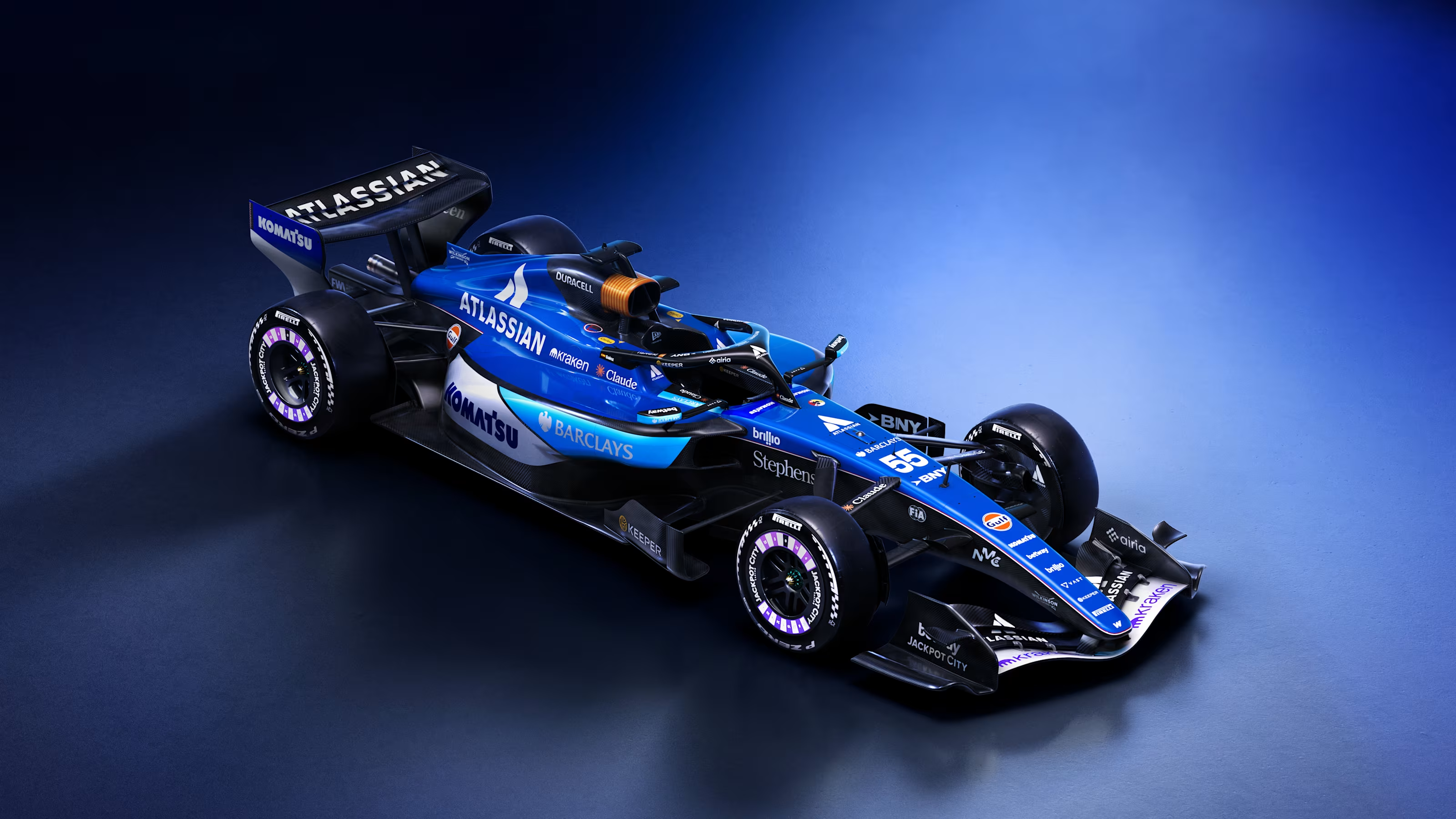
L'aileron avant est la première partie de la voiture à rencontrer l'air. Il génère son propre appui sur l'essieu avant et façonne l'écoulement dont profite tout ce qui se trouve derrière lui, en particulier le sillage des pneus avant. Ce double rôle, ajouté à son influence sur l'équilibre aérodynamique avant-arrière, explique pourquoi les équipes le modifient si souvent.
Ce qui a changé en 2026
L'aileron avant 2026 est plus étroit (la FIA a évoqué 100 mm de moins) et plus simple, et il fait désormais partie de l'aérodynamique active : ses volets basculent entre un mode virage (Corner Mode) à fort appui et un mode ligne droite (Straight Mode) à plus faible traînée, sous le contrôle de l'ECU standard de la FIA et uniquement dans les zones d'activation désignées. En cas de défaillance du système, les volets doivent revenir en mode virage. La FIA visait moins de traînée et moins d'outwash d'air turbulent, pour que les voitures puissent se suivre de plus près.
Règlement technique de la FIASection C · Art. C3.10.1Édition 21 · 2026-10-19
C3.10.1 · Front Wing Profiles
En surbrillance : l’espace que le règlement autorise pour cette zone (Annexe C2 de la FIA). Glissez pour pivoter. RV-FW-PROFILES · RV-FW-STRAKE · RV-FW-PYLON · RV-FW-SM-CL-FAIRING · RV-FW-SM-MID
En clair
Encadre les éléments de l'aileron avant. Ils doivent tenir dans RV-FW-PROFILES (l'espace 3D dans lequel ils doivent tenir), avec au plus trois éléments distincts et des fentes de 5 à 15 mm entre eux. Des règles strictes de forme et de courbure s'appliquent à chaque section, et un Gurney (un petit becquet) de 10 mm de haut au maximum peut être ajouté au bord de fuite de l'élément le plus en arrière.
“” is exempt from C3.2.4 (b) but must:
a. lie in its entirety within RV-FW-PROFILES.
b. comprise of up to three, non-intersecting, simply connected volumes.
c. have up to three sections in any .
d. when viewed from above, fully obscure RS-FW-PROFILES.
In any Y-Plane:
e. the rearmost point of every section must be visible when viewed from below.
f. except for the rearmost section, the rearmost point of every section must not be visible when viewed from above.
g. assessing each section independently, within 40mm of the rearmost point of each section:
i. a line tangent to any part of the section visible from below must have a positive slope. The slope of this line will be considered in the Y-Plane.
ii. no part of the section visible from above may be more than 10mm distant from the section visible from below, if outboard of Y = 400, or 15mm if inboard of Y = 400.
h. contain:
i. no concave radius of curvature visible from below.
ii. no concave radius of curvature less than 50mm visible from above.
Furthermore:
i. when measured against a vertical plane normal to RS-FW-SECTION, contain no normal to any point on the surface that subtends an angle greater than 30°. For volumes thicker than 0.5mm in their entirety (measured normal to the surface on any Y-Plane), compliance with this Article may be determined prior to application of any necessary to demonstrate compliance with C3.3.1 (a).
j. compliance with (i) is not required for surfaces that lie exactly on or Y = 675.
k. At all points along the span, the minimum distance between adjacent Front Wing Profiles volumes must be between 5mm and 15mm when measured with a spherical gauge.
l. The rearmost point of every individual Y-section, when projected in Z onto a plane through , must produce a single tangent continuous curve with no radius of curvature less than 200mm.
Once the Front Wing Profiles bodywork is fully defined, up to 10mm in height may be fitted to the trailing edge of the upper surface of the rearmost section. These Gurneys are considered to be part of the Front Wing Profiles and must satisfy the provisions of this Article except for (g) and (h) and, for the inner extremity of the innermost Gurney and outer extremity of the outermost Gurney, (i).
C3.10.10 · Front Wing Adjuster SystemArticles connexes
En clair
Définit l'aileron avant mobile. Un volet primaire et un volet secondaire pivotent autour d'axes fixes. Sous le contrôle de l'ECU de la FIA, ils basculent en 400 ms au plus entre deux positions définies, le mode virage (Corner Mode) et un mode ligne droite (Straight Mode) à plus faible incidence, à l'aide de deux actionneurs au maximum équipés de capteurs de position. Le mode ligne droite n'est autorisé qu'à l'arrêt ou dans une zone d'activation, et toute défaillance ramène l'aileron en mode virage.
The “” is defined as follows:
a. “FW Primary Flap”, if fitted, must:
i. be a continuous portion of , excluding the forwardmost volume.
ii. rotate about the “Primary Axis”, which must pass through Point A and Point B and be fixed relative to the forwardmost volume of Front Wing Profiles.
b. “”, if fitted, must:
i. be a continuous portion of only the rearmost volume of Front Wing Profiles.
ii. rotate about the “”, which must pass through Point C and Point D and be fixed relative to either the Primary Flap if fitted, or the forwardmost volume of Front Wing Profiles.
c. Both FW Primary Flap and FW Secondary Flap must include any fitted and any parts of Front Wing Auxiliary Components that are rigidly attached to the respective volumes.
d. “Point A” and ”Point B” must lie:
i. within the volume of FW Primary Flap.
ii. no more than 25mm from the forwardmost point of FW Primary Flap at their respective Y positions.
e. “Point C” and ”Point D” must lie:
i. within the volume of FW Secondary Flap.
ii. no more than 25mm from the forwardmost point of FW Secondary Flap at their respective Y positions.
f. Point A and Point C must lie inboard of Y = 150.
g. Point B and Point D must lie between Y = 475 and Y = 675.
With Front Wing Profiles positioned to comply with Article C3.10.1, up to two pairs of rotation surfaces (four in total) must be defined as follows:
h. “Primary Rotation Surfaces”, which must:
i. use the Primary Axis as their axis of revolution.
ii. pass through Point A for the first surface and Point B for the second surface.
iii. extend over the complete chord of FW Primary Flap.
i. “Secondary Rotation Surfaces”, which must:
i. use the Secondary Axis as their axis of revolution.
ii. pass through Point C for the third surface and Point D for the fourth surface.
iii. extend over the complete chord of FW Secondary Flap.
j. Over their intersection with the FW Primary and Secondary Flaps at their original design position (defined in accordance with Article C3.10.1), no surface of rotation may have a normal which forms an angle greater than 30 degrees to the Y-Axis.
Compared to the position of Front Wing Profiles defined in Article C3.10.1, adjustment not controlled by the is only allowed when the car is stationary and by the use of a tool, and in accordance with the Sporting Regulation and must:
k. not result in a decrease in incidence of the tangent lines defined in Article C3.10.1 (g) (i).
l. result in a maximum deviation for any point of Front Wing Profiles no greater than:
i. 30mm for FW Primary Flap.
ii. 60mm for FW Secondary Flap.
Any adjustment of Front Wing Profiles controlled by the FIA Standard ECU must:
m. be about one of the Primary Axis or Secondary Axis only.
n. when commanded, switch to one of two fixed positions defined as follows:
i. a “” position, that conforms to a position defined in (k) and that remains identical following any operation to its position beforehand.
ii. a “Straight Mode” position that, when compared to the Corner Mode position, results in a decrease in incidence of FW Primary Flap and/or FW Secondary Flap. Furthermore, except when limited by a physical stop defined in (u), the magnitude of decrease must remain constant.
o. have a maximum transition time between the two fixed positions that does not exceed 400ms, measured from the instant at which the command to change mode is issued by the FIA Standard ECU until the position sensor(s), connected to the FIA Standard ECU, confirm that the commanded fixed position has been reached.
p. be driven by up to two actuators, across both sides of the car.
q. be measured by position sensors, one for each of the actuators defined in (p), which:
i. are mechanically linked to Front Wing Profiles.
ii. output analogue signals calibrated over the actuator travel.
iii. are connected to the FIA Standard ECU as specified by the FIA.
r. be symmetrical about .
Furthermore:
s. Irrespective of whether the adjustment is controlled by the FIA Standard ECU, any fitted FW Primary Flap and FW Secondary Flap must:
i. except for Front Wing Fishplates, Front Wing Adjuster Fairing and any fitted Gurneys, remain in their entirety within RV-FW-PROFILES.
ii. retain the geometric relationship between all elements of FW Primary Flap, except when adjusting about the Secondary Axis only.
iii. retain the geometric relationship between all elements of FW Secondary Flap.
iv. conform with all bodywork regulations except for Article C3.2.4 (b), Article C3.10.11 (g) (i) and sub-clauses (b) to (l) of Article C3.10.1.
t. Except for a failure of the Front Wing Adjuster System, or during the transition between Corner Mode and Straight Mode, FW Primary Flap and FW Secondary Flap can only have the two positions defined in (n).
u. Physical Stops must be provided to prevent both FW Primary Flap and FW Secondary Flap from being rotated external to RV-FW-PROFILES.
v. The design is such that failure of the system will result in it returning to its Corner Mode position.
w. FW Primary Flap and FW Secondary Flap may only be in a when the car is stationary or fully inside an as defined by Article B7.1.1 (d).
Réunit les éléments de l'aileron avant, la dérive, le pylône et la strake facultative dans l'ensemble aileron avant, après suppression des parties qui dépassent, avec des congés jusqu'à 10 mm. Il doit former un seul volume, le pylône doit être caché vu de dessous, et toute strake située à plus de 715 mm en avant de la ligne de l'essieu avant doit être cachée vu de dessus.
“Front Wing Assembly” results from the of the following components:
a. .
b. Front Wing Endplate.
c. Front Wing Pylon.
d. Front Wing Strake, if fitted.
Before trimming is applied, any Front Wing Profiles remaining outboard of Front Wing Endplate and any Front Wing Pylon remaining below Front Wing Profiles must be discarded.
A , no greater than 10mm, may be applied along the intersections between the remaining component parts.
Once fully defined, Front Wing Assembly must:
e. be a single volume, with no overlapping regions.
f. when viewed from below, fully obscure Front Wing Pylon.
g. when viewed from above, fully obscure Front Wing Strake forward of = −715, if fitted.
Aucune modification enregistrée pour cet élément jusqu’à l’épreuve sélectionnée.
Élément 02 / 22
Dérive d’aileron avant
Pourquoi les équipes la font évoluer
Les dérives ferment les extrémités extérieures de l'aileron avant et déterminent la façon dont l'air est guidé près des pneus avant. Elles sont un outil clé pour gérer le sillage des pneus avant, qui influe sur le fond plat, les pontons et l'arrière de la voiture.
Ce qui a changé en 2026
Avec l'aileron avant plus étroit, la dérive 2026 est définie comme l'assemblage d'un corps de dérive, de semelles extérieure et intérieure et d'un diveplane facultatif, chacun dans son propre volume de référence. L'intention de la règle a changé : formula1.com explique que les nouveaux ailerons avant et les nouvelles planches du fond doivent empêcher l'air d'être repoussé vers l'extérieur autour des roues avant, ce qui crée des turbulences pour la voiture qui suit.
Règlement technique de la FIASection C · Art. C3.10.6Édition 21 · 2026-10-19
C3.10.6 · Front Wing Endplate
En surbrillance : l’espace que le règlement autorise pour cette zone (Annexe C2 de la FIA). Glissez pour pivoter. RV-FWEP-BODY · RV-FWEP-OFP · RV-FWEP-IFP · RV-FWEP-DIVEPLANE
En clair
La dérive d'aileron avant réunit le corps de dérive, les deux semelles et le diveplane facultatif, avec des congés jusqu'à 40 mm entre le corps et le diveplane et jusqu'à 10 mm ailleurs. Elle doit former un seul volume, faire au moins 10 mm d'épaisseur là où elle est visible de côté et couvrir les surfaces de référence RS-FWEP-TOP et RS-FWEP-SIDE.
“Front Wing Endplate” results from the of the following components:
a. Front Wing Endplate Body.
b. Front Wing Outboard Footplate.
c. Front Wing Inboard Footplate.
d. Front Wing Endplate Diveplane, if fitted.
Before trimming, any Front Wing Endplate Body remaining below Front Wing Inboard Footplate must be discarded.
A , no greater than 40mm, may be applied along the intersections between Front Wing Endplate Body and Front Wing Diveplane. A Fillet Radius, no greater than 10mm, may be applied along the intersections between the remaining component parts.
Once fully defined, Front Wing Endplate must:
e. be a single, simply connected volume, with no overlapping regions.
f. be no less than 10mm thick (being the minimum distance when measured normal to the surface), if visible from the side.
g. when viewed from above, fully obscure RS-FWEP-TOP:
h. when viewed parallel to the Y-Axis from inboard, fully obscure RS-FWEP-SIDE and Front Wing Endplate Diveplane.
C3.10.2 · Front Wing Endplate BodyArticles connexes
En clair
Le corps de la dérive d'aileron avant doit tenir dans RV-FWEP-BODY (l'espace 3D dans lequel il doit tenir), avec jusqu'à deux sections dans toute coupe verticale longitudinale. Ses courbes convexes doivent avoir un rayon d'au moins 5 mm et ses courbes concaves d'au moins 100 mm.
“Front Wing Endplate Body” must:
a. lie in its entirety within RV-FWEP-BODY.
b. have up to two sections in any .
Front Wing Endplate Body must contain:
c. no convex radius of curvature less than 5mm.
d. no concave radius of curvature less than 100mm.
C3.10.3 · Front Wing Outboard FootplateArticles connexes
En clair
La semelle extérieure de l'aileron avant doit tenir dans RV-FWEP-OFP (l'espace 3D dans lequel elle doit tenir), avec jusqu'à deux sections dans les coupes horizontales sous 160 mm de hauteur et dans les coupes transversales plus en arrière. Aucune courbe ne peut avoir un rayon inférieur à 5 mm, et les courbes concaves vues de dessous ou situées à plus de 825 mm de l'axe central doivent avoir un rayon d'au moins 50 mm.
“Front Wing Outboard Footplate” must:
a. lie in its entirety within RV-FWEP-OFP.
b. below Z = 160, have up to two sections in any Z-Plane.
c. rearwards of = −425, have up to two sections in any .
Front Wing Outboard Footplate must contain:
d. no radius of curvature less than 5mm.
e. no concave radius of curvature less than 50mm visible from below.
f. no concave radius of curvature less than 50mm outboard of Y = 825mm.
C3.10.5 · Front Wing Endplate DiveplaneArticles connexes
En clair
Le diveplane facultatif de la dérive d'aileron avant doit tenir à la fois dans une boîte de 300 x 325 x 50 mm et dans RV-FWEP-DIVEPLANE (l'espace 3D dans lequel il doit tenir). Ses courbes convexes doivent avoir un rayon d'au moins 5 mm et ses courbes concaves d'au moins 50 mm.
“Front Wing Endplate Diveplane” must:
a. lie in its entirety within:
i. an axis aligned cuboid of the following dimensions [X, Y, Z] = [300, 325, 50].
ii. RV-FWEP-DIVEPLANE.
Front Wing Endplate Diveplane must contain:
b. no convex radius of curvature less than 5mm.
c. no concave radius of curvature less than 50mm.
1) Compared to its launch car, Williams’ FW45 gets an updated floor with a new winglet/cutout ahead of the rear tyres to improve load. The geometry of the dive plane of the front wing endplates has been revised. A revised rear wing features new winglet and pillar extensions.…
Shown by the FIA on X; not listed in the FIA Car Presentation Submissions
Williams brought a revised strake for the front wing endplate, going from uowash to downwash. Which necessitated a move for the front tyre temperature sensor.#F1 #F1tech #AusGP📸 @WilliamsF1
Le nez porte l'aileron avant et abrite la structure d'impact frontale. Sa forme détermine aussi la quantité d'air qui passe dessous en direction du fond plat : de petits changements de sa largeur ou de son dessous peuvent donc influer sur toute la voiture.
Ce qui a changé en 2026
Le principal changement de 2026 concerne la sécurité : la FIA a introduit une structure d'impact frontale en deux étages, pour que le nez risque moins de se détacher lors d'un premier choc et de laisser la voiture sans protection lors d'un second. Le nez doit rester dans son volume de référence et respecter des règles de courbure qui gardent ses flancs lisses.
Règlement technique de la FIASection C · Art. C3.7.1Édition 21 · 2026-10-19
C3.7.1 · Nose
En surbrillance : l’espace que le règlement autorise pour cette zone (Annexe C2 de la FIA). Glissez pour pivoter. RV-NOSE · RV-CAMERA-2
En clair
Le nez doit tenir dans RV-NOSE (l'espace 3D dans lequel il doit tenir) et, vu de dessus, couvrir RS-NOSE en avant de la ligne X_A = 0. Ses surfaces doivent être lisses, sans courbe concave (creuse) dans aucune coupe transversale, avec des rayons minimaux de 45 mm et 20 mm en vue de dessus. Les caméras en position 2 et certains supports de fixation sont exemptés.
“Nose” must:
a. lie in its entirety within RV-NOSE.
b. when viewed from above, fully obscure RS-NOSE ahead of = 0.
Nose , must be Tangent Continuous, and in any must:
c. contain no concave radius of curvature.
d. between = −950 and XA = 0, have a section that when viewed from above:
i. is tangent to the Z-Axis at its outermost extremity.
ii. contains no radius of curvature less than 45mm at XA = 0.
iii. contains no radius of curvature less than 20mm forward of XA = 0.
Furthermore, the following will be exempt from the above:
e. Cameras in Position 2.
f. Mounting brackets defined in Article C8.16.7.
Aucune modification enregistrée pour cet élément jusqu’à l’épreuve sélectionnée.
Élément 04 / 22
Suspension avant
Pourquoi les équipes la font évoluer
La suspension avant contrôle le contact des pneus avant avec la piste au freinage, en virage et sur les bosses, et maintient la voiture à une hauteur de caisse stable pour que le fond plat fonctionne. Ses bras se trouvent en plein écoulement : les équipes façonnent donc aussi les carénages et positionnent les bras pour des raisons aérodynamiques.
Ce qui a changé en 2026
Chaque roue doit toujours être reliée par six éléments de suspension, avec des carénages étanches que l'air ne peut pas traverser. Le texte 2026 fixe aussi certaines règles d'implantation, par exemple l'espacement des fixations des triangles avant. L'objectif affiché par la FIA pour le nouveau fond plat était de réduire la dépendance à des réglages très rigides et très bas, ce qui change ce que les équipes demandent à leur suspension.
Règlement technique de la FIASection C · Art. C10.3Édition 21 · 2026-10-19
C10.3 · Outboard suspension
La forme affichée (arêtes en pointillés) est seulement indicative : dessinée par PITWALL pour montrer l’emplacement des pièces, pas une limite réglementaire.
En clair
Direction bloquée, la position de chaque roue ne doit dépendre que de son débattement vertical de suspension, et le carrossage ne peut varier de plus de 1 degré sur 10 mm de débattement. Chaque porte-moyeu doit compter exactement six éléments de suspension, dont un relié à la direction sur chaque roue avant, avec des points d'attache situés dans le tambour de roue et des règles d'espacement spécifiques à l'avant.
C10.3.1 With the steering wheel rotation fixed, the position of each wheel centre and the orientation of its rotation axis must be completely and uniquely defined by a function of its principally vertical suspension travel, save only for the effects of reasonable compliance which does not intentionally provide further degrees of freedom.
Additionally, the angle subtended between the normal projection of the Z axis onto the =0 plane and the Z axis must not vary by more than 1 degree over 10mm of suspension travel with the steering wheel rotation fixed. Compliance must be demonstrated by CAD, using camber values of −3 degrees front and −1 degree rear.
C10.3.2 There must be six suspension members connecting each suspension upright to the .
Redundant suspension members are not permitted.
On the front axle, one suspension member per wheel must be connected to the steering system.
C10.3.3 Suspension members having shared attachment points will be considered by a virtual dissection into discrete members.
C10.3.4 The outboard attachment points of each suspension member (defined as the kinematic centre of rotation of the joint that allows relative rotation between a suspension member and its adjoining upright) must lie:
a. outboard of YW =0.
b. Above ZW = −100 for the front axle and above ZW = −40 for the rear axle.
c. Inside the Drum defined in Article C3.14.2.
Exceptionally, the outboard attachment point of a suspension member connected inboard, to the rockers defined in Article C10.4.1 and outboard, directly to another suspension member, may not satisfy the provisions of this Article, but must in any case:
d. lie outboard of YW =50.
e. be no more than 25mm from the load line of the suspension member it is attaching to.
f. together with the inboard attachment point of the same suspension member, lie on the same side of the suspension member it is attaching to when viewed from the front.
C10.3.5 On the front axle only, considering the six suspension members connected to an upright, but excluding the members connected inboard to the steering system or the rockers defined in Article C10.4.1, they must form 2 independent pairs of members each with their inboard attachment points separated in X by no less than 300mm and above Z=250mm. Furthermore to form a pair, each suspension member must also be accompanied by the suspension member with the closest outboard attachment point in Z .
C3.17 · Suspension and Driveshaft FairingsArticles connexes
En clair
Des carénages de suspension doivent équiper chaque élément de suspension, sauf ceux de section ronde. Ils doivent aussi être étanches à l'intérieur afin qu'aucun air ne puisse les traverser.
C3.17.1 “Suspension Fairings” must be fitted to all suspension members defined in Article C10.3.6, except for those of circular cross section. Furthermore, Suspension Fairings must be internally sealed to prevent any internal airflow.
Les descriptions des évolutions sont affichées dans leur langue d’origine.
R05Canada
Front Suspension
“In concert with the updated FBD geometry, new suspension cladding will be available to improve the local interactions on the front corner and hence downstream across the rest of the car.”
Différences géométriquesRevised suspension cladding surfaces, with changes in chord and incidence across their span.
1) Red Bull Racing’s RB22 gets revised front wing elements in Montréal as well as adjustments to the floor to further optimise both the bib and forward floor devices. There are also bigger brake ducts, aimed at Canada and Monaco and circuit-specific changes to the engine cover…
1) The Williams FW48 gets revised front suspension cladding for the Japanese Grand Prix. The surrounds have been updated to work with new internal structure and should improve flow downstream.2) Aston Martin have brought a revised front wing and end plates and an updated floor…
Shown by the FIA on X; not listed in the FIA Car Presentation Submissions
Les écopes de frein avant amènent l'air de refroidissement aux freins et à la roue, puis laissent ressortir la chaleur. Comme elles sont juste à côté du pneu avant, leurs écopes et déflecteurs servent aussi à orienter le sillage du pneu : elles sont donc développées à la fois pour le refroidissement et pour l'aérodynamique.
Ce qui a changé en 2026
En 2026, l'écope de frein est traitée comme de la carrosserie de roue : un tambour de forme imposée, une écope d'entrée et des déflecteurs avant et arrière, chacun limité à un volume défini et mesuré dans le système de coordonnées propre à la roue. La FIA a indiqué qu'une partie de la carrosserie de roue est imposée pour améliorer le sillage des roues, conformément à son objectif de courses plus serrées.
Règlement technique de la FIASection C · Art. C3.14.2Édition 21 · 2026-10-19
C3.14.2 · Drum
Les écopes de frein sont réglementées comme composants de roue : tambour, écope (scoop) et déflecteurs de tambour.
La forme affichée (arêtes en pointillés) est seulement indicative : dessinée par PITWALL pour montrer l’emplacement des pièces, pas une limite réglementaire.
En clair
Les tambours des roues avant et arrière doivent respecter des formes fixes définies par les surfaces de référence RS-FWH-DRUM et RS-RWH-DRUM. Chacun nécessite un joint aérodynamique continu sur 360 degrés entre le tambour et l'essieu, et des joints souples peuvent être montés entre le tambour et la jante.
“Front Drum” and ”Rear Drum” , the latter being exempt from Article C3.2.4 (b), must:
a. be made to the geometry defined by RS-FWH-DRUM and RS-RWH-DRUM respectively.
Furthermore:
b. Drum Bodywork must be fitted with an , in the outboard of the two annotated volumes, between the Drum and the axle. This Aerodynamic Seal must be circumferential, continuous (around an arc of 360°), concentric about the axis, and uniform.
c. Drum Bodywork may be fitted with a flexible seal or seals, in the inboard of the two annotated volumes, between the Drum and the Wheel Rim.
C3.14.6 · Front Drum Front DeflectorArticles connexes
En clair
Le déflecteur avant facultatif du tambour avant doit tenir dans une boîte de 150 x 45 x 25 mm, qui peut être déplacée librement et tournée autour de la direction de l'essieu de la roue, en restant sous Z_W = 0. Il peut compter jusqu'à deux pièces distinctes et deux sections par coupe, et doit être caché vu de l'intérieur par la lèvre avant.
“Front Drum Front Deflector” , if present, must:
a. lie in its entirety:
i. within an axis aligned cuboid of the following dimensions [ , YW , ZW ] = [150, 45, 25], which may be freely translated along any axis, and rotated about the YW axis only.
ii. below ZW = 0.
b. comprise of up to two, non-intersecting, simply connected volumes.
c. have up to two sections in any XW , Y or ZW -Plane.
d. not be visible from inboard with the Front Lip present.
Furthermore,
e. Front Drum Front Deflector Bodywork is optionally fitted and exempt from Article C3.14.1 (b).
C3.14.7 · Front Drum Rear DeflectorArticles connexes
En clair
Le déflecteur arrière du tambour avant associe une surface de référence fixe (RS-FWH-RDEF) et un bord d'attaque situé dans RV-FWH-RDEF. Là où il est visible depuis l'intérieur, il peut faire au plus 15 mm d'épaisseur, et ses courbes concaves doivent avoir un rayon d'au moins 75 mm (partie avant, vue de l'extérieur) ou 50 mm (partie arrière).
“Front Drum Rear Deflector” , which is exempt from Article C3.2.4, results from the of the following components:
a. RS-FWH-RDEF.
b. Deflector Leading Edge, which must:
i. lie in its entirety within RV-FWH-RDEF.
ii. contain no more than a single section in any X and ZW -Plane.
iii. obscure RS-FWH-TOP when viewed from inboard.
Front Drum Rear Deflector Bodywork must:
c. be no more than 15mm thick (being the minimum distance when measured normal to the surface), if visible from inboard.
Furthermore:
d. Compliance with (c) is not required within 5mm of the side-view boundary of Front Drum Rear Deflector when viewed from inboard.
Front Drum Rear Deflector must:
e. in any -Plane forward of XW = 150, contain no concave radius of curvature:
i. less than 75mm visible from outboard.
ii. visible from inboard.
f. in any XW -Plane rearward of XW = 150, contain no concave radius of curvature less than 50mm.
Les écopes des roues avant et arrière doivent tenir respectivement dans RV-FWH-SCO et RV-RWH-SCO (les espaces 3D dans lesquels elles doivent tenir). Leurs surfaces doivent être entièrement visibles depuis l'intérieur et ne peuvent pas avoir de rayon de courbure inférieur à 20 mm, sauf pour la partie de l'écope arrière située derrière X_W = 0 dans le système de coordonnées propre à la roue.
The “Front Scoop” and ”Rear Scoop” must:
a. lie in their entirety within RV-FWH-SCO and RV-RWH-SCO respectively.
Furthermore, Rear Scoop Bodywork rearwards of = 0:
b. is exempt from Article C3.2.4 (b).
Scoop must:
c. be fully visible from inboard.
d. contain no radius of curvature less than 20mm, except for regions of the Rear Scoop rearwards of XW = 0.
Les descriptions des évolutions sont affichées dans leur langue d’origine.
R05Canada
Front Corner
“To suit the demands of the Gilles-Villeneuve circuit, a new FBD geometry will be introduced which offers an increased level of overall brake system cooling.”
Différences géométriquesA new FBD scoop geometry with a reprofiled exit area.
1) Red Bull Racing’s RB22 gets revised front wing elements in Montréal as well as adjustments to the floor to further optimise both the bib and forward floor devices. There are also bigger brake ducts, aimed at Canada and Monaco and circuit-specific changes to the engine cover…
Les roues et les pneus sont le seul contact de la voiture avec la piste. Les jantes sont étroitement encadrées, mais la façon dont l'air contourne et traverse la roue influe sur la traînée, la température des freins et le sillage que le reste de la voiture doit gérer.
Ce qui a changé en 2026
Les roues de 18 pouces introduites en 2022 restent, mais les pneus sont plus étroits : de 25 mm à l'avant et de 30 mm à l'arrière, selon la FIA. Formula1.com rapporte que les enjoliveurs de roue ont été supprimés pour gagner du poids, et la FIA a retiré les petits arceaux de roue avant utilisés depuis 2022. Les jantes doivent être en alliage de magnésium et ne doivent comporter aucun élément conçu pour modifier les transferts de chaleur.
Règlement technique de la FIASection C · Art. C10.7.2Édition 21 · 2026-10-19
C10.7.2 · Wheel rim dimensions
En surbrillance : l’espace que le règlement autorise pour cette zone (Annexe C2 de la FIA). Glissez pour pivoter. TYRE-FRONT
En clair
Fixe les dimensions des jantes, notamment un diamètre de 462,5 à 463 mm et des largeurs de montage du pneu de 315 mm à l'avant et 401,3 mm à l'arrière. La jante est un profil de révolution unique d'au moins 2,5 mm d'épaisseur, avec des zones limitées où de la matière peut être retirée. Aucun air ne peut passer entre ses cavités intérieure et extérieure, et les modèles gauche et droit doivent être identiques.
a. The Wheel Rim key dimensions are:
Front Wheel Rear Wheel Rim Diameter 462.5 / 463 462.5 / 463 Tyre Mounting Width 315 ± 0.5 401.3 ± 0.5 Lip External Diameter 496 ± 0.5 496 ± 0.5 Overall Width 334 ref. 420.3 ref.
Outboard Lip Thickness 8.5 ± 0.2 8.5 ± 0.2 Inboard Lip Thickness 10.5 ± 0.2 10.5 ± 0.2
b. The Wheel Rim must be a solid of rotation formed by revolving a single profile around the axis of rotation of the Wheel Rim. The profile must be tangent continuous with a minimum radius of curvature of 8mm in the area:
i. more than 80mm from the axis Y .
and
ii. outboard of =−36.
and
iii. inboard of; YW =−302 for the front rim and YW =−388 for the rear rim.
c. Once the revolved solid has been fully defined, material may be :
i. removed between YW =−210 and YW =−392.5 on the rear wheel and between YW =−188 and YW =−319 on the front wheel. Any new surface created must have no concave radius of curvature smaller than 6mm.
ii. removed in areas less than 80mm from the axis Y .
iii. added or removed to form features for mounting the inflation valve and TPMS sensors.
iv. removed on the outer flanges, between a radius of 238mm and a radius of 246mm from the axis Y and up to 1mm deep for wheel branding, logo, or part numbers.
v. added or removed to form features for mounting the disc described in Article C10.7.5 or closing panel described in C10.7.2.e.
d. No part of the front or rear Wheel Rim may lie within RV−F−RIM−MIN or RV−R−RIM−MIN respectively.
e. There must be no passage for air between the inboard and outboard cavities of the Wheel Rim.
Any closing panel may either be integrated into the rim or may be a separate piece. All separate closing panels must respect clauses (d), (j), and (k) of this Article. Closing panels which are not required to prevent airflow between the inner and outer cavities are not permitted.
f. The minimum Wheel Rim thickness is 2.5mm.
g. The minimum bead thickness is 4.0mm (measured from hump to outer edge of the lip).
h. The ETRTO standard bead profile is prescribed.
i. The design of the wheel must meet the general requirements of the tyre supplier for the mounting and dismounting of tyres including allowance for sensors and valves.
j. The Wheel Rim design cannot be handed between left and right designs.
k. Features intended to influence the heat transfer characteristics of the Wheel Rim are not permitted. F1 Teams are required to submit designs to the FIA for approval.
l. Design guidelines for the Wheel Rims are set out in FIA-F1-DOC-021. Any deviation from the guidelines must be agreed with the Tyre Supplier.
Le manufacturier de pneus fixe les spécifications des pneus avec la FIA, selon le calendrier du document FIA-F1-DOC-057. Elles ne peuvent ensuite changer qu'avec l'accord de la Commission F1, sauf que la FIA peut les modifier en cours de saison pour des raisons de sécurité, sans préavis.
Tyre specifications will be determined by the tyre supplier, in agreement with the FIA, data will be divided into data blocks as defined in the document FIA-F1-DOC-057 and according to the timetable given in that document.
Once determined in this way, the specification of the tyres will not be changed without the agreement of the Formula One Commission.
Notwithstanding the above, the FIA may decide to change the specification during the Championship season for safety reasons without notice or delay.
Les jantes doivent être en alliage de magnésium AZ70 ou AZ80. Seuls des traitements de surface à visée esthétique et protectrice sont autorisés par-dessus.
With the exception of surface treatments for appearance and protection, Wheel Rims must be made from AZ70 or AZ80 magnesium alloy.
Aucune modification enregistrée pour cet élément jusqu’à l’épreuve sélectionnée.
Élément 07 / 22
Rétroviseurs
Pourquoi les équipes la font évoluer
Les rétroviseurs sont un élément de sécurité, mais ils se trouvent dans un écoulement propre et rapide à côté du cockpit. Les équipes façonnent les coques des rétroviseurs et leurs supports pour qu'ils perturbent l'air le moins possible, voire qu'ils aident à le guider vers les pontons.
Ce qui a changé en 2026
La surface réfléchissante des rétroviseurs garde une taille fixe et doit offrir au pilote une vue vers l'arrière et des deux côtés. Nouveauté 2026 : le corps du rétroviseur doit enfermer un feu de sécurité latéral qui, selon la FIA, indique l'état de l'ERS si la voiture s'arrête en piste, afin que les commissaires sachent s'ils peuvent s'en approcher sans danger.
Règlement technique de la FIASection C · Art. C3.7.5Édition 21 · 2026-10-19
C3.7.5 · Mirror
En surbrillance : l’espace que le règlement autorise pour cette zone (Annexe C2 de la FIA). Glissez pour pivoter. RV-MIRROR-BODY · RV-MIRROR-ISTAY · RV-MIRROR-RSTAY
En clair
Définit la carrosserie des rétroviseurs. Le corps du rétroviseur doit tenir dans RV-MIRROR-BODY et enfermer un feu de sécurité latéral, qui peut être déplacé librement et tourné jusqu'à 5 degrés. Un support intérieur le relie au châssis et un support arrière (moins de 50 mm de haut et 10 mm de large) au ponton ; ensemble, ils doivent former un seul volume, avec des congés jusqu'à 10 mm.
“Mirror Body” must:
a. lie in its entirety within RV-MIRROR-BODY.
b. fully enclose an individual instance of RV-LATERAL-SAFETY-LIGHT which may be freely translated along any axis, and rotated up to +/-5deg about any Z-axis only.
c. have an external surface coincident with the highlighted surface of RV-LATERAL-SAFETY- LIGHT.
“Mirror Inner Stay” Bodywork must:
d. lie in its entirety within RV-MIRROR-ISTAY.
e. intersect Mirror Body and Mid Chassis.
“Mirror Rear Stay” bodywork must:
f. lie in its entirety within RV-MIRROR-RSTAY.
g. intersect Mirror Body and Sidepod.
h. in any , measure less than:
i. 50mm in Z.
ii. 10mm in Y.
“Mirror” results from the of the following components:
i. Mirror Body.
j. Mirror Inner Stay.
k. Mirror Rear Stay.
A , no greater than 10mm, may be applied along the intersections between the remaining component parts.
Once fully defined, Mirror must:
l. be a single volume with no overlapping regions.
Chaque voiture doit avoir deux rétroviseurs symétriques offrant au pilote une vue vers l'arrière et des deux côtés. Chaque surface réfléchissante se trouve dans RV-MIRROR-BODY et forme un rectangle de 200 x 50 mm (plus 2 mm au maximum), avec des rayons d'angle jusqu'à 10 mm, sans zone concave et sans courbure de rayon inférieur à 400 mm. La FIA peut demander les données CAO et déplacer le volume du rétroviseur pour des raisons de sécurité.
C14.2.1 All cars must have two mirrors positioned symmetrically about the car’s centre plane and mounted so that the driver has visibility to the rear and both sides of the car.
C14.2.2 The reflective surface of each mirror must satisfy the following conditions:
a. It must be contained within RV−MIRROR−BODY and not be obstructed by the Mirror Body, either towards the driver or in the rearward direction.
b. Its four edges must project orthogonally onto the edges of a vertical rectangle which is 200mm wide and 50mm high (+2mm/−0mm for both dimensions), with a radius of up to 10mm applied to each corner.
c. Over its whole area it must:
i. not contain any concave parts.
ii. be tangency continuous.
iii. not have any normal radius of curvature less than 400mm.
d. When cut by any Z−Plane and before any radius is applied to the corners:
i. the normal to the curve at its inboard end must subtend an angle of between 24deg and 28deg to the X axis, pointing towards the plane.
ii. the angle between normals to the curve at its inboard and outboard ends must be greater than 8 degrees.
For the avoidance of doubt, any non−reflective parts of the mirror must be contained within the Mirror Body.
C14.2.3 F1 Teams will be required on request to supply the FIA with CAD data with regard to the visibility of their mirror arrangement, and the FIA will retain the right to modify the position of the volume defined in Article C3.6.4 (a) should it become apparent that the mirror position does not meet the safety requirements.
1) Like many teams, Williams have brought a substantial upgrade to Miami. The floor, sidepods and engine cover of the FW48 have all had a makeover in pursuit of improved flow conditioning and better cooling. There are also tweaks to the mirror assembly, the exhaust bracket, the…
Shown by the FIA on X; not listed in the FIA Car Presentation Submissions
Cette zone couvre le dessus et les flancs de la cellule de survie, l'arceau de sécurité au-dessus de la tête du pilote et l'éventuel refroidissement du pilote. L'arceau forme aussi la prise d'air du moteur, et la carrosserie autour du cockpit influe sur l'air qui s'écoule vers le capot moteur et l'aileron arrière.
Ce qui a changé en 2026
Pour 2026, la FIA a relevé les charges de l'arceau de sécurité de 16 G à 20 G et durci la protection contre les intrusions latérales, avec une protection plus que doublée à côté du réservoir. Le halo reste une pièce standard fabriquée selon une spécification FIA par des fabricants désignés.
Règlement technique de la FIASection C · Art. C12.4.2Édition 21 · 2026-10-19
C12.4.2 · Secondary Roll Structure (Halo)
Pièces autour du cockpit : le halo (structure antiretournement secondaire) et le carénage de l’arceau.
En surbrillance : l’espace que le règlement autorise pour cette zone (Annexe C2 de la FIA). Glissez pour pivoter. RV-ROLL-HOOP · RV-DRI-COOL · RV-CH-FRONT · RV-CH-MID · RV-CH-FRONT-MIN
En clair
Le halo (structure antiretournement secondaire) ne fait pas partie de la cellule de survie. Il doit être symétrique par rapport à l'axe de la voiture, avec son axe de fixation avant à X = -975 et Z = 660 et ses faces de fixation arrière à Z = 695. Il est fabriqué selon la norme FIA 8869-2018 par un fabricant désigné par la FIA, et la FIA veille à ce que les halos des différents fabricants aient une masse similaire.
The , which is not considered part of the , must be positioned symmetrically about the car centre plane with its front fixing axis at X = −975 and Z=660. The mounting faces for the rearward fixings must lie on the plane Z=695.
The Secondary Roll Structure must be made to standard FIA8869−2018 and supplied by an FIA designated manufacturer. Details of the structure and its mountings may be found in the document FIA-F1-DOC-115.
The FIA will take the appropriate measures to ensure that Secondary Roll Structures supplied by different FIA designated manufacturers are of similar mass.
La carrosserie de l'arceau de sécurité doit simplement se trouver entièrement dans le volume de référence RV-ROLL-HOOP (l'espace 3D dans lequel elle doit tenir). Elle est exemptée de la règle générale de carrosserie C3.2.4.
“Roll Hoop” is exempt from Article C3.2.4, but must:
a. lie in its entirety within RV-ROLL-HOOP.
Aucune modification enregistrée pour cet élément jusqu’à l’épreuve sélectionnée.
Élément 09 / 22
Déflecteurs de fond plat
Pourquoi les équipes la font évoluer
Les planches du fond sont les panneaux verticaux à l'avant du fond plat, juste derrière les roues avant. Leur rôle est de gérer le sillage turbulent des pneus avant et de guider l'air le long des flancs de la voiture vers le fond plat et les pontons.
Ce qui a changé en 2026
Les bargeboards classiques sont interdits depuis 2022. Le règlement 2026 réintroduit des planches dans cette zone, mais la FIA les présente comme des panneaux de contrôle du sillage des roues qui renvoient l'air vers l'intérieur : ils doivent orienter le sillage des pneus avant vers l'intérieur au lieu de le projeter sur les côtés, où il perturbe les voitures qui suivent. Leur forme est limitée à un volume de référence, avec des règles sur les angles et la courbure.
Règlement technique de la FIASection C · Art. C3.5.5Édition 21 · 2026-10-19
C3.5.5 · Floor Board
Le règlement 2026 les appelle Floor Boards ; les bargeboards classiques sont interdits depuis 2022.
En surbrillance : l’espace que le règlement autorise pour cette zone (Annexe C2 de la FIA). Glissez pour pivoter. RV-FLOOR-BOARD · RV-FLOOR-BRACE · RV-FLOOR-FOOT
En clair
La planche du fond (Floor Board) doit tenir dans RV-FLOOR-BOARD (l'espace 3D dans lequel elle doit tenir), avec jusqu'à trois sections dans toute coupe. Ses surfaces visibles de côté situées à plus de 825 mm derrière la ligne de l'essieu avant doivent être orientées vers l'arrière et former un angle d'au moins 15 degrés avec l'axe de la voiture, sans courbe concave de rayon inférieur à 100 mm, sauf autour de trois petits points exemptés au maximum.
“Floor Board” must:
a. lie in its entirety within RV-FLOOR-BOARD.
b. have up to three sections in any X, Y and .
Floor Board visible from the side must:
c. rearward of = 825, at any point, in any Z-Section have a:
i. normal with a positive X component.
ii. tangent that forms an angle of at least 15 degrees to the X-Axis.
d. contain no concave radius of curvature less than 100mm.
Furthermore:
e. compliance with (c) and (d) is not required within 35mm of up to three points, which must sit forward of XF = 1100 and be no closer than 50mm to each other.
Aucune modification enregistrée pour cet élément jusqu’à l’épreuve sélectionnée.
Élément 10 / 22
Entrée du fond plat
Pourquoi les équipes la font évoluer
L'avant du fond plat, avec son bord d'attaque et le bib sous le nez, détermine la quantité d'air qui entre sous la voiture et la propreté de cet écoulement. Faire entrer cet air sous le fond de façon maîtrisée est le point de départ de l'appui que produit le fond plat.
Ce qui a changé en 2026
De 2022 à 2025, le fond plat alimentait deux grands tunnels sous la voiture (effet de sol). Le règlement 2026 de la FIA impose un fond partiellement plat qui produit moins d'effet de sol : l'entrée du fond alimente donc un soubassement moins puissant. Le dispositif de bord d'attaque et le bib ont chacun leur propre volume de référence et leurs propres règles de forme.
Règlement technique de la FIASection C · Art. C3.5.7Édition 21 · 2026-10-19
C3.5.7 · Floor Leading Edge Device
En surbrillance : l’espace que le règlement autorise pour cette zone (Annexe C2 de la FIA). Glissez pour pivoter. RV-FLOOR-BIB · RV-FLOOR-LED · RV-BIB-STAY · RV-SLIP
En clair
Le dispositif de bord d'attaque du fond plat (Floor Leading Edge Device) doit tenir dans RV-FLOOR-LED (l'espace 3D dans lequel il doit tenir), avec jusqu'à cinq sections dans toute coupe transversale ou horizontale. Au-dessus de 60 mm de hauteur, il doit faire au moins 4 mm d'épaisseur, et ses arêtes convexes ne peuvent pas avoir un rayon inférieur à 2 mm.
“Floor Leading Edge Device” must:
a. lie in its entirety within RV-FLOOR-LED.
b. have up to five sections in any X and .
c. above Z = 60, be no less than 4mm thick when measured normal to Floor Leading Edge Device only.
Floor Leading Edge Device Aerodynamic Surfaces above Z = 60 must:
d. contain no convex radius of curvature less than 2mm
Le bib du fond plat (Floor Bib) doit tenir entièrement dans RV-FLOOR-BIB (l'espace 3D dans lequel il doit tenir), et chaque surface doit être visible de dessus ou de dessous. Vues de dessous, ses surfaces ne peuvent avoir aucune courbe concave (creuse) ; vues de dessus, aucune de rayon inférieur à 50 mm.
“Floor Bib” must:
a. lie in its entirety within RV-FLOOR-BIB.
b. be fully visible from either above or below, such that any surface obscured from one direction is visible from the other.
Floor Bib must:
c. contain no concave radius of curvature:
i. visible from below.
ii. less than 50mm, if visible from above.
Aucune modification enregistrée pour cet élément jusqu’à l’épreuve sélectionnée.
Élément 11 / 22
Corps du fond plat
Pourquoi les équipes la font évoluer
Le fond plat est la plus grande surface aérodynamique de la voiture et produit une grande part de son appui. L'air accéléré sous la voiture crée une dépression qui la plaque au sol, ce qui explique pourquoi les équipes ne cessent de remodeler le fond plat tout au long de la saison.
Ce qui a changé en 2026
Le fond plat 2026 est plus étroit et partiellement plat, à la place des tunnels Venturi profilés de 2022 à 2025. La FIA voulait réduire l'effet de sol et le besoin de voitures très rigides et très basses, à l'origine des rebonds et du marsouinage. Le corps du fond plat doit aussi couvrir le volume du diffuseur : le diffuseur est désormais réglementé comme une partie du fond.
Règlement technique de la FIASection C · Art. C3.5.1Édition 21 · 2026-10-19
C3.5.1 · Floor Body
En surbrillance : l’espace que le règlement autorise pour cette zone (Annexe C2 de la FIA). Glissez pour pivoter. RV-FLOOR-BODY · RV-PLANK
En clair
Le corps du fond plat (Floor Body) est la pièce principale sous la voiture. Il doit tenir entièrement dans RV-FLOOR-BODY (l'espace 3D dans lequel la pièce doit tenir) et, vu de dessous, couvrir complètement le volume moteur RV-PU-ICE et le volume RV-DIFF. Toute coupe horizontale ne peut montrer plus de deux sections distinctes.
“Floor Body” must:
a. lie in its entirety within RV-FLOOR-BODY.
b. when viewed from below, fully obscure:
i. RV-PU-ICE
ii. RV-DIFF.
c. have up to two sections in any .
Le fond principal (Main Floor) réunit le corps, le pied et la paroi latérale du fond plat en une seule pièce pleine, avec des congés de raccordement jusqu'à 30 mm. Chaque surface doit être visible de dessus ou de dessous et, vu de côté, il doit couvrir RS-FLOOR-SIDEWALL. Ses surfaces ne peuvent pas avoir de rayon de courbure inférieur à 25 mm, sauf dans quelques petites zones listées.
“” results from the of the following components:
a. Floor Body.
b. Floor Foot.
c. Floor Sidewall.
A , no greater than 30 mm, may be applied along the intersections between the remaining component parts.
Once fully defined, Main Floor must:
d. be a single, simply connected volume, with no overlapping regions.
e. be fully visible from either above or below, such that any surface obscured from one direction is visible from the other.
f. when viewed from the side, fully obscure RS-FLOOR-SIDEWALL.
Main Floor must:
g. contain no radius of curvature less than 25mm, except for regions:
i. within 5mm of the plan-view-boundary of Main Floor, when viewed from above or below.
ii. within 45mm of a single point that lies in RV-FLOOR-SPHERE.
iii. of convex curvature, visible from above, and within 10mm of the load application points defined in Article C3.18.6.
iv. within 5mm of the Fillet Radii permitted as part of the Main Floor Trim and Combination, where the radius of curvature must be no less than 5mm.
L'ailette de fond plat (Floor Fence) doit tenir à la fois dans une boîte de 450 x 40 x 200 mm et dans RV-FLOOR-FENCE (l'espace 3D dans lequel elle doit tenir). Chaque surface doit être visible de dessus ou de dessous, avec au plus deux sections dans toute coupe verticale longitudinale. Sur ses 100 derniers millimètres, son bord de fuite ne peut pas dévier de plus de 5 degrés de l'axe de la voiture.
“Floor Fence” must:
a. lie in its entirety within:
i. an axis aligned cuboid of the following dimensions [X, Y, Z] = [450, 40, 200]
ii. RV-FLOOR-FENCE.
b. be fully visible from either above or below, such that any surface obscured from one direction is visible from the other.
c. have up to two sections in any .
Furthermore,
d. when considering a section formed by the intersection with any Z-Plane, within 100mm of the rearmost point of the section, a line tangent to any part of the section visible from the side must not form an angle greater than 5 degrees, when measured against the X-axis.
1) Like many teams, Williams have brought a substantial upgrade to Miami. The floor, sidepods and engine cover of the FW48 have all had a makeover in pursuit of improved flow conditioning and better cooling. There are also tweaks to the mirror assembly, the exhaust bracket, the…
Shown by the FIA on X; not listed in the FIA Car Presentation Submissions
1) Compared to its launch car, Williams’ FW45 gets an updated floor with a new winglet/cutout ahead of the rear tyres to improve load. The geometry of the dive plane of the front wing endplates has been revised. A revised rear wing features new winglet and pillar extensions.…
Shown by the FIA on X; not listed in the FIA Car Presentation Submissions
Le bord du fond plat est l'endroit où l'air sous la voiture rencontre celui qui s'écoule le long de ses flancs. Les équipes façonnent ce bord, ses parois latérales et de petits winglets pour empêcher l'air extérieur de s'infiltrer sous le fond, ce qui préserve la dépression sous la voiture.
Ce qui a changé en 2026
Le fond plat 2026, plus étroit, rapproche son bord du centre de la voiture. Le règlement définit désormais des pièces distinctes pour la paroi latérale, le coin et le winglet du fond, et le winglet de fond plat est obligatoire, avec seulement de petits ajustements de rotation et de hauteur autorisés. Comme pour le reste du fond, l'objectif est de moins dépendre de l'effet de sol.
Règlement technique de la FIASection C · Art. C3.5.3Édition 21 · 2026-10-19
C3.5.3 · Floor Sidewall
En surbrillance : l’espace que le règlement autorise pour cette zone (Annexe C2 de la FIA). Glissez pour pivoter. RV-FLOOR-SIDEWALL · RV-FLOOR-CORNER · RV-FLOOR-FENCE · RV-FLOOR-SPHERE
En clair
Encadre la paroi latérale du fond plat (Floor Sidewall), sa paroi verticale. Elle doit tenir entièrement dans RV-FLOOR-SIDEWALL (l'espace 3D dans lequel elle doit tenir), avec au plus deux sections dans toute coupe verticale longitudinale et, à plus de 100 mm au-dessus du plan de référence, au plus deux sections dans toute coupe horizontale.
“Floor Sidewall” must:
a. lie in its entirety within RV-FLOOR-SIDEWALL.
b. have up to two sections in any .
c. above Z = 100, have up to two sections in any Z-Plane.
Le coin du fond plat (Floor Corner) doit tenir entièrement dans RV-FLOOR-CORNER (l'espace 3D dans lequel il doit tenir) et il est exempté de la règle générale de carrosserie C3.2.4. Il peut compter jusqu'à 3 sections dans toute coupe transversale, jusqu'à 4 dans toute coupe verticale longitudinale et jusqu'à 2 dans toute coupe horizontale.
“Floor Corner” is exempt from Article C3.2.4, but must:
a. lie in its entirety within RV-FLOOR-CORNER.
b. have up to 3 sections in any .
c. have up to 4 sections in any Y-Plane.
d. have up to 2 sections in any Z-Plane.
Un winglet de fond plat (Floor Winglet) est obligatoire. Il associe une surface de référence fixe (RS-FLOOR-WINGLET), un profil à élément unique dans RV-FLOOR-WINGLET et un support caché vu de dessous. Le winglet fini peut être tourné de 5 degrés au maximum et déplacé vers le haut ou le bas de 10 mm au maximum, mais doit rester dans RV-FLOOR-WINGLET-ENVELOPE.
“Floor Winglet” , which is exempt from Article C3.2.4, must be fitted and results from the of the following components:
a. RS-FLOOR-WINGLET.
b. “Winglet Profile”, which must:
i. lie in its entirety within RV-FLOOR-WINGLET.
ii. contain no more than a single section in any X, Y and .
c. A single Hanger, which must:
i. when viewed from below, be fully obscured by RS-FLOOR-WINGLET.
Furthermore, Winglet Profile must:
d. contain no concave radius of curvature less than 20mm.
Once Trimmed and Combined, Floor Winglet and the annotated surface ‘TRIM-SURFACE’ may only be modified together, and in the following order:
e. Rotated by ±5 Degrees about a Y-aligned axis that passes though the point [X , ZR] = [295, 200]
f. Translated by ±10mm in Z.
Furthermore, Floor Winglet may be:
g. trimmed below the annotated surface ‘TRIM-SURFACE’ in RS-FLOOR-WINGLET.
Once fully defined, Floor Winglet must:
h. have up to two sections in any Z-Plane below the annotated surface ‘TRIM-SURFACE’ in RS- FLOOR-WINGLET.
i. except for C3.5.8(c), lie in its entirety within RV-FLOOR-WINGLET-ENVELOPE.
Aucune modification enregistrée pour cet élément jusqu’à l’épreuve sélectionnée.
Élément 13 / 22
Pontons
Pourquoi les équipes la font évoluer
Les pontons abritent les radiateurs et les structures d'impact latéral. Leurs entrées amènent l'air de refroidissement, et leur forme extérieure guide l'air vers l'arrière de la voiture et le dessus du fond plat : les équipes doivent donc concilier refroidissement, traînée et écoulement quand elles les font évoluer.
Ce qui a changé en 2026
Le ponton doit toujours tenir dans un volume de référence avec des limites minimales de courbure, et rester à une distance définie des nouvelles planches du fond. Les nouveaux groupes propulseurs et les planches qui renvoient l'air vers l'intérieur, en amont des pontons, modifient l'écoulement et les besoins de refroidissement que les pontons doivent gérer. La FIA a aussi durci la protection contre les intrusions latérales.
Règlement technique de la FIASection C · Art. C3.8.1Édition 21 · 2026-10-19
C3.8.1 · Sidepod
En surbrillance : l’espace que le règlement autorise pour cette zone (Annexe C2 de la FIA). Glissez pour pivoter. RV-SIDEPOD · RV-PU-ERS
En clair
Le ponton doit tenir dans RV-SIDEPOD (l'espace 3D dans lequel il doit tenir) et rester à plus de 50 mm de la planche du fond. Ses courbes convexes doivent avoir un rayon d'au moins 50 mm et ses courbes concaves d'au moins 100 mm, avec des limites plus serrées admises près de la structure d'impact latéral (10 mm) et de l'entrée de ponton (5 mm).
“Sidepod” must:
a. lie in its entirety:
i. within RV-SIDEPOD.
ii. more than 50mm from Floor Board.
Sidepod must contain:
b. no convex radius less than 50mm.
c. no concave radius less than 100mm.
Furthermore, compliance with:
d. (b) and (c) is not required within 20mm of the upper Side Impact Structure, where the radius of curvature must not be less than 10mm.
e. (b) is not required within 25mm of the C3.16.9, where the convex radius must not be less than 5mm.
1) Like many teams, Williams have brought a substantial upgrade to Miami. The floor, sidepods and engine cover of the FW48 have all had a makeover in pursuit of improved flow conditioning and better cooling. There are also tweaks to the mirror assembly, the exhaust bracket, the…
Shown by the FIA on X; not listed in the FIA Car Presentation Submissions
Le capot moteur enveloppe le groupe propulseur et la boîte de vitesses et guide l'air vers l'aileron arrière et le dessus du fond plat à l'arrière. Un capot plus resserré, dans la zone souvent appelée coke (rétrécissement de la carrosserie), signifie moins de traînée et un écoulement plus propre vers l'arrière, mais laisse moins de place pour le refroidissement.
Ce qui a changé en 2026
Aucun changement majeur du capot moteur n'a été annoncé pour 2026. Il doit rester dans son volume de référence, avec des limites minimales de courbure. Les équipes ont dû loger dessous les nouveaux groupes propulseurs 2026, qui exploitent beaucoup plus de puissance électrique.
Règlement technique de la FIASection C · Art. C3.8.2Édition 21 · 2026-10-19
C3.8.2 · Engine Cover
En surbrillance : l’espace que le règlement autorise pour cette zone (Annexe C2 de la FIA). Glissez pour pivoter. RV-EC
En clair
Le capot moteur doit tenir dans RV-EC (l'espace 3D dans lequel il doit tenir) et, vu de côté, couvrir RS-EC. En coupe transversale, les courbes convexes doivent avoir un rayon d'au moins 75 mm et les courbes concaves d'au moins 50 mm, avec des exceptions près des structures d'impact latéral, de l'antenne CCU et de l'axe central. Aucune surface plane orientée vers l'avant n'est autorisée en avant d'un point situé 55 mm devant la ligne de l'essieu arrière.
“Engine Cover” must:
a. lie in its entirety within RV-EC.
b. have up to two sections in any Z-Plane.
c. when viewed from the side, fully obscure RS-EC.
Engine Cover , in any outboard of Y = 5, must contain:
d. no convex radius of curvature less than 75mm.
e. no concave radius of curvature less than 50mm.
Furthermore, when considering Aerodynamic Surfaces only:
f. compliance with (d) and (e) is not required:
i. within 20mm of the upper and lower Side Impact Structures, where the radius of curvature, measured independent of direction, must not be less than 10mm.
ii. within 20mm of the CCU Antenna, defined in Article C8.5.4, where the radius of curvature, measured independent of direction, must not be less than 5mm.
iii. inboard of Y = 25, where the radius of curvature, in any X-Plane, must not be less than 25mm.
g. rearward of X = −300 and below ZR = 350, the X component of any normal to the surface visible from the side must not be negative.
h. there must be no surface parallel to an X-Plane ahead of = −55.
1) Like many teams, Williams have brought a substantial upgrade to Miami. The floor, sidepods and engine cover of the FW48 have all had a makeover in pursuit of improved flow conditioning and better cooling. There are also tweaks to the mirror assembly, the exhaust bracket, the…
Shown by the FIA on X; not listed in the FIA Car Presentation Submissions
1) Compared to its launch car, Williams’ FW45 gets an updated floor with a new winglet/cutout ahead of the rear tyres to improve load. The geometry of the dive plane of the front wing endplates has been revised. A revised rear wing features new winglet and pillar extensions.…
Shown by the FIA on X; not listed in the FIA Car Presentation Submissions
Les ouïes de refroidissement sont des ouvertures dans la carrosserie qui laissent sortir l'air chaud des pontons et du capot moteur. En ouvrir davantage refroidit mieux le groupe propulseur, mais coûte de la traînée et de l'appui : les équipes apportent donc différentes configurations d'ouïes selon que la course est chaude ou fraîche.
Ce qui a changé en 2026
Dans le texte 2026, les ouïes sont réglementées comme des ouvertures : chaque type d'ouverture ne peut se trouver que dans une zone définie de la carrosserie, avec une surface maximale par côté, et l'air ne peut sortir que dans le sens indiqué. Aucun changement majeur des ouvertures de refroidissement n'a été annoncé ; la principale différence tient aux besoins de refroidissement des nouveaux groupes propulseurs.
Règlement technique de la FIASection C · Art. C3.16Édition 21 · 2026-10-19
C3.16 · Apertures
Les ouïes de refroidissement sont réglementées comme ouvertures dans la carrosserie.
En surbrillance : l’espace que le règlement autorise pour cette zone (Annexe C2 de la FIA). Glissez pour pivoter. RV-BW-APERTURE
En clair
Les ouvertures sont des orifices découpés dans la carrosserie finie. Chacune doit tenir dans un volume de référence en forme de boîte, déplaçable et orientable dans certaines limites, rester sous une surface maximale par côté, ne pas chevaucher d'autres ouvertures et ne laisser passer l'air que dans le sens indiqué. Le tableau commence par une entrée d'air de 750 mm² dans le nez, au moins 1100 mm en avant de la ligne de l'essieu avant.
Once the Final Assembly and Wheel Assembly have been fully defined, the apertures listed in the following table may be applied. “” shall be interpreted as mathematical surfaces bound by their peripheries and can only be defined after their respective has been translated and rotated. Unless otherwise stated, each aperture may only be applied once, and must:
a. lie in its entirety within the stated Aperture RV. Unless otherwise stated, each individual “Aperture RV”:
i. is an axis aligned cuboid that is bounded by a single internal diagonal extending from [0,0,0] to the stated co-ordinates.
ii. may be freely translated in space.
iii. may be rotated about [0, 0, 0] within the prescribed limits. [X° Limit, Y° Limit, Z° Limit]. Any rotation must be applied before any translation.
All Aperture RVs are referenced to the except for the Wheel Bodywork Aperture RVs which are referenced to the .
b. be a simply connected surface.
c. be fully coincident with the surface of the stated Bodywork component and any permitted or applied to the stated Bodywork component.
d. have a surface area no greater than the stated area, per side of the car.
e. unless otherwise stated, and with only the corresponding Bodywork group and Fillet or Edge Radius defined in (c) present, be fully visible from the given direction , with the Aperture surface assumed to be non-transparent.
f. respect all other stated criteria.
g. not overlap any other Aperture, except for C3.16.15.
h. except for regions of zero or incidental flow, which the FIA may request be demonstrated, only result in flux through the Aperture in the stated direction, when considered relative to the Bodywork. Furthermore, if no direction is stated, the flux direction will not be assessed.
(c) (a.i) / (a.iii) (d) (e) (f) (h) C3.16.1 Nose [15, 40, 20] 750 Front i. Must lie in its entirety forward of Nose [0°, ±10°, 0°] XF = −1100.
Aucune modification enregistrée pour cet élément jusqu’à l’épreuve sélectionnée.
Élément 16 / 22
Suspension arrière
Pourquoi les équipes la font évoluer
La suspension arrière contrôle la façon dont les pneus arrière moteurs transmettent la puissance et dont varie la hauteur de caisse arrière, ce qui compte énormément pour le fond plat. Ses bras et carénages se trouvent dans l'écoulement près du diffuseur : les équipes les façonnent donc aussi pour l'aérodynamique.
Ce qui a changé en 2026
Les règles de base sont les mêmes qu'à l'avant : six éléments par roue, des carénages étanches et des limites cinématiques sur les mouvements de la roue. L'objectif affiché par la FIA de réduire, grâce au nouveau fond plat, la dépendance aux réglages rigides et bas modifie les compromis que font les équipes dans la conception de la suspension.
Règlement technique de la FIASection C · Art. C10.3Édition 21 · 2026-10-19
C10.3 · Outboard suspension
La forme affichée (arêtes en pointillés) est seulement indicative : dessinée par PITWALL pour montrer l’emplacement des pièces, pas une limite réglementaire.
En clair
Direction bloquée, la position de chaque roue ne doit dépendre que de son débattement vertical de suspension, et le carrossage ne peut varier de plus de 1 degré sur 10 mm de débattement. Chaque porte-moyeu doit compter exactement six éléments de suspension, dont un relié à la direction sur chaque roue avant, avec des points d'attache situés dans le tambour de roue et des règles d'espacement spécifiques à l'avant.
C10.3.1 With the steering wheel rotation fixed, the position of each wheel centre and the orientation of its rotation axis must be completely and uniquely defined by a function of its principally vertical suspension travel, save only for the effects of reasonable compliance which does not intentionally provide further degrees of freedom.
Additionally, the angle subtended between the normal projection of the Z axis onto the =0 plane and the Z axis must not vary by more than 1 degree over 10mm of suspension travel with the steering wheel rotation fixed. Compliance must be demonstrated by CAD, using camber values of −3 degrees front and −1 degree rear.
C10.3.2 There must be six suspension members connecting each suspension upright to the .
Redundant suspension members are not permitted.
On the front axle, one suspension member per wheel must be connected to the steering system.
C10.3.3 Suspension members having shared attachment points will be considered by a virtual dissection into discrete members.
C10.3.4 The outboard attachment points of each suspension member (defined as the kinematic centre of rotation of the joint that allows relative rotation between a suspension member and its adjoining upright) must lie:
a. outboard of YW =0.
b. Above ZW = −100 for the front axle and above ZW = −40 for the rear axle.
c. Inside the Drum defined in Article C3.14.2.
Exceptionally, the outboard attachment point of a suspension member connected inboard, to the rockers defined in Article C10.4.1 and outboard, directly to another suspension member, may not satisfy the provisions of this Article, but must in any case:
d. lie outboard of YW =50.
e. be no more than 25mm from the load line of the suspension member it is attaching to.
f. together with the inboard attachment point of the same suspension member, lie on the same side of the suspension member it is attaching to when viewed from the front.
C10.3.5 On the front axle only, considering the six suspension members connected to an upright, but excluding the members connected inboard to the steering system or the rockers defined in Article C10.4.1, they must form 2 independent pairs of members each with their inboard attachment points separated in X by no less than 300mm and above Z=250mm. Furthermore to form a pair, each suspension member must also be accompanied by the suspension member with the closest outboard attachment point in Z .
C3.17 · Suspension and Driveshaft FairingsArticles connexes
En clair
Des carénages de suspension doivent équiper chaque élément de suspension, sauf ceux de section ronde. Ils doivent aussi être étanches à l'intérieur afin qu'aucun air ne puisse les traverser.
C3.17.1 “Suspension Fairings” must be fitted to all suspension members defined in Article C10.3.6, except for those of circular cross section. Furthermore, Suspension Fairings must be internally sealed to prevent any internal airflow.
Aucune modification enregistrée pour cet élément jusqu’à l’épreuve sélectionnée.
Élément 17 / 22
Écopes de freins arrière
Pourquoi les équipes la font évoluer
Les écopes de frein arrière refroidissent les freins arrière et façonnent l'écoulement près des pneus arrière et du diffuseur. Leurs winglets et déflecteurs peuvent ajouter de l'appui local : elles sont donc adaptées selon les circuits.
Ce qui a changé en 2026
Comme à l'avant, l'écope de frein arrière 2026 est de la carrosserie de roue, composée d'un tambour de forme imposée, d'une écope et d'un déflecteur facultatif de tambour arrière, dans des volumes définis. Selon la FIA, la récupération d'énergie au freinage double en 2026, ce qui modifie l'équilibre entre les freins et le système électrique à l'arrière.
Règlement technique de la FIASection C · Art. C3.14.2Édition 21 · 2026-10-19
C3.14.2 · Drum
Les écopes de frein sont réglementées comme composants de roue : tambour, écope (scoop) et déflecteurs de tambour.
La forme affichée (arêtes en pointillés) est seulement indicative : dessinée par PITWALL pour montrer l’emplacement des pièces, pas une limite réglementaire.
En clair
Les tambours des roues avant et arrière doivent respecter des formes fixes définies par les surfaces de référence RS-FWH-DRUM et RS-RWH-DRUM. Chacun nécessite un joint aérodynamique continu sur 360 degrés entre le tambour et l'essieu, et des joints souples peuvent être montés entre le tambour et la jante.
“Front Drum” and ”Rear Drum” , the latter being exempt from Article C3.2.4 (b), must:
a. be made to the geometry defined by RS-FWH-DRUM and RS-RWH-DRUM respectively.
Furthermore:
b. Drum Bodywork must be fitted with an , in the outboard of the two annotated volumes, between the Drum and the axle. This Aerodynamic Seal must be circumferential, continuous (around an arc of 360°), concentric about the axis, and uniform.
c. Drum Bodywork may be fitted with a flexible seal or seals, in the inboard of the two annotated volumes, between the Drum and the Wheel Rim.
Le déflecteur facultatif du tambour arrière doit tenir dans RV-RWH-FDEF (l'espace 3D dans lequel il doit tenir), avec jusqu'à deux sections dans les coupes situées sous Z_W = -170. Sa section la plus en arrière doit mesurer au moins 50 mm de long, son bord de fuite ne peut pas dévier de plus de 5 degrés de l'axe de la voiture, et ses courbes concaves doivent avoir un rayon d'au moins 50 mm.
“Rear Drum Deflector” must:
a. lie in its entirety within RV-RWH-FDEF.
b. have up to two sections in any , Y and ZW -Plane below ZW = −170.
c. in any ZW -Plane:
i. the rearmost section must contain at least two points 50mm apart.
ii. within 50mm of the rearmost point of the section, a line tangent to any part of the section visible from inboard must not form an angle greater than 5 degrees when measured against the X -axis.
Furthermore:
d. Rear Drum Deflector Bodywork is optionally fitted and exempt from Article C3.14.1 (b).
Rear Drum Deflector must:
e. contain no concave radius of curvature less than 50mm.
Furthermore:
f. compliance with (e) is not required within a single transition between one and two Z sections that is contained within two Z -Planes up to 10mm apart.
Les écopes des roues avant et arrière doivent tenir respectivement dans RV-FWH-SCO et RV-RWH-SCO (les espaces 3D dans lesquels elles doivent tenir). Leurs surfaces doivent être entièrement visibles depuis l'intérieur et ne peuvent pas avoir de rayon de courbure inférieur à 20 mm, sauf pour la partie de l'écope arrière située derrière X_W = 0 dans le système de coordonnées propre à la roue.
The “Front Scoop” and ”Rear Scoop” must:
a. lie in their entirety within RV-FWH-SCO and RV-RWH-SCO respectively.
Furthermore, Rear Scoop Bodywork rearwards of = 0:
b. is exempt from Article C3.2.4 (b).
Scoop must:
c. be fully visible from inboard.
d. contain no radius of curvature less than 20mm, except for regions of the Rear Scoop rearwards of XW = 0.
Aucune modification enregistrée pour cet élément jusqu’à l’épreuve sélectionnée.
Élément 18 / 22
Diffuseur
Pourquoi les équipes la font évoluer
Le diffuseur est la partie arrière relevée du fond plat. Il permet à l'air rapide venu de sous la voiture de ralentir et de rejoindre l'air situé derrière, ce qui aide à maintenir la dépression sous le fond et produit donc de l'appui.
Ce qui a changé en 2026
Le règlement 2026 ne contient pas d'article distinct pour le diffuseur : son volume fait partie du corps du fond plat. La FIA décrit le nouveau diffuseur comme moins puissant, dans le cadre de son objectif de réduire l'effet de sol et les réglages rigides et bas à l'origine du marsouinage depuis 2022.
Règlement technique de la FIASection C · Art. C3.5.1Édition 21 · 2026-10-19
C3.5.1 · Floor Body
Le règlement 2026 n’a pas d’article distinct pour le diffuseur : son volume (RV-DIFF) fait partie du Floor Body.
En surbrillance : l’espace que le règlement autorise pour cette zone (Annexe C2 de la FIA). Glissez pour pivoter. RV-FLOOR-BODY
En clair
Le corps du fond plat (Floor Body) est la pièce principale sous la voiture. Il doit tenir entièrement dans RV-FLOOR-BODY (l'espace 3D dans lequel la pièce doit tenir) et, vu de dessous, couvrir complètement le volume moteur RV-PU-ICE et le volume RV-DIFF. Toute coupe horizontale ne peut montrer plus de deux sections distinctes.
“Floor Body” must:
a. lie in its entirety within RV-FLOOR-BODY.
b. when viewed from below, fully obscure:
i. RV-PU-ICE
ii. RV-DIFF.
c. have up to two sections in any .
Le fond principal (Main Floor) réunit le corps, le pied et la paroi latérale du fond plat en une seule pièce pleine, avec des congés de raccordement jusqu'à 30 mm. Chaque surface doit être visible de dessus ou de dessous et, vu de côté, il doit couvrir RS-FLOOR-SIDEWALL. Ses surfaces ne peuvent pas avoir de rayon de courbure inférieur à 25 mm, sauf dans quelques petites zones listées.
“” results from the of the following components:
a. Floor Body.
b. Floor Foot.
c. Floor Sidewall.
A , no greater than 30 mm, may be applied along the intersections between the remaining component parts.
Once fully defined, Main Floor must:
d. be a single, simply connected volume, with no overlapping regions.
e. be fully visible from either above or below, such that any surface obscured from one direction is visible from the other.
f. when viewed from the side, fully obscure RS-FLOOR-SIDEWALL.
Main Floor must:
g. contain no radius of curvature less than 25mm, except for regions:
i. within 5mm of the plan-view-boundary of Main Floor, when viewed from above or below.
ii. within 45mm of a single point that lies in RV-FLOOR-SPHERE.
iii. of convex curvature, visible from above, and within 10mm of the load application points defined in Article C3.18.6.
iv. within 5mm of the Fillet Radii permitted as part of the Main Floor Trim and Combination, where the radius of curvature must be no less than 5mm.
Aucune modification enregistrée pour cet élément jusqu’à l’épreuve sélectionnée.
Élément 19 / 22
Beam wing (aileron inférieur)
Pourquoi les équipes la font évoluer
De 2022 à 2025, le beam wing était un petit aileron situé sous l'aileron arrière principal, près de l'échappement. Il travaillait avec le diffuseur et l'aileron arrière pour extraire l'air de sous la voiture, et les équipes modifiaient sa taille pour ajuster l'appui et la traînée selon les circuits.
Ce qui a changé en 2026
La FIA a supprimé le beam wing pour 2026 ; l'aileron arrière compte désormais trois éléments à la place. Le règlement 2026 ne contient pas d'article distinct sur le beam wing : les évolutions classées dans cette zone concernent les éléments inférieurs de l'aileron arrière et l'écoulement qui les entoure.
Règlement technique de la FIASection C · Art. C3.11.1Édition 21 · 2026-10-19
C3.11.1 · Rear Wing Profiles
Pas d’article distinct pour le beam wing en 2026 : l’aileron arrière peut compter jusqu’à trois profils, et les écuries appellent le profil inférieur beam wing.
En surbrillance : l’espace que le règlement autorise pour cette zone (Annexe C2 de la FIA). Glissez pour pivoter. RV-RW-PROFILES · RV-RW-BRACE
En clair
Encadre les éléments de l'aileron arrière. Ils doivent tenir dans RV-RW-PROFILES (l'espace 3D dans lequel ils doivent tenir), avec au plus trois éléments distincts et des fentes de 8 à 12 mm entre eux. Des limites de forme et de courbure s'appliquent à chaque section, et un Gurney (un petit becquet) de 10 mm de haut au maximum peut être ajouté au bord de fuite de l'élément le plus en arrière.
“” must:
a. lie in its entirety within RV-RW-PROFILES.
b. comprise of up to three, non-intersecting, simply connected volumes.
c. when assessing each volume independently, contain no more than two sections in any Z-Plane and a single section in any X and Y -Plane.
d. in any , within 40mm of the rearmost point of the forwardmost section, a line tangent to any part of the section visible from below, must not form an angle greater than 10 degrees when measured against the X-axis.
e. in any Y-Plane, contain:
i. no concave radius of curvature visible from below.
ii. no concave radius of curvature less than 100mm visible from above.
Furthermore:
f. when measured against a Y-Plane, contain no normal to any point on the surface that subtends an angle greater than 20°, or greater than 45° for the region within RV-RW-NOTCH. For volumes thicker than 0.5mm in their entirety (measured normal to the surface on any Y-Plane), compliance with this Article may be determined prior to application of any necessary to demonstrate compliance with C3.3.1 (a).
i. compliance with (f) is not required for surfaces that lie exactly on or Y= 575.
g. at all points along the span, the minimum distance between adjacent Rear Wing Profiles volumes must be between 8mm and 12mm and will be measured with a spherical gauge.
Once the Rear Wing Profiles bodywork is fully defined, a of up to 10mm may be fitted to the trailing edge of the upper surface of the rearmost section. This Gurney is considered part of the Rear Wing Profiles and must satisfy the provisions of this Article except for (c), (e) and (f).
Aucune modification enregistrée pour cet élément jusqu’à l’épreuve sélectionnée.
Élément 20 / 22
Aileron arrière
Pourquoi les équipes la font évoluer
L'aileron arrière produit une grande part de l'appui de la voiture sur l'essieu arrière et une bonne partie de sa traînée. Les équipes apportent différents ailerons arrière pour les circuits à fort appui et à faible traînée, ce qui en fait l'une des pièces les plus souvent mises à jour.
Ce qui a changé en 2026
L'aileron arrière 2026 compte trois éléments et fait partie de l'aérodynamique active : son volet bascule entre le mode virage (Corner Mode) et un mode ligne droite (Straight Mode) à plus faible incidence, actionné par un seul actionneur et commandé par l'ECU standard de la FIA, uniquement dans les zones d'activation. Ce système remplace le DRS, que seul le pilote revenu à moins d'une seconde pouvait utiliser. Pour les nouvelles voitures, la FIA visait environ 30 % d'appui et 55 % de traînée en moins.
Règlement technique de la FIASection C · Art. C3.11.1Édition 21 · 2026-10-19
C3.11.1 · Rear Wing Profiles
En surbrillance : l’espace que le règlement autorise pour cette zone (Annexe C2 de la FIA). Glissez pour pivoter. RV-RW-PROFILES · RV-RW-PYLON · RV-RW-SM-FAIRING · RV-RW-NOTCH
En clair
Encadre les éléments de l'aileron arrière. Ils doivent tenir dans RV-RW-PROFILES (l'espace 3D dans lequel ils doivent tenir), avec au plus trois éléments distincts et des fentes de 8 à 12 mm entre eux. Des limites de forme et de courbure s'appliquent à chaque section, et un Gurney (un petit becquet) de 10 mm de haut au maximum peut être ajouté au bord de fuite de l'élément le plus en arrière.
“” must:
a. lie in its entirety within RV-RW-PROFILES.
b. comprise of up to three, non-intersecting, simply connected volumes.
c. when assessing each volume independently, contain no more than two sections in any Z-Plane and a single section in any X and Y -Plane.
d. in any , within 40mm of the rearmost point of the forwardmost section, a line tangent to any part of the section visible from below, must not form an angle greater than 10 degrees when measured against the X-axis.
e. in any Y-Plane, contain:
i. no concave radius of curvature visible from below.
ii. no concave radius of curvature less than 100mm visible from above.
Furthermore:
f. when measured against a Y-Plane, contain no normal to any point on the surface that subtends an angle greater than 20°, or greater than 45° for the region within RV-RW-NOTCH. For volumes thicker than 0.5mm in their entirety (measured normal to the surface on any Y-Plane), compliance with this Article may be determined prior to application of any necessary to demonstrate compliance with C3.3.1 (a).
i. compliance with (f) is not required for surfaces that lie exactly on or Y= 575.
g. at all points along the span, the minimum distance between adjacent Rear Wing Profiles volumes must be between 8mm and 12mm and will be measured with a spherical gauge.
Once the Rear Wing Profiles bodywork is fully defined, a of up to 10mm may be fitted to the trailing edge of the upper surface of the rearmost section. This Gurney is considered part of the Rear Wing Profiles and must satisfy the provisions of this Article except for (c), (e) and (f).
Définit l'aileron arrière mobile. Le volet arrière (RW Flap : les éléments situés derrière l'élément avant, à moins de 530 mm de l'axe central) pivote autour d'un axe transversal. Seul l'ECU de la FIA peut le commander, en 400 ms au plus, entre le mode virage (Corner Mode) et un mode ligne droite (Straight Mode) à plus faible incidence, à l'aide d'un seul actionneur. Le mode ligne droite n'est autorisé qu'à l'arrêt ou dans une zone d'activation ; en cas de défaillance, le volet revient en mode virage.
The “” is defined as follows:
a. “” is constructed solely from and must:
i. exclude all the forwardmost volume.
ii. exclude all remaining volumes outboard of Y = 535.
iii. include all remaining volumes inboard of Y = 530.
iv. include any fitted and any parts of Rear Wing Auxiliary Components that are rigidly attached to any included volumes.
b. Adjustment of RW Flap is about a fixed axis of rotation, which must be aligned with the Y-Axis.
Furthermore, in , the axis of rotation must:
i. lie within RV-RW-PROFILES.
ii. at Y = 50, lie between the rearmost point and the mid-point of RW Flap, measured in the X-direction.
iii. between Y = 50 and Y = 530, when viewed from below, be fully obscured by RW Flap.
Any adjustment of RW Flap may only be controlled by the and must:
c. when commanded, switch to one of two fixed positions defined as follows:
i. a “Corner Mode” position, that exactly conforms to the position of Rear Wing Profiles defined in Article C3.11.1 and that remains identical following any operation to its position beforehand.
ii. a “Straight Mode” position that, when compared to the Corner Mode position, results in a decrease in incidence of RW Flap. Furthermore, the magnitude of decrease must always remain identical.
d. have a maximum transition time between the two fixed positions that does not exceed 400ms, measured from the instant at which the command to change mode is issued by the FIA Standard ECU until the position sensor, connected to the FIA Standard ECU, confirms that the commanded fixed position has been reached.
e. be driven by a single actuator.
f. be measured by a position sensor which:
i. is mechanically linked to the RW Flap.
ii. outputs analogue signals calibrated over the actuator travel.
iii. is connected to the FIA Standard ECU as specified by the FIA.
Furthermore:
g. Any adjustment of RW Flap must maintain:
i. the geometric relationship between all parts of RW Flap.
ii. compliance with all bodywork regulations except for Article C3.11.1.
h. Except for a failure of the Rear Wing Adjuster System, or during the transition between Corner Mode and Straight Mode, RW Flap can only have the two positions defined in (c).
i. The design is such that failure of the system will result in RW Flap returning to its Corner Mode position.
j. RW Flap may only be in a when the car is stationary or fully inside an as defined by Article B7.1.1 (d).
k. Physical stops must be provided to prevent RW Flap from being rotated beyond these limits.
Réunit les éléments de l'aileron arrière, le corps de dérive, le renfort et le pylône dans l'ensemble aileron arrière. Les parties des éléments et du renfort qui dépassent de la dérive sont supprimées, des congés jusqu'à 10 mm sont autorisés, et le résultat doit former un seul volume sans chevauchement.
“Rear Wing Assembly” results from the of the following components:
a. .
b. Rear Wing Endplate Body.
c. Rear Wing Brace.
d. Rear Wing Pylon.
Before trimming is applied, any Rear Wing Profiles and Rear Wing Brace remaining outboard of Rear Wing Endplate Body must be discarded.
A , no greater than 10mm, may be applied along the intersections between the remaining component parts.
Once fully defined, Rear Wing Assembly must:
e. be a single volume, with no overlapping regions.
1) Compared to its launch car, Williams’ FW45 gets an updated floor with a new winglet/cutout ahead of the rear tyres to improve load. The geometry of the dive plane of the front wing endplates has been revised. A revised rear wing features new winglet and pillar extensions.…
Shown by the FIA on X; not listed in the FIA Car Presentation Submissions
Les dérives ferment les extrémités de l'aileron arrière et empêchent l'air en surpression au-dessus de l'aileron de contourner celui-ci vers la zone en dépression située dessous. Leur forme influe sur l'efficacité de l'aileron et sur les tourbillons marginaux qu'il laisse derrière lui.
Ce qui a changé en 2026
La FIA a simplifié les dérives d'aileron arrière pour 2026, et le règlement les limite désormais à un volume de référence avec un grand rayon de courbure minimal. La FIA a aussi indiqué que les feux arrière montés sur les dérives sont homologués et plus lumineux.
Règlement technique de la FIASection C · Art. C3.11.2Édition 21 · 2026-10-19
C3.11.2 · Rear Wing Endplate Body
En surbrillance : l’espace que le règlement autorise pour cette zone (Annexe C2 de la FIA). Glissez pour pivoter. RV-RWEP-BODY
En clair
Le corps de la dérive d'aileron arrière doit tenir dans RV-RWEP-BODY (l'espace 3D dans lequel il doit tenir), avec jusqu'à deux sections dans toute coupe verticale longitudinale. Vu de côté, il doit couvrir RS-RWEP, et ses courbes concaves doivent avoir un rayon d'au moins 100 mm.
“Rear Wing Endplate Body” must:
a. lie in its entirety within RV-RWEP-BODY.
b. have up to two sections in any
c. when viewed from the side, fully obscure RS-RWEP.
Rear Wing Endplate Body must:
d. contain no concave radius of curvature less than 100mm.
Aucune modification enregistrée pour cet élément jusqu’à l’épreuve sélectionnée.
Élément 22 / 22
Structure arrière et échappement
Pourquoi les équipes la font évoluer
Cette zone couvre la poupe de la voiture autour de la structure d'impact et de l'échappement. Sa forme compte pour la façon dont l'écoulement venu du capot moteur et du fond plat rejoint l'aileron arrière, et elle porte la sortie d'échappement.
Ce qui a changé en 2026
Avec la suppression du beam wing, l'écoulement sous l'aileron arrière est différent. Le règlement 2026 conserve une sortie d'échappement unique et centrale, avec une position, une plage de diamètres et un angle définis, et la poupe doit rester dans son volume de référence.
Règlement technique de la FIASection C · Art. C3.9.1Édition 21 · 2026-10-19
C3.9.1 · Tail
En surbrillance : l’espace que le règlement autorise pour cette zone (Annexe C2 de la FIA). Glissez pour pivoter. RV-TAIL · RV-TAILPIPE
En clair
La carrosserie de la poupe doit tenir dans RV-TAIL (l'espace 3D dans lequel elle doit tenir). Vue de dessous, elle doit être cachée par le corps du fond plat jusqu'à 295 mm derrière la ligne de l'essieu arrière et, sous 450 mm de hauteur, elle peut compter jusqu'à trois sections dans toute coupe horizontale.
“Tail” must:
a. lie in its entirety within RV-TAIL.
b. when viewed from below, be fully obscured by Floor Body forward of = 295.
c. below Z = 450, have up to three sections in any .
La sortie d'échappement doit tenir dans RV-TAILPIPE, avec une paroi de 0,5 à 3 mm d'épaisseur. Sa sortie se situe 390 à 400 mm derrière la ligne de l'essieu arrière et au-dessus de 350 mm de hauteur. Sur ses 370 derniers millimètres, c'est un tube rond et droit de 90 à 130 mm de diamètre, unique et placé sur l'axe central, incliné vers le haut de 0 à 2,5 degrés.
“Exhaust Tailpipe” is exempt from Article C3.2.4 (a), but must:
a. lie in its entirety within RV-TAILPIPE.
b. have up to two sections in any Y and .
c. have a wall thickness of between 0.5mm and 3mm.
d. only have an exit whose entire circumference lies:
i. between = 390 and XR = 400.
ii. above Z = 350.
e. over its last 370mm, have a circular internal cross-section of a constant diameter between 90mm and 130mm.
f. remain unobstructed internally and in full compliance with the provisions of this Article after Final Assembly of all Bodywork groups and application of .
When considering both sides of the car, over its last 150mm it must:
g. comprise of a single tailpipe and a support.
i. The support is exempt from Article C3.2.4 and must lie in its entirety within an individual instance of RV-TAILPIPE-BRACKET.
ii. RV-TAILPIPE-BRACKET may have a free orientation in space but must intersect both Exhaust Tailpipe and Tail.
h. have an internal surface which is a right circular cylinder and has a single axis that:
i. lies on .
ii. forms an angle between 0.0 and 2.5° to the X-Axis (tail up).
Les descriptions des évolutions sont affichées dans leur langue d’origine.
R05Canada
Exhaust Tailpipe
“Following on from an update introduced at the previous Miami GP, a further step on the exhaust system will be evaluated which offers an improved coupling with the surrounding aerodynamic components.”
1) Red Bull Racing’s RB22 gets revised front wing elements in Montréal as well as adjustments to the floor to further optimise both the bib and forward floor devices. There are also bigger brake ducts, aimed at Canada and Monaco and circuit-specific changes to the engine cover…
1) Like many teams, Williams have brought a substantial upgrade to Miami. The floor, sidepods and engine cover of the FW48 have all had a makeover in pursuit of improved flow conditioning and better cooling. There are also tweaks to the mirror assembly, the exhaust bracket, the…
Shown by the FIA on X; not listed in the FIA Car Presentation Submissions