↔ Arrastra o desplázate para ver otros Grandes Premios
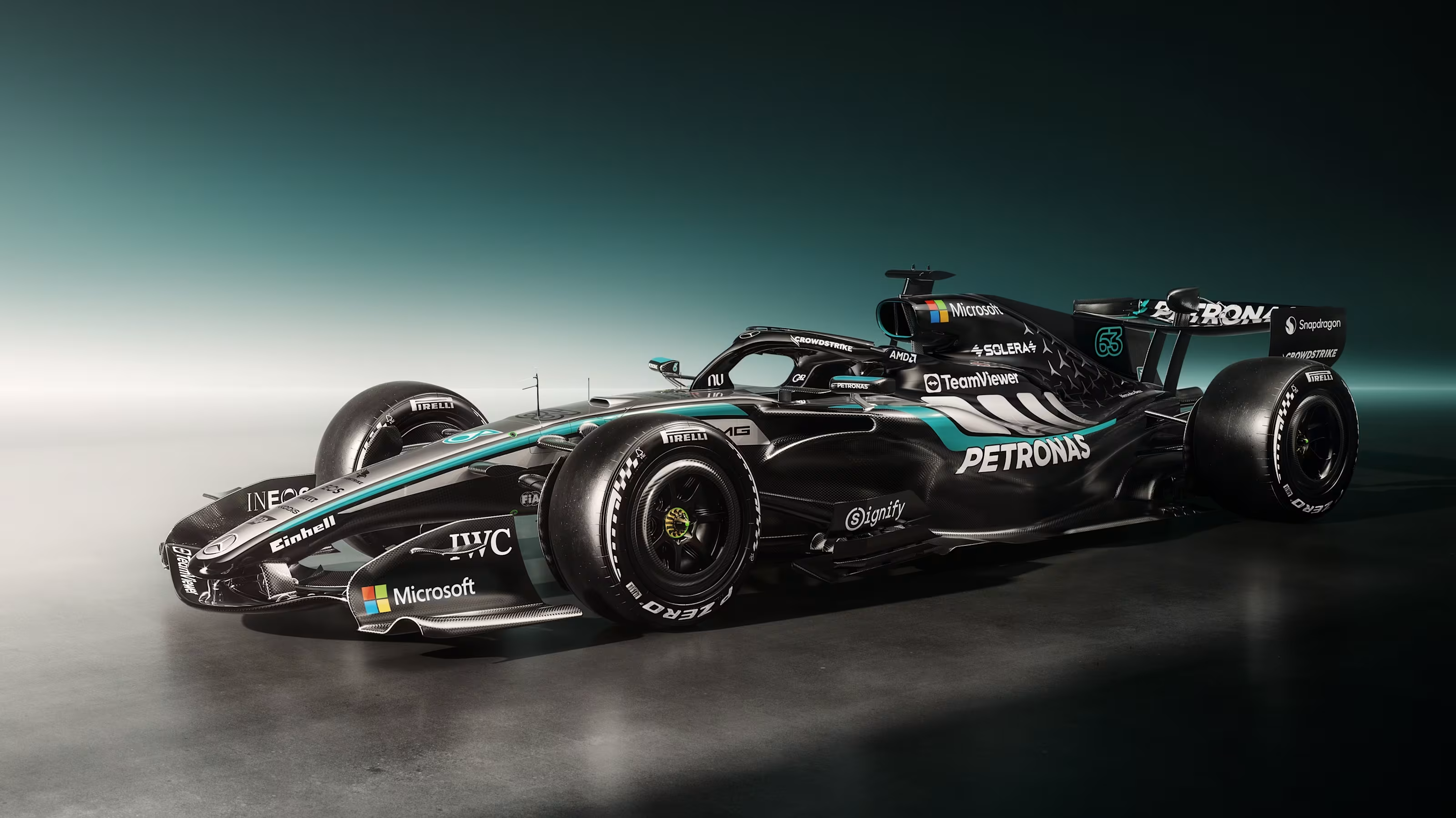
Ronda 6 · 2026 · Mercedes
Gran Premio de Mónaco
01Mejoras
01Áreas
De un vistazo
Últimas mejoras
+5 más en el coche, abajo
Última gran mejora en foto · Mónaco
Fotos y análisis
The Race@wearetheraceJune 4, 2026
👀 Mercedes and Red Bull introduce radical winglets in Monaco.In the chase for marginal chains, teams have seen opportunity from no active aero at the Monaco GP and have re-engineered the mechanism areas on their rear wings to introduce some unique extra winglets that will add…
El alerón delantero es la primera parte del coche que se encuentra con el aire. Genera su propia carga aerodinámica sobre el eje delantero y da forma al flujo que aprovecha todo lo que va detrás, sobre todo la estela de los neumáticos delanteros. Esa doble función, unida a su papel en el equilibrio aerodinámico entre delante y detrás, explica por qué los equipos lo cambian tan a menudo.
Qué cambió en 2026
El alerón delantero de 2026 es más estrecho (la FIA habló de 100 mm menos) y más sencillo, y ahora forma parte de la aerodinámica activa: sus flaps alternan entre un modo curva (Corner Mode) de alta carga y un modo recta (Straight Mode) de menor resistencia, controlados por la ECU estándar de la FIA y permitidos solo en las zonas de activación designadas. Si el sistema falla, los flaps deben volver al modo curva. Los objetivos de la FIA eran reducir la resistencia aerodinámica y el outwash de aire turbulento, para que los coches puedan seguirse más de cerca.
Reglamento Técnico de la FIASección C · Art. C3.10.1Edición 21 · 2026-10-19
C3.10.1 · Front Wing Profiles
Resaltado: el espacio que el reglamento permite para esta área (Apéndice C2 de la FIA). Arrastra para girar. RV-FW-PROFILES · RV-FW-STRAKE · RV-FW-PYLON · RV-FW-SM-CL-FAIRING · RV-FW-SM-MID
En pocas palabras
Regula los elementos del alerón delantero. Deben caber dentro de RV-FW-PROFILES (el espacio 3D en el que deben caber), con un máximo de tres elementos separados y huecos de 5 a 15 mm entre ellos. Cada sección tiene normas estrictas de forma y curvatura, y en el borde de salida del último elemento se puede añadir un Gurney (un pequeño labio) de hasta 10 mm de alto.
“” is exempt from C3.2.4 (b) but must:
a. lie in its entirety within RV-FW-PROFILES.
b. comprise of up to three, non-intersecting, simply connected volumes.
c. have up to three sections in any .
d. when viewed from above, fully obscure RS-FW-PROFILES.
In any Y-Plane:
e. the rearmost point of every section must be visible when viewed from below.
f. except for the rearmost section, the rearmost point of every section must not be visible when viewed from above.
g. assessing each section independently, within 40mm of the rearmost point of each section:
i. a line tangent to any part of the section visible from below must have a positive slope. The slope of this line will be considered in the Y-Plane.
ii. no part of the section visible from above may be more than 10mm distant from the section visible from below, if outboard of Y = 400, or 15mm if inboard of Y = 400.
h. contain:
i. no concave radius of curvature visible from below.
ii. no concave radius of curvature less than 50mm visible from above.
Furthermore:
i. when measured against a vertical plane normal to RS-FW-SECTION, contain no normal to any point on the surface that subtends an angle greater than 30°. For volumes thicker than 0.5mm in their entirety (measured normal to the surface on any Y-Plane), compliance with this Article may be determined prior to application of any necessary to demonstrate compliance with C3.3.1 (a).
j. compliance with (i) is not required for surfaces that lie exactly on or Y = 675.
k. At all points along the span, the minimum distance between adjacent Front Wing Profiles volumes must be between 5mm and 15mm when measured with a spherical gauge.
l. The rearmost point of every individual Y-section, when projected in Z onto a plane through , must produce a single tangent continuous curve with no radius of curvature less than 200mm.
Once the Front Wing Profiles bodywork is fully defined, up to 10mm in height may be fitted to the trailing edge of the upper surface of the rearmost section. These Gurneys are considered to be part of the Front Wing Profiles and must satisfy the provisions of this Article except for (g) and (h) and, for the inner extremity of the innermost Gurney and outer extremity of the outermost Gurney, (i).
C3.10.10 · Front Wing Adjuster SystemArtículos relacionados
En pocas palabras
Define el alerón delantero móvil. Un flap primario y otro secundario giran sobre ejes fijos. Bajo el control de la ECU de la FIA alternan entre dos posiciones fijas, el modo curva (Corner Mode) y un modo recta (Straight Mode) de menor ángulo, en menos de 400 ms, con hasta dos actuadores dotados de sensores de posición. El modo recta solo se permite con el coche parado o dentro de una zona de activación, y ante un fallo el alerón vuelve al modo curva.
The “” is defined as follows:
a. “FW Primary Flap”, if fitted, must:
i. be a continuous portion of , excluding the forwardmost volume.
ii. rotate about the “Primary Axis”, which must pass through Point A and Point B and be fixed relative to the forwardmost volume of Front Wing Profiles.
b. “”, if fitted, must:
i. be a continuous portion of only the rearmost volume of Front Wing Profiles.
ii. rotate about the “”, which must pass through Point C and Point D and be fixed relative to either the Primary Flap if fitted, or the forwardmost volume of Front Wing Profiles.
c. Both FW Primary Flap and FW Secondary Flap must include any fitted and any parts of Front Wing Auxiliary Components that are rigidly attached to the respective volumes.
d. “Point A” and ”Point B” must lie:
i. within the volume of FW Primary Flap.
ii. no more than 25mm from the forwardmost point of FW Primary Flap at their respective Y positions.
e. “Point C” and ”Point D” must lie:
i. within the volume of FW Secondary Flap.
ii. no more than 25mm from the forwardmost point of FW Secondary Flap at their respective Y positions.
f. Point A and Point C must lie inboard of Y = 150.
g. Point B and Point D must lie between Y = 475 and Y = 675.
With Front Wing Profiles positioned to comply with Article C3.10.1, up to two pairs of rotation surfaces (four in total) must be defined as follows:
h. “Primary Rotation Surfaces”, which must:
i. use the Primary Axis as their axis of revolution.
ii. pass through Point A for the first surface and Point B for the second surface.
iii. extend over the complete chord of FW Primary Flap.
i. “Secondary Rotation Surfaces”, which must:
i. use the Secondary Axis as their axis of revolution.
ii. pass through Point C for the third surface and Point D for the fourth surface.
iii. extend over the complete chord of FW Secondary Flap.
j. Over their intersection with the FW Primary and Secondary Flaps at their original design position (defined in accordance with Article C3.10.1), no surface of rotation may have a normal which forms an angle greater than 30 degrees to the Y-Axis.
Compared to the position of Front Wing Profiles defined in Article C3.10.1, adjustment not controlled by the is only allowed when the car is stationary and by the use of a tool, and in accordance with the Sporting Regulation and must:
k. not result in a decrease in incidence of the tangent lines defined in Article C3.10.1 (g) (i).
l. result in a maximum deviation for any point of Front Wing Profiles no greater than:
i. 30mm for FW Primary Flap.
ii. 60mm for FW Secondary Flap.
Any adjustment of Front Wing Profiles controlled by the FIA Standard ECU must:
m. be about one of the Primary Axis or Secondary Axis only.
n. when commanded, switch to one of two fixed positions defined as follows:
i. a “” position, that conforms to a position defined in (k) and that remains identical following any operation to its position beforehand.
ii. a “Straight Mode” position that, when compared to the Corner Mode position, results in a decrease in incidence of FW Primary Flap and/or FW Secondary Flap. Furthermore, except when limited by a physical stop defined in (u), the magnitude of decrease must remain constant.
o. have a maximum transition time between the two fixed positions that does not exceed 400ms, measured from the instant at which the command to change mode is issued by the FIA Standard ECU until the position sensor(s), connected to the FIA Standard ECU, confirm that the commanded fixed position has been reached.
p. be driven by up to two actuators, across both sides of the car.
q. be measured by position sensors, one for each of the actuators defined in (p), which:
i. are mechanically linked to Front Wing Profiles.
ii. output analogue signals calibrated over the actuator travel.
iii. are connected to the FIA Standard ECU as specified by the FIA.
r. be symmetrical about .
Furthermore:
s. Irrespective of whether the adjustment is controlled by the FIA Standard ECU, any fitted FW Primary Flap and FW Secondary Flap must:
i. except for Front Wing Fishplates, Front Wing Adjuster Fairing and any fitted Gurneys, remain in their entirety within RV-FW-PROFILES.
ii. retain the geometric relationship between all elements of FW Primary Flap, except when adjusting about the Secondary Axis only.
iii. retain the geometric relationship between all elements of FW Secondary Flap.
iv. conform with all bodywork regulations except for Article C3.2.4 (b), Article C3.10.11 (g) (i) and sub-clauses (b) to (l) of Article C3.10.1.
t. Except for a failure of the Front Wing Adjuster System, or during the transition between Corner Mode and Straight Mode, FW Primary Flap and FW Secondary Flap can only have the two positions defined in (n).
u. Physical Stops must be provided to prevent both FW Primary Flap and FW Secondary Flap from being rotated external to RV-FW-PROFILES.
v. The design is such that failure of the system will result in it returning to its Corner Mode position.
w. FW Primary Flap and FW Secondary Flap may only be in a when the car is stationary or fully inside an as defined by Article B7.1.1 (d).
C3.10.9 · Front Wing AssemblyArtículos relacionados
En pocas palabras
Reúne los elementos del alerón delantero, la placa terminal, el pilón y el strake opcional en el conjunto del alerón delantero, eliminando antes los sobrantes que sobresalen y permitiendo radios de acuerdo de hasta 10 mm. Debe ser un único volumen, el pilón debe quedar oculto desde abajo y cualquier strake situado a más de 715 mm por delante de la línea del eje delantero debe quedar oculto desde arriba.
“Front Wing Assembly” results from the of the following components:
a. .
b. Front Wing Endplate.
c. Front Wing Pylon.
d. Front Wing Strake, if fitted.
Before trimming is applied, any Front Wing Profiles remaining outboard of Front Wing Endplate and any Front Wing Pylon remaining below Front Wing Profiles must be discarded.
A , no greater than 10mm, may be applied along the intersections between the remaining component parts.
Once fully defined, Front Wing Assembly must:
e. be a single volume, with no overlapping regions.
f. when viewed from below, fully obscure Front Wing Pylon.
g. when viewed from above, fully obscure Front Wing Strake forward of = −715, if fitted.
Las descripciones de las mejoras se muestran en su idioma original.
R05Canadá
Front Wing
“Running the front wing elements into the footplate, and adding strakes, results in more robust flow structures, improving flow to the rear of the car and gaining downforce.”
Diferencias geométricasFront wing outboard elements dropped in height and run into the footplate.
1) After bringing significant upgrades to Miami last time out, McLaren introduce the second half of the package in Montréal with a new front wing, a revised engine cover and cooling louvres, a new halo winglet, revised rear wing endplates, updated rear suspension fairings and new…
A very big upgrade for #MercedesF1 at the #CanadianGP 🇨🇦New front wing and endplates, new bargeboards, revised floor corner and a new diffuser roof (to be checked) — Mercedes has clearly arrived in Montreal with serious intent.#F1 #Mercedes #TechF1
1) McLaren bring a new rear wing to Melbourne. It features a revised mainplane and flap elements for improved load. The MCL40 also gets a revised floor edge for better flow control around the rear tyres and new rear suspension fairings for better flow around the rear impact…
Il primo venerdì dell'anno ha confermato che la Mercedes è la squadra da battere. La W17 si è presentata in Australia con l'ala anteriore testata per pochi giri in Bahrain, che presenta delle superfici aerodinamiche aggiuntive nelle zone laterali. Confermata l'ala posteriore con…
Las placas terminales cierran los extremos exteriores del alerón delantero y deciden cómo se guía el aire cerca de los neumáticos delanteros. Son una herramienta clave para gestionar la estela de esos neumáticos, que afecta al suelo, a los pontones y a la parte trasera del coche.
Qué cambió en 2026
Con el alerón delantero más estrecho, la placa terminal de 2026 se define como la combinación de un cuerpo de placa terminal, unas placas base exterior e interior y un diveplane opcional, cada uno dentro de su propio volumen de referencia. La intención de la norma cambió: formula1.com explica que los nuevos alerones delanteros y los deflectores del suelo buscan evitar que el aire se empuje hacia fuera alrededor de las ruedas delanteras, algo que genera turbulencias para el coche que va detrás.
Reglamento Técnico de la FIASección C · Art. C3.10.6Edición 21 · 2026-10-19
C3.10.6 · Front Wing Endplate
Resaltado: el espacio que el reglamento permite para esta área (Apéndice C2 de la FIA). Arrastra para girar. RV-FWEP-BODY · RV-FWEP-OFP · RV-FWEP-IFP · RV-FWEP-DIVEPLANE
En pocas palabras
La placa terminal del alerón delantero es la unión del cuerpo de la placa, las dos placas base y el diveplane opcional, con radios de acuerdo de hasta 40 mm entre el cuerpo y el diveplane y de 10 mm en el resto. Debe ser un único volumen, de al menos 10 mm de espesor donde se ve de lado, y debe cubrir las superficies de referencia RS-FWEP-TOP y RS-FWEP-SIDE.
“Front Wing Endplate” results from the of the following components:
a. Front Wing Endplate Body.
b. Front Wing Outboard Footplate.
c. Front Wing Inboard Footplate.
d. Front Wing Endplate Diveplane, if fitted.
Before trimming, any Front Wing Endplate Body remaining below Front Wing Inboard Footplate must be discarded.
A , no greater than 40mm, may be applied along the intersections between Front Wing Endplate Body and Front Wing Diveplane. A Fillet Radius, no greater than 10mm, may be applied along the intersections between the remaining component parts.
Once fully defined, Front Wing Endplate must:
e. be a single, simply connected volume, with no overlapping regions.
f. be no less than 10mm thick (being the minimum distance when measured normal to the surface), if visible from the side.
g. when viewed from above, fully obscure RS-FWEP-TOP:
h. when viewed parallel to the Y-Axis from inboard, fully obscure RS-FWEP-SIDE and Front Wing Endplate Diveplane.
C3.10.2 · Front Wing Endplate BodyArtículos relacionados
En pocas palabras
El cuerpo de la placa terminal del alerón delantero debe caber dentro de RV-FWEP-BODY (el espacio 3D en el que debe caber), con hasta dos secciones en cualquier corte vertical longitudinal. Sus curvas convexas deben tener un radio de al menos 5 mm y las cóncavas de al menos 100 mm.
“Front Wing Endplate Body” must:
a. lie in its entirety within RV-FWEP-BODY.
b. have up to two sections in any .
Front Wing Endplate Body must contain:
c. no convex radius of curvature less than 5mm.
d. no concave radius of curvature less than 100mm.
C3.10.3 · Front Wing Outboard FootplateArtículos relacionados
En pocas palabras
La placa base exterior del alerón delantero debe caber dentro de RV-FWEP-OFP (el espacio 3D en el que debe caber), con hasta dos secciones en los cortes horizontales por debajo de 160 mm de altura y en las secciones transversales más atrasadas. Ninguna curva puede tener un radio inferior a 5 mm, y las curvas cóncavas vistas desde abajo o situadas a más de 825 mm del eje central deben ser de al menos 50 mm.
“Front Wing Outboard Footplate” must:
a. lie in its entirety within RV-FWEP-OFP.
b. below Z = 160, have up to two sections in any Z-Plane.
c. rearwards of = −425, have up to two sections in any .
Front Wing Outboard Footplate must contain:
d. no radius of curvature less than 5mm.
e. no concave radius of curvature less than 50mm visible from below.
f. no concave radius of curvature less than 50mm outboard of Y = 825mm.
C3.10.5 · Front Wing Endplate DiveplaneArtículos relacionados
En pocas palabras
El diveplane opcional de la placa terminal del alerón delantero debe caber a la vez dentro de una caja de 300 x 325 x 50 mm y de RV-FWEP-DIVEPLANE (el espacio 3D en el que debe caber). Sus curvas convexas deben tener un radio de al menos 5 mm y las cóncavas de al menos 50 mm.
“Front Wing Endplate Diveplane” must:
a. lie in its entirety within:
i. an axis aligned cuboid of the following dimensions [X, Y, Z] = [300, 325, 50].
ii. RV-FWEP-DIVEPLANE.
Front Wing Endplate Diveplane must contain:
b. no convex radius of curvature less than 5mm.
c. no concave radius of curvature less than 50mm.
Las descripciones de las mejoras se muestran en su idioma original.
R05Canadá
Front Wing Endplate
“Running the front wing elements into the footplate, and adding strakes, results in more robust flow structures, improving flow to the rear of the car and gaining downforce.”
Diferencias geométricasFront wing endplate and footplate adjusted to accommodate the above. Footplate stakes added. Diveplane camber adjusted.
1) After bringing significant upgrades to Miami last time out, McLaren introduce the second half of the package in Montréal with a new front wing, a revised engine cover and cooling louvres, a new halo winglet, revised rear wing endplates, updated rear suspension fairings and new…
A very big upgrade for #MercedesF1 at the #CanadianGP 🇨🇦New front wing and endplates, new bargeboards, revised floor corner and a new diffuser roof (to be checked) — Mercedes has clearly arrived in Montreal with serious intent.#F1 #Mercedes #TechF1
El morro sostiene el alerón delantero y contiene la estructura de impacto frontal. Su forma también determina cuánto aire pasa por debajo hacia el suelo, así que pequeños cambios en su anchura y en su parte inferior pueden afectar a todo el coche.
Qué cambió en 2026
El principal cambio de 2026 tiene que ver con la seguridad: la FIA introdujo una estructura de impacto frontal en dos fases para que el morro tenga menos probabilidades de desprenderse en un primer impacto y dejar el coche desprotegido en un segundo. El morro debe quedar dentro de su volumen de referencia y cumplir normas de curvatura que mantienen sus laterales lisos.
Reglamento Técnico de la FIASección C · Art. C3.7.1Edición 21 · 2026-10-19
C3.7.1 · Nose
Resaltado: el espacio que el reglamento permite para esta área (Apéndice C2 de la FIA). Arrastra para girar. RV-NOSE · RV-CAMERA-2
En pocas palabras
El morro debe caber dentro de RV-NOSE (el espacio 3D en el que debe caber) y, visto desde arriba, cubrir RS-NOSE por delante de la línea X_A = 0. Sus superficies deben ser lisas, sin curvas cóncavas (huecas) en ninguna sección transversal y con radios mínimos en planta de 45 mm y 20 mm. Las cámaras en la posición 2 y ciertos soportes de montaje están exentos.
“Nose” must:
a. lie in its entirety within RV-NOSE.
b. when viewed from above, fully obscure RS-NOSE ahead of = 0.
Nose , must be Tangent Continuous, and in any must:
c. contain no concave radius of curvature.
d. between = −950 and XA = 0, have a section that when viewed from above:
i. is tangent to the Z-Axis at its outermost extremity.
ii. contains no radius of curvature less than 45mm at XA = 0.
iii. contains no radius of curvature less than 20mm forward of XA = 0.
Furthermore, the following will be exempt from the above:
e. Cameras in Position 2.
f. Mounting brackets defined in Article C8.16.7.
No hay cambios registrados para este componente hasta el evento seleccionado.
Componente 04 / 22
Suspensión delantera
Por qué los equipos lo desarrollan
La suspensión delantera controla cómo apoyan los neumáticos delanteros en la frenada, en curva y sobre los baches, y mantiene el coche a una altura estable para que el suelo funcione. Sus brazos están en pleno flujo de aire, así que los equipos también dan forma a los carenados y colocan los brazos por motivos aerodinámicos.
Qué cambió en 2026
Cada rueda debe seguir unida por seis elementos de suspensión, con carenados sellados para que el aire no los atraviese. El texto de 2026 también fija algunas normas de disposición, como la separación entre los anclajes del trapecio delantero. El objetivo declarado de la FIA para el nuevo suelo era reducir la dependencia de reglajes muy rígidos y muy bajos, lo que cambia lo que los equipos piden a su suspensión.
Reglamento Técnico de la FIASección C · Art. C10.3Edición 21 · 2026-10-19
C10.3 · Outboard suspension
La forma mostrada (bordes discontinuos) es solo orientativa: dibujada por PITWALL para mostrar dónde van las piezas, no un límite reglamentario.
En pocas palabras
Con la dirección fija, la posición de cada rueda debe depender solo de su recorrido vertical de suspensión, y la caída no puede variar más de 1 grado en 10 mm de recorrido. Cada mangueta necesita exactamente seis elementos de suspensión, uno de ellos en cada rueda delantera unido a la dirección, con puntos de anclaje dentro del tambor de la rueda y normas específicas de separación en el tren delantero.
C10.3.1 With the steering wheel rotation fixed, the position of each wheel centre and the orientation of its rotation axis must be completely and uniquely defined by a function of its principally vertical suspension travel, save only for the effects of reasonable compliance which does not intentionally provide further degrees of freedom.
Additionally, the angle subtended between the normal projection of the Z axis onto the =0 plane and the Z axis must not vary by more than 1 degree over 10mm of suspension travel with the steering wheel rotation fixed. Compliance must be demonstrated by CAD, using camber values of −3 degrees front and −1 degree rear.
C10.3.2 There must be six suspension members connecting each suspension upright to the .
Redundant suspension members are not permitted.
On the front axle, one suspension member per wheel must be connected to the steering system.
C10.3.3 Suspension members having shared attachment points will be considered by a virtual dissection into discrete members.
C10.3.4 The outboard attachment points of each suspension member (defined as the kinematic centre of rotation of the joint that allows relative rotation between a suspension member and its adjoining upright) must lie:
a. outboard of YW =0.
b. Above ZW = −100 for the front axle and above ZW = −40 for the rear axle.
c. Inside the Drum defined in Article C3.14.2.
Exceptionally, the outboard attachment point of a suspension member connected inboard, to the rockers defined in Article C10.4.1 and outboard, directly to another suspension member, may not satisfy the provisions of this Article, but must in any case:
d. lie outboard of YW =50.
e. be no more than 25mm from the load line of the suspension member it is attaching to.
f. together with the inboard attachment point of the same suspension member, lie on the same side of the suspension member it is attaching to when viewed from the front.
C10.3.5 On the front axle only, considering the six suspension members connected to an upright, but excluding the members connected inboard to the steering system or the rockers defined in Article C10.4.1, they must form 2 independent pairs of members each with their inboard attachment points separated in X by no less than 300mm and above Z=250mm. Furthermore to form a pair, each suspension member must also be accompanied by the suspension member with the closest outboard attachment point in Z .
C3.17 · Suspension and Driveshaft FairingsArtículos relacionados
En pocas palabras
Todos los elementos de suspensión deben llevar carenados, salvo los de sección circular. Además, deben estar sellados por dentro para que el aire no pueda circular a través de ellos.
C3.17.1 “Suspension Fairings” must be fitted to all suspension members defined in Article C10.3.6, except for those of circular cross section. Furthermore, Suspension Fairings must be internally sealed to prevent any internal airflow.
No hay cambios registrados para este componente hasta el evento seleccionado.
Componente 05 / 22
Tomas de freno delanteras
Por qué los equipos lo desarrollan
Las tomas de freno delanteras llevan aire de refrigeración a los frenos y a la rueda y dejan salir el calor. Como están justo al lado del neumático delantero, sus tomas y deflectores también se usan para dirigir la estela del neumático, así que se desarrollan tanto para la refrigeración como para la aerodinámica.
Qué cambió en 2026
En 2026 la toma de freno se trata como carrocería de la rueda: un tambor de forma prescrita, una toma de entrada (scoop) y deflectores delantero y trasero, cada uno limitado a un volumen fijo y medido en el sistema de coordenadas propio de la rueda. La FIA explicó que parte de la carrocería de la rueda es obligatoria para mejorar la estela que sale de las ruedas, en línea con su objetivo de carreras más igualadas.
Reglamento Técnico de la FIASección C · Art. C3.14.2Edición 21 · 2026-10-19
C3.14.2 · Drum
Las tomas de freno se regulan como componentes de rueda: tambor, scoop y deflectores del tambor.
La forma mostrada (bordes discontinuos) es solo orientativa: dibujada por PITWALL para mostrar dónde van las piezas, no un límite reglamentario.
En pocas palabras
Los tambores de las ruedas delanteras y traseras deben construirse con formas fijas definidas por las superficies de referencia RS-FWH-DRUM y RS-RWH-DRUM. Cada uno necesita un sello aerodinámico continuo de 360 grados entre el tambor y el eje, y se pueden montar sellos flexibles entre el tambor y la llanta.
“Front Drum” and ”Rear Drum” , the latter being exempt from Article C3.2.4 (b), must:
a. be made to the geometry defined by RS-FWH-DRUM and RS-RWH-DRUM respectively.
Furthermore:
b. Drum Bodywork must be fitted with an , in the outboard of the two annotated volumes, between the Drum and the axle. This Aerodynamic Seal must be circumferential, continuous (around an arc of 360°), concentric about the axis, and uniform.
c. Drum Bodywork may be fitted with a flexible seal or seals, in the inboard of the two annotated volumes, between the Drum and the Wheel Rim.
C3.14.6 · Front Drum Front DeflectorArtículos relacionados
En pocas palabras
El deflector frontal opcional del tambor delantero debe caber dentro de una caja de 150 x 45 x 25 mm que puede desplazarse libremente y girarse alrededor de la dirección del eje de la rueda, siempre por debajo de Z_W = 0. Puede tener hasta dos piezas separadas y dos secciones por corte, y debe quedar oculto desde el interior por el labio delantero.
“Front Drum Front Deflector” , if present, must:
a. lie in its entirety:
i. within an axis aligned cuboid of the following dimensions [ , YW , ZW ] = [150, 45, 25], which may be freely translated along any axis, and rotated about the YW axis only.
ii. below ZW = 0.
b. comprise of up to two, non-intersecting, simply connected volumes.
c. have up to two sections in any XW , Y or ZW -Plane.
d. not be visible from inboard with the Front Lip present.
Furthermore,
e. Front Drum Front Deflector Bodywork is optionally fitted and exempt from Article C3.14.1 (b).
C3.14.7 · Front Drum Rear DeflectorArtículos relacionados
En pocas palabras
El deflector trasero del tambor delantero combina una superficie de referencia fija (RS-FWH-RDEF) con un borde de ataque dentro de RV-FWH-RDEF. Donde se ve desde el interior, puede tener como máximo 15 mm de espesor, y sus curvas cóncavas deben tener un radio de al menos 75 mm (parte delantera, vista desde el exterior) o 50 mm (parte trasera).
“Front Drum Rear Deflector” , which is exempt from Article C3.2.4, results from the of the following components:
a. RS-FWH-RDEF.
b. Deflector Leading Edge, which must:
i. lie in its entirety within RV-FWH-RDEF.
ii. contain no more than a single section in any X and ZW -Plane.
iii. obscure RS-FWH-TOP when viewed from inboard.
Front Drum Rear Deflector Bodywork must:
c. be no more than 15mm thick (being the minimum distance when measured normal to the surface), if visible from inboard.
Furthermore:
d. Compliance with (c) is not required within 5mm of the side-view boundary of Front Drum Rear Deflector when viewed from inboard.
Front Drum Rear Deflector must:
e. in any -Plane forward of XW = 150, contain no concave radius of curvature:
i. less than 75mm visible from outboard.
ii. visible from inboard.
f. in any XW -Plane rearward of XW = 150, contain no concave radius of curvature less than 50mm.
Las tomas (scoops) de las ruedas delanteras y traseras deben caber dentro de RV-FWH-SCO y RV-RWH-SCO respectivamente (los espacios 3D en los que deben caber). Sus superficies deben verse por completo desde el interior y no pueden curvarse con un radio inferior a 20 mm, salvo la parte de la toma trasera situada detrás de X_W = 0 en el sistema de coordenadas propio de la rueda.
The “Front Scoop” and ”Rear Scoop” must:
a. lie in their entirety within RV-FWH-SCO and RV-RWH-SCO respectively.
Furthermore, Rear Scoop Bodywork rearwards of = 0:
b. is exempt from Article C3.2.4 (b).
Scoop must:
c. be fully visible from inboard.
d. contain no radius of curvature less than 20mm, except for regions of the Rear Scoop rearwards of XW = 0.
“Due to the high braking demands of Montreal - increasing the duct inlet and exit size increases mass flow feeding the discs resulting in more cooling.”
Diferencias geométricasIncreased inlet and exit size.
1) After bringing significant upgrades to Miami last time out, McLaren introduce the second half of the package in Montréal with a new front wing, a revised engine cover and cooling louvres, a new halo winglet, revised rear wing endplates, updated rear suspension fairings and new…
1) McLaren have brought a large upgrade package to Miami, with the MCL40 getting revised front corner aero elements, new furniture and cooling louvres on the engine cover, redesigned sidepod inlets and mirrors, an all-new floor, revised rear corner furniture and an updated rear…
Las ruedas y los neumáticos son el único contacto del coche con la pista. Las llantas están muy reguladas, pero la forma en que el aire rodea y atraviesa la rueda afecta a la resistencia aerodinámica, a la temperatura de los frenos y a la estela con la que tiene que lidiar el resto del coche.
Qué cambió en 2026
Se mantienen las ruedas de 18 pulgadas introducidas en 2022, pero los neumáticos son más estrechos: 25 mm menos delante y 30 mm menos detrás, según la FIA. Formula1.com informa de que se eliminaron los tapacubos para ahorrar peso, y la FIA suprimió los pequeños guardabarros delanteros usados desde 2022. Las llantas deben ser de aleación de magnesio y no pueden incluir elementos pensados para modificar la transferencia de calor.
Reglamento Técnico de la FIASección C · Art. C10.7.2Edición 21 · 2026-10-19
C10.7.2 · Wheel rim dimensions
Resaltado: el espacio que el reglamento permite para esta área (Apéndice C2 de la FIA). Arrastra para girar. TYRE-FRONT
En pocas palabras
Fija las dimensiones de la llanta, entre ellas un diámetro de 462,5 a 463 mm y anchos de montaje del neumático de 315 mm delante y 401,3 mm detrás. La llanta es un único perfil de revolución de al menos 2,5 mm de espesor, con zonas limitadas donde se puede retirar material. El aire no puede pasar entre sus cavidades interior y exterior, y los diseños izquierdo y derecho deben ser idénticos.
a. The Wheel Rim key dimensions are:
Front Wheel Rear Wheel Rim Diameter 462.5 / 463 462.5 / 463 Tyre Mounting Width 315 ± 0.5 401.3 ± 0.5 Lip External Diameter 496 ± 0.5 496 ± 0.5 Overall Width 334 ref. 420.3 ref.
Outboard Lip Thickness 8.5 ± 0.2 8.5 ± 0.2 Inboard Lip Thickness 10.5 ± 0.2 10.5 ± 0.2
b. The Wheel Rim must be a solid of rotation formed by revolving a single profile around the axis of rotation of the Wheel Rim. The profile must be tangent continuous with a minimum radius of curvature of 8mm in the area:
i. more than 80mm from the axis Y .
and
ii. outboard of =−36.
and
iii. inboard of; YW =−302 for the front rim and YW =−388 for the rear rim.
c. Once the revolved solid has been fully defined, material may be :
i. removed between YW =−210 and YW =−392.5 on the rear wheel and between YW =−188 and YW =−319 on the front wheel. Any new surface created must have no concave radius of curvature smaller than 6mm.
ii. removed in areas less than 80mm from the axis Y .
iii. added or removed to form features for mounting the inflation valve and TPMS sensors.
iv. removed on the outer flanges, between a radius of 238mm and a radius of 246mm from the axis Y and up to 1mm deep for wheel branding, logo, or part numbers.
v. added or removed to form features for mounting the disc described in Article C10.7.5 or closing panel described in C10.7.2.e.
d. No part of the front or rear Wheel Rim may lie within RV−F−RIM−MIN or RV−R−RIM−MIN respectively.
e. There must be no passage for air between the inboard and outboard cavities of the Wheel Rim.
Any closing panel may either be integrated into the rim or may be a separate piece. All separate closing panels must respect clauses (d), (j), and (k) of this Article. Closing panels which are not required to prevent airflow between the inner and outer cavities are not permitted.
f. The minimum Wheel Rim thickness is 2.5mm.
g. The minimum bead thickness is 4.0mm (measured from hump to outer edge of the lip).
h. The ETRTO standard bead profile is prescribed.
i. The design of the wheel must meet the general requirements of the tyre supplier for the mounting and dismounting of tyres including allowance for sensors and valves.
j. The Wheel Rim design cannot be handed between left and right designs.
k. Features intended to influence the heat transfer characteristics of the Wheel Rim are not permitted. F1 Teams are required to submit designs to the FIA for approval.
l. Design guidelines for the Wheel Rims are set out in FIA-F1-DOC-021. Any deviation from the guidelines must be agreed with the Tyre Supplier.
C10.8.2 · Tyre specificationArtículos relacionados
En pocas palabras
El proveedor de neumáticos fija las especificaciones de los neumáticos junto con la FIA, siguiendo el calendario del documento FIA-F1-DOC-057. A partir de entonces solo pueden cambiar con el acuerdo de la Comisión de la Fórmula 1, salvo que la FIA puede cambiarlas durante la temporada por motivos de seguridad sin previo aviso.
Tyre specifications will be determined by the tyre supplier, in agreement with the FIA, data will be divided into data blocks as defined in the document FIA-F1-DOC-057 and according to the timetable given in that document.
Once determined in this way, the specification of the tyres will not be changed without the agreement of the Formula One Commission.
Notwithstanding the above, the FIA may decide to change the specification during the Championship season for safety reasons without notice or delay.
No hay cambios registrados para este componente hasta el evento seleccionado.
Componente 07 / 22
Retrovisores
Por qué los equipos lo desarrollan
Los retrovisores son un elemento de seguridad, pero están en un flujo de aire limpio y rápido junto al cockpit. Los equipos dan forma a las carcasas y a sus soportes para que perturben el aire lo menos posible, o incluso para que ayuden a guiarlo hacia los pontones.
Qué cambió en 2026
La superficie reflectante del retrovisor sigue teniendo un tamaño fijo y debe dar al piloto visión hacia atrás y hacia ambos lados. Como novedad de 2026, el cuerpo del retrovisor debe alojar una luz de seguridad lateral que, según la FIA, muestra el estado del ERS si el coche se detiene en pista, para que los comisarios sepan si es seguro acercarse.
Reglamento Técnico de la FIASección C · Art. C3.7.5Edición 21 · 2026-10-19
C3.7.5 · Mirror
Resaltado: el espacio que el reglamento permite para esta área (Apéndice C2 de la FIA). Arrastra para girar. RV-MIRROR-BODY · RV-MIRROR-ISTAY · RV-MIRROR-RSTAY
En pocas palabras
Define la carrocería de los retrovisores. El cuerpo del retrovisor debe caber dentro de RV-MIRROR-BODY y alojar una luz de seguridad lateral, que puede desplazarse libremente y girarse hasta 5 grados. Un soporte interior lo une al chasis y un soporte trasero (de menos de 50 mm de alto y 10 mm de ancho) al pontón; juntos deben formar un único volumen, con radios de acuerdo de hasta 10 mm.
“Mirror Body” must:
a. lie in its entirety within RV-MIRROR-BODY.
b. fully enclose an individual instance of RV-LATERAL-SAFETY-LIGHT which may be freely translated along any axis, and rotated up to +/-5deg about any Z-axis only.
c. have an external surface coincident with the highlighted surface of RV-LATERAL-SAFETY- LIGHT.
“Mirror Inner Stay” Bodywork must:
d. lie in its entirety within RV-MIRROR-ISTAY.
e. intersect Mirror Body and Mid Chassis.
“Mirror Rear Stay” bodywork must:
f. lie in its entirety within RV-MIRROR-RSTAY.
g. intersect Mirror Body and Sidepod.
h. in any , measure less than:
i. 50mm in Z.
ii. 10mm in Y.
“Mirror” results from the of the following components:
i. Mirror Body.
j. Mirror Inner Stay.
k. Mirror Rear Stay.
A , no greater than 10mm, may be applied along the intersections between the remaining component parts.
Once fully defined, Mirror must:
l. be a single volume with no overlapping regions.
Todos los coches necesitan dos retrovisores simétricos que den al piloto visión hacia atrás y hacia ambos lados. Cada superficie reflectante se sitúa dentro de RV-MIRROR-BODY y es un rectángulo de 200 x 50 mm (más hasta 2 mm), con radios de esquina de hasta 10 mm, sin zonas cóncavas y sin curvaturas de radio inferior a 400 mm. La FIA puede pedir los datos CAD y mover el volumen del retrovisor por seguridad.
C14.2.1 All cars must have two mirrors positioned symmetrically about the car’s centre plane and mounted so that the driver has visibility to the rear and both sides of the car.
C14.2.2 The reflective surface of each mirror must satisfy the following conditions:
a. It must be contained within RV−MIRROR−BODY and not be obstructed by the Mirror Body, either towards the driver or in the rearward direction.
b. Its four edges must project orthogonally onto the edges of a vertical rectangle which is 200mm wide and 50mm high (+2mm/−0mm for both dimensions), with a radius of up to 10mm applied to each corner.
c. Over its whole area it must:
i. not contain any concave parts.
ii. be tangency continuous.
iii. not have any normal radius of curvature less than 400mm.
d. When cut by any Z−Plane and before any radius is applied to the corners:
i. the normal to the curve at its inboard end must subtend an angle of between 24deg and 28deg to the X axis, pointing towards the plane.
ii. the angle between normals to the curve at its inboard and outboard ends must be greater than 8 degrees.
For the avoidance of doubt, any non−reflective parts of the mirror must be contained within the Mirror Body.
C14.2.3 F1 Teams will be required on request to supply the FIA with CAD data with regard to the visibility of their mirror arrangement, and the FIA will retain the right to modify the position of the volume defined in Article C3.6.4 (a) should it become apparent that the mirror position does not meet the safety requirements.
No hay cambios registrados para este componente hasta el evento seleccionado.
Componente 08 / 22
Elementos del cockpit
Por qué los equipos lo desarrollan
Esta zona abarca la parte superior y los laterales de la célula de supervivencia, el arco antivuelco sobre la cabeza del piloto y cualquier refrigeración para el piloto. El arco antivuelco también hace de toma de aire del motor, y la carrocería alrededor del cockpit influye en el aire que llega a la cubierta del motor y al alerón trasero.
Qué cambió en 2026
Para 2026 la FIA elevó las cargas del arco antivuelco de 16 G a 20 G y endureció la protección contra intrusiones laterales, con más del doble de protección junto al depósito de combustible. El halo sigue siendo una pieza estándar fabricada según una especificación de la FIA por fabricantes designados.
Reglamento Técnico de la FIASección C · Art. C12.4.2Edición 21 · 2026-10-19
C12.4.2 · Secondary Roll Structure (Halo)
Piezas del área del cockpit: el halo (estructura antivuelco secundaria) y el carenado del arco antivuelco.
Resaltado: el espacio que el reglamento permite para esta área (Apéndice C2 de la FIA). Arrastra para girar. RV-ROLL-HOOP · RV-DRI-COOL · RV-CH-FRONT · RV-CH-MID · RV-CH-FRONT-MIN
En pocas palabras
El halo (estructura antivuelco secundaria) no forma parte de la célula de supervivencia. Debe ser simétrico respecto al eje central del coche, con su eje de fijación delantero en X = -975 y Z = 660 y sus caras de anclaje traseras en Z = 695. Se fabrica según la norma FIA 8869-2018 por un fabricante designado por la FIA, y la FIA mantiene una masa similar entre los halos de distintos fabricantes.
The , which is not considered part of the , must be positioned symmetrically about the car centre plane with its front fixing axis at X = −975 and Z=660. The mounting faces for the rearward fixings must lie on the plane Z=695.
The Secondary Roll Structure must be made to standard FIA8869−2018 and supplied by an FIA designated manufacturer. Details of the structure and its mountings may be found in the document FIA-F1-DOC-115.
The FIA will take the appropriate measures to ensure that Secondary Roll Structures supplied by different FIA designated manufacturers are of similar mass.
La carrocería del arco antivuelco solo tiene que quedar por completo dentro del volumen de referencia RV-ROLL-HOOP (el espacio 3D en el que debe caber). Está exenta de la norma general de carrocería C3.2.4.
“Roll Hoop” is exempt from Article C3.2.4, but must:
a. lie in its entirety within RV-ROLL-HOOP.
No hay cambios registrados para este componente hasta el evento seleccionado.
Componente 09 / 22
Deflectores del suelo
Por qué los equipos lo desarrollan
Los deflectores del suelo son las placas verticales situadas en la parte delantera del suelo, justo detrás de las ruedas delanteras. Su función es gestionar la estela turbulenta de los neumáticos delanteros y guiar el aire por el lateral del coche hacia el suelo y los pontones.
Qué cambió en 2026
Los bargeboards clásicos se prohibieron a partir de 2022. El reglamento de 2026 recupera placas en esta zona, pero la FIA las llama placas de control de la estela de las ruedas con efecto inwash: su objetivo es dirigir la estela de los neumáticos delanteros hacia dentro en lugar de lanzarla hacia los lados, donde molesta a los coches que siguen detrás. Su forma está limitada a un volumen de referencia, con normas sobre ángulos y curvatura.
Reglamento Técnico de la FIASección C · Art. C3.5.5Edición 21 · 2026-10-19
C3.5.5 · Floor Board
El reglamento 2026 las llama Floor Boards; los bargeboards clásicos se prohibieron en 2022.
Resaltado: el espacio que el reglamento permite para esta área (Apéndice C2 de la FIA). Arrastra para girar. RV-FLOOR-BOARD · RV-FLOOR-BRACE · RV-FLOOR-FOOT
En pocas palabras
El deflector del suelo debe caber dentro de RV-FLOOR-BOARD (el espacio 3D en el que debe caber), con hasta tres secciones en cualquier corte. Sus superficies visibles de lado situadas a más de 825 mm por detrás de la línea del eje delantero deben mirar hacia atrás y formar al menos 15 grados con el eje longitudinal del coche, sin curvas cóncavas de radio inferior a 100 mm, salvo alrededor de un máximo de tres pequeños puntos exentos.
“Floor Board” must:
a. lie in its entirety within RV-FLOOR-BOARD.
b. have up to three sections in any X, Y and .
Floor Board visible from the side must:
c. rearward of = 825, at any point, in any Z-Section have a:
i. normal with a positive X component.
ii. tangent that forms an angle of at least 15 degrees to the X-Axis.
d. contain no concave radius of curvature less than 100mm.
Furthermore:
e. compliance with (c) and (d) is not required within 35mm of up to three points, which must sit forward of XF = 1100 and be no closer than 50mm to each other.
Las descripciones de las mejoras se muestran en su idioma original.
R05Canadá
Floor Board
“Reprofiled elements to improve local pressure distribution and reduce separations at the extremes of the operating envelope, resulting in increased local load.”
1) After bringing significant upgrades to Miami last time out, McLaren introduce the second half of the package in Montréal with a new front wing, a revised engine cover and cooling louvres, a new halo winglet, revised rear wing endplates, updated rear suspension fairings and new…
A very big upgrade for #MercedesF1 at the #CanadianGP 🇨🇦New front wing and endplates, new bargeboards, revised floor corner and a new diffuser roof (to be checked) — Mercedes has clearly arrived in Montreal with serious intent.#F1 #Mercedes #TechF1
La parte delantera del suelo, incluidos el borde de ataque y el babero bajo el morro, decide cuánto aire entra bajo el coche y con qué limpieza. Llevar ese aire al suelo de forma controlada es el punto de partida de la carga aerodinámica que produce el suelo.
Qué cambió en 2026
De 2022 a 2025 el suelo alimentaba dos grandes túneles bajo el coche (efecto suelo). El reglamento de 2026 de la FIA usa un suelo parcialmente plano que genera menos efecto suelo, así que la entrada del suelo alimenta unos bajos menos potentes. El dispositivo del borde de ataque y el babero tienen cada uno su propio volumen de referencia y sus normas de forma.
Reglamento Técnico de la FIASección C · Art. C3.5.7Edición 21 · 2026-10-19
C3.5.7 · Floor Leading Edge Device
Resaltado: el espacio que el reglamento permite para esta área (Apéndice C2 de la FIA). Arrastra para girar. RV-FLOOR-BIB · RV-FLOOR-LED · RV-BIB-STAY · RV-SLIP
En pocas palabras
El dispositivo del borde de ataque del suelo debe caber dentro de RV-FLOOR-LED (el espacio 3D en el que debe caber), con hasta cinco secciones en cualquier sección transversal o corte horizontal. Por encima de 60 mm de altura debe tener al menos 4 mm de espesor, y sus aristas convexas no pueden tener un radio inferior a 2 mm.
“Floor Leading Edge Device” must:
a. lie in its entirety within RV-FLOOR-LED.
b. have up to five sections in any X and .
c. above Z = 60, be no less than 4mm thick when measured normal to Floor Leading Edge Device only.
Floor Leading Edge Device Aerodynamic Surfaces above Z = 60 must:
d. contain no convex radius of curvature less than 2mm
El babero del suelo debe caber por completo dentro de RV-FLOOR-BIB (el espacio 3D en el que debe caber) y todas sus superficies deben verse desde arriba o desde abajo. Vistas desde abajo, sus superficies no pueden tener ninguna curva cóncava (hueca), y vistas desde arriba, ninguna de radio inferior a 50 mm.
“Floor Bib” must:
a. lie in its entirety within RV-FLOOR-BIB.
b. be fully visible from either above or below, such that any surface obscured from one direction is visible from the other.
Floor Bib must:
c. contain no concave radius of curvature:
i. visible from below.
ii. less than 50mm, if visible from above.
No hay cambios registrados para este componente hasta el evento seleccionado.
Componente 11 / 22
Cuerpo del suelo
Por qué los equipos lo desarrollan
El suelo es la mayor superficie aerodinámica del coche y genera una buena parte de su carga aerodinámica. El aire acelerado bajo el coche crea una baja presión que lo aspira hacia el asfalto, y por eso los equipos no dejan de rediseñar el suelo durante toda la temporada.
Qué cambió en 2026
El suelo de 2026 es más estrecho y parcialmente plano, y sustituye a los túneles Venturi perfilados de 2022 a 2025. El objetivo de la FIA era reducir el efecto suelo y la necesidad de coches muy rígidos y muy bajos, que provocaban rebotes y porpoising. El cuerpo del suelo también debe cubrir el volumen del difusor, así que el difusor se regula ahora como parte del suelo.
Reglamento Técnico de la FIASección C · Art. C3.5.1Edición 21 · 2026-10-19
C3.5.1 · Floor Body
Resaltado: el espacio que el reglamento permite para esta área (Apéndice C2 de la FIA). Arrastra para girar. RV-FLOOR-BODY · RV-PLANK
En pocas palabras
El cuerpo del suelo es la pieza principal de la parte inferior del coche. Debe caber por completo dentro de RV-FLOOR-BODY (el espacio 3D en el que debe caber la pieza) y, vista desde abajo, cubrir totalmente el volumen del motor RV-PU-ICE y el volumen RV-DIFF. Cualquier corte horizontal puede mostrar como máximo dos secciones separadas.
“Floor Body” must:
a. lie in its entirety within RV-FLOOR-BODY.
b. when viewed from below, fully obscure:
i. RV-PU-ICE
ii. RV-DIFF.
c. have up to two sections in any .
El suelo principal es la unión del cuerpo, el pie y la pared lateral del suelo en una sola pieza sólida, con radios de acuerdo de hasta 30 mm. Todas sus superficies deben verse desde arriba o desde abajo y, de lado, debe cubrir RS-FLOOR-SIDEWALL. Sus superficies no pueden curvarse con un radio inferior a 25 mm, salvo en unas pocas zonas pequeñas enumeradas.
“” results from the of the following components:
a. Floor Body.
b. Floor Foot.
c. Floor Sidewall.
A , no greater than 30 mm, may be applied along the intersections between the remaining component parts.
Once fully defined, Main Floor must:
d. be a single, simply connected volume, with no overlapping regions.
e. be fully visible from either above or below, such that any surface obscured from one direction is visible from the other.
f. when viewed from the side, fully obscure RS-FLOOR-SIDEWALL.
Main Floor must:
g. contain no radius of curvature less than 25mm, except for regions:
i. within 5mm of the plan-view-boundary of Main Floor, when viewed from above or below.
ii. within 45mm of a single point that lies in RV-FLOOR-SPHERE.
iii. of convex curvature, visible from above, and within 10mm of the load application points defined in Article C3.18.6.
iv. within 5mm of the Fillet Radii permitted as part of the Main Floor Trim and Combination, where the radius of curvature must be no less than 5mm.
La aleta del suelo debe caber a la vez dentro de una caja de 450 x 40 x 200 mm y de RV-FLOOR-FENCE (el espacio 3D en el que debe caber). Todas sus superficies deben verse desde arriba o desde abajo, con un máximo de dos secciones en cualquier corte vertical longitudinal. En sus últimos 100 mm, el borde de salida no puede desviarse más de 5 grados del eje longitudinal del coche.
“Floor Fence” must:
a. lie in its entirety within:
i. an axis aligned cuboid of the following dimensions [X, Y, Z] = [450, 40, 200]
ii. RV-FLOOR-FENCE.
b. be fully visible from either above or below, such that any surface obscured from one direction is visible from the other.
c. have up to two sections in any .
Furthermore,
d. when considering a section formed by the intersection with any Z-Plane, within 100mm of the rearmost point of the section, a line tangent to any part of the section visible from the side must not form an angle greater than 5 degrees, when measured against the X-axis.
1) After bringing significant upgrades to Miami last time out, McLaren introduce the second half of the package in Montréal with a new front wing, a revised engine cover and cooling louvres, a new halo winglet, revised rear wing endplates, updated rear suspension fairings and new…
El borde del suelo es donde el aire que pasa bajo el coche se encuentra con el que baja por su lateral. Los equipos dan forma al borde, a sus paredes laterales y a pequeños winglets para impedir que el aire exterior se cuele bajo el suelo, lo que mantiene activa la baja presión del suelo.
Qué cambió en 2026
El suelo más estrecho de 2026 acerca su borde al centro del coche. El reglamento define ahora por separado la pared lateral, la esquina y el winglet del suelo, y el winglet es obligatorio, con solo pequeños ajustes de giro y altura permitidos. Como en el resto del suelo, el objetivo es depender menos del efecto suelo.
Reglamento Técnico de la FIASección C · Art. C3.5.3Edición 21 · 2026-10-19
C3.5.3 · Floor Sidewall
Resaltado: el espacio que el reglamento permite para esta área (Apéndice C2 de la FIA). Arrastra para girar. RV-FLOOR-SIDEWALL · RV-FLOOR-CORNER · RV-FLOOR-FENCE · RV-FLOOR-SPHERE
En pocas palabras
Regula la pared lateral del suelo, el lateral vertical del suelo. Debe caber por completo dentro de RV-FLOOR-SIDEWALL (el espacio 3D en el que debe caber), con un máximo de dos secciones en cualquier corte vertical longitudinal y, a más de 100 mm sobre el plano de referencia, un máximo de dos secciones en cualquier corte horizontal.
“Floor Sidewall” must:
a. lie in its entirety within RV-FLOOR-SIDEWALL.
b. have up to two sections in any .
c. above Z = 100, have up to two sections in any Z-Plane.
La esquina del suelo debe caber por completo dentro de RV-FLOOR-CORNER (el espacio 3D en el que debe caber) y está exenta de la norma general de carrocería C3.2.4. Puede tener hasta 3 secciones en cualquier sección transversal, hasta 4 en cualquier corte vertical longitudinal y hasta 2 en cualquier corte horizontal.
“Floor Corner” is exempt from Article C3.2.4, but must:
a. lie in its entirety within RV-FLOOR-CORNER.
b. have up to 3 sections in any .
c. have up to 4 sections in any Y-Plane.
d. have up to 2 sections in any Z-Plane.
El winglet del suelo es obligatorio. Combina una superficie de referencia fija (RS-FLOOR-WINGLET), un perfil de un solo elemento dentro de RV-FLOOR-WINGLET y un único soporte oculto desde abajo. El winglet terminado puede girarse hasta 5 grados y subirse o bajarse hasta 10 mm, pero debe quedar dentro de RV-FLOOR-WINGLET-ENVELOPE.
“Floor Winglet” , which is exempt from Article C3.2.4, must be fitted and results from the of the following components:
a. RS-FLOOR-WINGLET.
b. “Winglet Profile”, which must:
i. lie in its entirety within RV-FLOOR-WINGLET.
ii. contain no more than a single section in any X, Y and .
c. A single Hanger, which must:
i. when viewed from below, be fully obscured by RS-FLOOR-WINGLET.
Furthermore, Winglet Profile must:
d. contain no concave radius of curvature less than 20mm.
Once Trimmed and Combined, Floor Winglet and the annotated surface ‘TRIM-SURFACE’ may only be modified together, and in the following order:
e. Rotated by ±5 Degrees about a Y-aligned axis that passes though the point [X , ZR] = [295, 200]
f. Translated by ±10mm in Z.
Furthermore, Floor Winglet may be:
g. trimmed below the annotated surface ‘TRIM-SURFACE’ in RS-FLOOR-WINGLET.
Once fully defined, Floor Winglet must:
h. have up to two sections in any Z-Plane below the annotated surface ‘TRIM-SURFACE’ in RS- FLOOR-WINGLET.
i. except for C3.5.8(c), lie in its entirety within RV-FLOOR-WINGLET-ENVELOPE.
1) After bringing significant upgrades to Miami last time out, McLaren introduce the second half of the package in Montréal with a new front wing, a revised engine cover and cooling louvres, a new halo winglet, revised rear wing endplates, updated rear suspension fairings and new…
A very big upgrade for #MercedesF1 at the #CanadianGP 🇨🇦New front wing and endplates, new bargeboards, revised floor corner and a new diffuser roof (to be checked) — Mercedes has clearly arrived in Montreal with serious intent.#F1 #Mercedes #TechF1
Los pontones alojan los radiadores y las estructuras de impacto lateral. Sus tomas aportan aire de refrigeración y su forma exterior guía el aire hacia la parte trasera del coche y la cara superior del suelo, así que al desarrollarlos los equipos buscan el equilibrio entre refrigeración, resistencia aerodinámica y flujo de aire.
Qué cambió en 2026
El pontón debe seguir dentro de un volumen de referencia con límites mínimos de curvatura y mantenerse a una distancia fija de los nuevos deflectores del suelo. Las nuevas unidades de potencia y los deflectores con efecto inwash situados por delante de los pontones cambian el flujo de aire y la refrigeración que tienen que gestionar. La FIA también endureció la protección contra intrusiones laterales.
Reglamento Técnico de la FIASección C · Art. C3.8.1Edición 21 · 2026-10-19
C3.8.1 · Sidepod
Resaltado: el espacio que el reglamento permite para esta área (Apéndice C2 de la FIA). Arrastra para girar. RV-SIDEPOD · RV-PU-ERS
En pocas palabras
El pontón debe caber dentro de RV-SIDEPOD (el espacio 3D en el que debe caber) y quedar a más de 50 mm del deflector del suelo. Sus curvas convexas deben tener un radio de al menos 50 mm y las cóncavas de al menos 100 mm, con límites más ajustados permitidos cerca de la estructura de impacto lateral (10 mm) y de la toma del pontón (5 mm).
“Sidepod” must:
a. lie in its entirety:
i. within RV-SIDEPOD.
ii. more than 50mm from Floor Board.
Sidepod must contain:
b. no convex radius less than 50mm.
c. no concave radius less than 100mm.
Furthermore, compliance with:
d. (b) and (c) is not required within 20mm of the upper Side Impact Structure, where the radius of curvature must not be less than 10mm.
e. (b) is not required within 25mm of the C3.16.9, where the convex radius must not be less than 5mm.
1) McLaren bring a new rear wing to Melbourne. It features a revised mainplane and flap elements for improved load. The MCL40 also gets a revised floor edge for better flow control around the rear tyres and new rear suspension fairings for better flow around the rear impact…
La cubierta del motor envuelve la unidad de potencia y la caja de cambios y guía el aire hacia el alerón trasero y la cara superior del suelo en la parte trasera. Una cubierta más ceñida, la zona que suele llamarse coke, supone menos resistencia aerodinámica y un flujo más limpio hacia atrás, pero deja menos espacio para la refrigeración.
Qué cambió en 2026
No se anunció ningún cambio destacado en la cubierta del motor para 2026. Debe quedar dentro de su volumen de referencia con límites mínimos de curvatura. Los equipos han tenido que alojar debajo las nuevas unidades de potencia de 2026, que usan mucha más potencia eléctrica.
Reglamento Técnico de la FIASección C · Art. C3.8.2Edición 21 · 2026-10-19
C3.8.2 · Engine Cover
Resaltado: el espacio que el reglamento permite para esta área (Apéndice C2 de la FIA). Arrastra para girar. RV-EC
En pocas palabras
La cubierta del motor debe caber dentro de RV-EC (el espacio 3D en el que debe caber) y, vista de lado, cubrir RS-EC. En sección transversal, las curvas convexas deben ser de al menos 75 mm y las cóncavas de al menos 50 mm, con excepciones cerca de las estructuras de impacto lateral, la antena de la CCU y el eje central. No se permite ninguna superficie plana orientada hacia delante por delante de 55 mm antes de la línea del eje trasero.
“Engine Cover” must:
a. lie in its entirety within RV-EC.
b. have up to two sections in any Z-Plane.
c. when viewed from the side, fully obscure RS-EC.
Engine Cover , in any outboard of Y = 5, must contain:
d. no convex radius of curvature less than 75mm.
e. no concave radius of curvature less than 50mm.
Furthermore, when considering Aerodynamic Surfaces only:
f. compliance with (d) and (e) is not required:
i. within 20mm of the upper and lower Side Impact Structures, where the radius of curvature, measured independent of direction, must not be less than 10mm.
ii. within 20mm of the CCU Antenna, defined in Article C8.5.4, where the radius of curvature, measured independent of direction, must not be less than 5mm.
iii. inboard of Y = 25, where the radius of curvature, in any X-Plane, must not be less than 25mm.
g. rearward of X = −300 and below ZR = 350, the X component of any normal to the surface visible from the side must not be negative.
h. there must be no surface parallel to an X-Plane ahead of = −55.
Las rejillas de refrigeración son aberturas en la carrocería que dejan salir el aire caliente de los pontones y de la cubierta del motor. Abrir más rejillas refrigera mejor la unidad de potencia, pero cuesta resistencia aerodinámica y carga, así que los equipos llevan distintas opciones de rejillas para carreras calurosas y frescas.
Qué cambió en 2026
En el texto de 2026 las rejillas se regulan como aberturas: cada tipo de abertura solo puede situarse en una zona concreta de la carrocería, tiene un área máxima por lado y el aire solo puede salir en la dirección indicada. No se anunció ningún cambio destacado en las aberturas de refrigeración; la principal diferencia son las necesidades de refrigeración de las nuevas unidades de potencia.
Reglamento Técnico de la FIASección C · Art. C3.16Edición 21 · 2026-10-19
C3.16 · Apertures
Las rejillas de refrigeración se regulan como aberturas en la carrocería.
Resaltado: el espacio que el reglamento permite para esta área (Apéndice C2 de la FIA). Arrastra para girar. RV-BW-APERTURE
En pocas palabras
Las aberturas son huecos recortados en la carrocería terminada. Cada una debe caber dentro de un volumen de referencia en forma de caja que puede desplazarse y girarse dentro de unos límites, no superar un área máxima por lado, no solaparse con otras aberturas y dejar pasar el aire solo en la dirección indicada. La tabla empieza con una entrada de 750 mm² en el morro, al menos 1100 mm por delante de la línea del eje delantero.
Once the Final Assembly and Wheel Assembly have been fully defined, the apertures listed in the following table may be applied. “” shall be interpreted as mathematical surfaces bound by their peripheries and can only be defined after their respective has been translated and rotated. Unless otherwise stated, each aperture may only be applied once, and must:
a. lie in its entirety within the stated Aperture RV. Unless otherwise stated, each individual “Aperture RV”:
i. is an axis aligned cuboid that is bounded by a single internal diagonal extending from [0,0,0] to the stated co-ordinates.
ii. may be freely translated in space.
iii. may be rotated about [0, 0, 0] within the prescribed limits. [X° Limit, Y° Limit, Z° Limit]. Any rotation must be applied before any translation.
All Aperture RVs are referenced to the except for the Wheel Bodywork Aperture RVs which are referenced to the .
b. be a simply connected surface.
c. be fully coincident with the surface of the stated Bodywork component and any permitted or applied to the stated Bodywork component.
d. have a surface area no greater than the stated area, per side of the car.
e. unless otherwise stated, and with only the corresponding Bodywork group and Fillet or Edge Radius defined in (c) present, be fully visible from the given direction , with the Aperture surface assumed to be non-transparent.
f. respect all other stated criteria.
g. not overlap any other Aperture, except for C3.16.15.
h. except for regions of zero or incidental flow, which the FIA may request be demonstrated, only result in flux through the Aperture in the stated direction, when considered relative to the Bodywork. Furthermore, if no direction is stated, the flux direction will not be assessed.
(c) (a.i) / (a.iii) (d) (e) (f) (h) C3.16.1 Nose [15, 40, 20] 750 Front i. Must lie in its entirety forward of Nose [0°, ±10°, 0°] XF = −1100.
No hay cambios registrados para este componente hasta el evento seleccionado.
Componente 16 / 22
Suspensión trasera
Por qué los equipos lo desarrollan
La suspensión trasera controla cómo transmiten la potencia los neumáticos traseros motrices y cómo varía la altura trasera del coche, algo muy importante para el suelo. Sus brazos y carenados están en el flujo de aire cerca del difusor, así que los equipos también les dan forma aerodinámica.
Qué cambió en 2026
Las normas básicas son las mismas que delante: seis elementos por rueda, carenados sellados y límites cinemáticos sobre cómo puede moverse la rueda. El objetivo declarado de la FIA de reducir, con el nuevo suelo, la dependencia de reglajes rígidos y bajos cambia los compromisos que los equipos asumen al diseñar la suspensión.
Reglamento Técnico de la FIASección C · Art. C10.3Edición 21 · 2026-10-19
C10.3 · Outboard suspension
La forma mostrada (bordes discontinuos) es solo orientativa: dibujada por PITWALL para mostrar dónde van las piezas, no un límite reglamentario.
En pocas palabras
Con la dirección fija, la posición de cada rueda debe depender solo de su recorrido vertical de suspensión, y la caída no puede variar más de 1 grado en 10 mm de recorrido. Cada mangueta necesita exactamente seis elementos de suspensión, uno de ellos en cada rueda delantera unido a la dirección, con puntos de anclaje dentro del tambor de la rueda y normas específicas de separación en el tren delantero.
C10.3.1 With the steering wheel rotation fixed, the position of each wheel centre and the orientation of its rotation axis must be completely and uniquely defined by a function of its principally vertical suspension travel, save only for the effects of reasonable compliance which does not intentionally provide further degrees of freedom.
Additionally, the angle subtended between the normal projection of the Z axis onto the =0 plane and the Z axis must not vary by more than 1 degree over 10mm of suspension travel with the steering wheel rotation fixed. Compliance must be demonstrated by CAD, using camber values of −3 degrees front and −1 degree rear.
C10.3.2 There must be six suspension members connecting each suspension upright to the .
Redundant suspension members are not permitted.
On the front axle, one suspension member per wheel must be connected to the steering system.
C10.3.3 Suspension members having shared attachment points will be considered by a virtual dissection into discrete members.
C10.3.4 The outboard attachment points of each suspension member (defined as the kinematic centre of rotation of the joint that allows relative rotation between a suspension member and its adjoining upright) must lie:
a. outboard of YW =0.
b. Above ZW = −100 for the front axle and above ZW = −40 for the rear axle.
c. Inside the Drum defined in Article C3.14.2.
Exceptionally, the outboard attachment point of a suspension member connected inboard, to the rockers defined in Article C10.4.1 and outboard, directly to another suspension member, may not satisfy the provisions of this Article, but must in any case:
d. lie outboard of YW =50.
e. be no more than 25mm from the load line of the suspension member it is attaching to.
f. together with the inboard attachment point of the same suspension member, lie on the same side of the suspension member it is attaching to when viewed from the front.
C10.3.5 On the front axle only, considering the six suspension members connected to an upright, but excluding the members connected inboard to the steering system or the rockers defined in Article C10.4.1, they must form 2 independent pairs of members each with their inboard attachment points separated in X by no less than 300mm and above Z=250mm. Furthermore to form a pair, each suspension member must also be accompanied by the suspension member with the closest outboard attachment point in Z .
C3.17 · Suspension and Driveshaft FairingsArtículos relacionados
En pocas palabras
Todos los elementos de suspensión deben llevar carenados, salvo los de sección circular. Además, deben estar sellados por dentro para que el aire no pueda circular a través de ellos.
C3.17.1 “Suspension Fairings” must be fitted to all suspension members defined in Article C10.3.6, except for those of circular cross section. Furthermore, Suspension Fairings must be internally sealed to prevent any internal airflow.
No hay cambios registrados para este componente hasta el evento seleccionado.
Componente 17 / 22
Tomas de freno traseras
Por qué los equipos lo desarrollan
Las tomas de freno traseras refrigeran los frenos traseros y dan forma al flujo de aire cerca de los neumáticos traseros y del difusor. Sus winglets y deflectores pueden añadir carga local, así que se ajustan según el circuito.
Qué cambió en 2026
Como delante, la toma de freno trasera de 2026 es carrocería de la rueda formada por un tambor de forma prescrita, una toma (scoop) y un deflector opcional del tambor trasero dentro de volúmenes fijos. Según la FIA, la recuperación de energía en la frenada se duplica en 2026, lo que cambia el reparto entre los frenos y el sistema eléctrico en el eje trasero.
Reglamento Técnico de la FIASección C · Art. C3.14.2Edición 21 · 2026-10-19
C3.14.2 · Drum
Las tomas de freno se regulan como componentes de rueda: tambor, scoop y deflectores del tambor.
La forma mostrada (bordes discontinuos) es solo orientativa: dibujada por PITWALL para mostrar dónde van las piezas, no un límite reglamentario.
En pocas palabras
Los tambores de las ruedas delanteras y traseras deben construirse con formas fijas definidas por las superficies de referencia RS-FWH-DRUM y RS-RWH-DRUM. Cada uno necesita un sello aerodinámico continuo de 360 grados entre el tambor y el eje, y se pueden montar sellos flexibles entre el tambor y la llanta.
“Front Drum” and ”Rear Drum” , the latter being exempt from Article C3.2.4 (b), must:
a. be made to the geometry defined by RS-FWH-DRUM and RS-RWH-DRUM respectively.
Furthermore:
b. Drum Bodywork must be fitted with an , in the outboard of the two annotated volumes, between the Drum and the axle. This Aerodynamic Seal must be circumferential, continuous (around an arc of 360°), concentric about the axis, and uniform.
c. Drum Bodywork may be fitted with a flexible seal or seals, in the inboard of the two annotated volumes, between the Drum and the Wheel Rim.
El deflector opcional del tambor trasero debe caber dentro de RV-RWH-FDEF (el espacio 3D en el que debe caber), con hasta dos secciones en los cortes por debajo de Z_W = -170. Su sección más atrasada debe medir al menos 50 mm de largo, su borde de salida no puede desviarse más de 5 grados del eje longitudinal del coche y las curvas cóncavas deben ser de al menos 50 mm.
“Rear Drum Deflector” must:
a. lie in its entirety within RV-RWH-FDEF.
b. have up to two sections in any , Y and ZW -Plane below ZW = −170.
c. in any ZW -Plane:
i. the rearmost section must contain at least two points 50mm apart.
ii. within 50mm of the rearmost point of the section, a line tangent to any part of the section visible from inboard must not form an angle greater than 5 degrees when measured against the X -axis.
Furthermore:
d. Rear Drum Deflector Bodywork is optionally fitted and exempt from Article C3.14.1 (b).
Rear Drum Deflector must:
e. contain no concave radius of curvature less than 50mm.
Furthermore:
f. compliance with (e) is not required within a single transition between one and two Z sections that is contained within two Z -Planes up to 10mm apart.
Las tomas (scoops) de las ruedas delanteras y traseras deben caber dentro de RV-FWH-SCO y RV-RWH-SCO respectivamente (los espacios 3D en los que deben caber). Sus superficies deben verse por completo desde el interior y no pueden curvarse con un radio inferior a 20 mm, salvo la parte de la toma trasera situada detrás de X_W = 0 en el sistema de coordenadas propio de la rueda.
The “Front Scoop” and ”Rear Scoop” must:
a. lie in their entirety within RV-FWH-SCO and RV-RWH-SCO respectively.
Furthermore, Rear Scoop Bodywork rearwards of = 0:
b. is exempt from Article C3.2.4 (b).
Scoop must:
c. be fully visible from inboard.
d. contain no radius of curvature less than 20mm, except for regions of the Rear Scoop rearwards of XW = 0.
1) After bringing significant upgrades to Miami last time out, McLaren introduce the second half of the package in Montréal with a new front wing, a revised engine cover and cooling louvres, a new halo winglet, revised rear wing endplates, updated rear suspension fairings and new…
El difusor es la sección trasera ascendente del suelo. Permite que el aire rápido de debajo del coche se frene y se reúna con el aire de detrás, lo que ayuda a mantener la baja presión bajo el suelo y, por tanto, genera carga aerodinámica.
Qué cambió en 2026
El reglamento de 2026 no tiene un artículo propio para el difusor: el volumen del difusor forma parte del cuerpo del suelo. La FIA describe el nuevo difusor como menos potente, dentro de su objetivo de reducir el efecto suelo y los reglajes rígidos y bajos que provocaron el porpoising desde 2022.
Reglamento Técnico de la FIASección C · Art. C3.5.1Edición 21 · 2026-10-19
C3.5.1 · Floor Body
El reglamento 2026 no tiene un artículo propio para el difusor: el volumen del difusor (RV-DIFF) forma parte del Floor Body.
Resaltado: el espacio que el reglamento permite para esta área (Apéndice C2 de la FIA). Arrastra para girar. RV-FLOOR-BODY
En pocas palabras
El cuerpo del suelo es la pieza principal de la parte inferior del coche. Debe caber por completo dentro de RV-FLOOR-BODY (el espacio 3D en el que debe caber la pieza) y, vista desde abajo, cubrir totalmente el volumen del motor RV-PU-ICE y el volumen RV-DIFF. Cualquier corte horizontal puede mostrar como máximo dos secciones separadas.
“Floor Body” must:
a. lie in its entirety within RV-FLOOR-BODY.
b. when viewed from below, fully obscure:
i. RV-PU-ICE
ii. RV-DIFF.
c. have up to two sections in any .
El suelo principal es la unión del cuerpo, el pie y la pared lateral del suelo en una sola pieza sólida, con radios de acuerdo de hasta 30 mm. Todas sus superficies deben verse desde arriba o desde abajo y, de lado, debe cubrir RS-FLOOR-SIDEWALL. Sus superficies no pueden curvarse con un radio inferior a 25 mm, salvo en unas pocas zonas pequeñas enumeradas.
“” results from the of the following components:
a. Floor Body.
b. Floor Foot.
c. Floor Sidewall.
A , no greater than 30 mm, may be applied along the intersections between the remaining component parts.
Once fully defined, Main Floor must:
d. be a single, simply connected volume, with no overlapping regions.
e. be fully visible from either above or below, such that any surface obscured from one direction is visible from the other.
f. when viewed from the side, fully obscure RS-FLOOR-SIDEWALL.
Main Floor must:
g. contain no radius of curvature less than 25mm, except for regions:
i. within 5mm of the plan-view-boundary of Main Floor, when viewed from above or below.
ii. within 45mm of a single point that lies in RV-FLOOR-SPHERE.
iii. of convex curvature, visible from above, and within 10mm of the load application points defined in Article C3.18.6.
iv. within 5mm of the Fillet Radii permitted as part of the Main Floor Trim and Combination, where the radius of curvature must be no less than 5mm.
No hay cambios registrados para este componente hasta el evento seleccionado.
Componente 19 / 22
Beam wing (ala inferior)
Por qué los equipos lo desarrollan
De 2022 a 2025 el beam wing era un pequeño alerón situado bajo el alerón trasero principal, cerca del escape. Trabajaba junto al difusor y al alerón trasero para extraer el aire de debajo del coche, y los equipos cambiaban su tamaño para ajustar la carga y la resistencia aerodinámica en cada circuito.
Qué cambió en 2026
La FIA eliminó el beam wing para 2026; a cambio, el alerón trasero tiene ahora tres elementos. El reglamento de 2026 no tiene un artículo propio para el beam wing, así que los cambios registrados en esta zona se refieren a los elementos más bajos del alerón trasero y al flujo de aire a su alrededor.
Reglamento Técnico de la FIASección C · Art. C3.11.1Edición 21 · 2026-10-19
C3.11.1 · Rear Wing Profiles
En 2026 no hay un artículo propio para el beam wing: el alerón trasero puede tener hasta tres perfiles y los equipos llaman beam wing al inferior.
Resaltado: el espacio que el reglamento permite para esta área (Apéndice C2 de la FIA). Arrastra para girar. RV-RW-PROFILES · RV-RW-BRACE
En pocas palabras
Regula los elementos del alerón trasero. Deben caber dentro de RV-RW-PROFILES (el espacio 3D en el que deben caber), con un máximo de tres elementos separados y huecos de 8 a 12 mm entre ellos. Cada sección tiene límites de forma y curvatura, y en el borde de salida del último elemento se puede añadir un Gurney (un pequeño labio) de hasta 10 mm de alto.
“” must:
a. lie in its entirety within RV-RW-PROFILES.
b. comprise of up to three, non-intersecting, simply connected volumes.
c. when assessing each volume independently, contain no more than two sections in any Z-Plane and a single section in any X and Y -Plane.
d. in any , within 40mm of the rearmost point of the forwardmost section, a line tangent to any part of the section visible from below, must not form an angle greater than 10 degrees when measured against the X-axis.
e. in any Y-Plane, contain:
i. no concave radius of curvature visible from below.
ii. no concave radius of curvature less than 100mm visible from above.
Furthermore:
f. when measured against a Y-Plane, contain no normal to any point on the surface that subtends an angle greater than 20°, or greater than 45° for the region within RV-RW-NOTCH. For volumes thicker than 0.5mm in their entirety (measured normal to the surface on any Y-Plane), compliance with this Article may be determined prior to application of any necessary to demonstrate compliance with C3.3.1 (a).
i. compliance with (f) is not required for surfaces that lie exactly on or Y= 575.
g. at all points along the span, the minimum distance between adjacent Rear Wing Profiles volumes must be between 8mm and 12mm and will be measured with a spherical gauge.
Once the Rear Wing Profiles bodywork is fully defined, a of up to 10mm may be fitted to the trailing edge of the upper surface of the rearmost section. This Gurney is considered part of the Rear Wing Profiles and must satisfy the provisions of this Article except for (c), (e) and (f).
No hay cambios registrados para este componente hasta el evento seleccionado.
Componente 20 / 22
Alerón trasero
Por qué los equipos lo desarrollan
El alerón trasero genera una gran parte de la carga aerodinámica del coche en el eje trasero y buena parte de su resistencia aerodinámica. Los equipos llevan distintos alerones traseros para circuitos de alta carga y de baja resistencia, y por eso es una de las piezas que más se actualizan.
Qué cambió en 2026
El alerón trasero de 2026 tiene tres elementos y forma parte de la aerodinámica activa: su flap alterna entre el modo curva (Corner Mode) y un modo recta (Straight Mode) de menor incidencia, movido por un solo actuador y controlado por la ECU estándar de la FIA, solo en las zonas de activación. Sustituye al DRS, que solo podía usar el piloto perseguidor a menos de un segundo. Los objetivos de la FIA para los nuevos coches eran alrededor de un 30 % menos de carga aerodinámica y un 55 % menos de resistencia aerodinámica.
Reglamento Técnico de la FIASección C · Art. C3.11.1Edición 21 · 2026-10-19
C3.11.1 · Rear Wing Profiles
Resaltado: el espacio que el reglamento permite para esta área (Apéndice C2 de la FIA). Arrastra para girar. RV-RW-PROFILES · RV-RW-PYLON · RV-RW-SM-FAIRING · RV-RW-NOTCH
En pocas palabras
Regula los elementos del alerón trasero. Deben caber dentro de RV-RW-PROFILES (el espacio 3D en el que deben caber), con un máximo de tres elementos separados y huecos de 8 a 12 mm entre ellos. Cada sección tiene límites de forma y curvatura, y en el borde de salida del último elemento se puede añadir un Gurney (un pequeño labio) de hasta 10 mm de alto.
“” must:
a. lie in its entirety within RV-RW-PROFILES.
b. comprise of up to three, non-intersecting, simply connected volumes.
c. when assessing each volume independently, contain no more than two sections in any Z-Plane and a single section in any X and Y -Plane.
d. in any , within 40mm of the rearmost point of the forwardmost section, a line tangent to any part of the section visible from below, must not form an angle greater than 10 degrees when measured against the X-axis.
e. in any Y-Plane, contain:
i. no concave radius of curvature visible from below.
ii. no concave radius of curvature less than 100mm visible from above.
Furthermore:
f. when measured against a Y-Plane, contain no normal to any point on the surface that subtends an angle greater than 20°, or greater than 45° for the region within RV-RW-NOTCH. For volumes thicker than 0.5mm in their entirety (measured normal to the surface on any Y-Plane), compliance with this Article may be determined prior to application of any necessary to demonstrate compliance with C3.3.1 (a).
i. compliance with (f) is not required for surfaces that lie exactly on or Y= 575.
g. at all points along the span, the minimum distance between adjacent Rear Wing Profiles volumes must be between 8mm and 12mm and will be measured with a spherical gauge.
Once the Rear Wing Profiles bodywork is fully defined, a of up to 10mm may be fitted to the trailing edge of the upper surface of the rearmost section. This Gurney is considered part of the Rear Wing Profiles and must satisfy the provisions of this Article except for (c), (e) and (f).
Define el alerón trasero móvil. El flap del alerón trasero (los elementos situados detrás del delantero, por dentro de 530 mm desde el eje central) gira sobre un eje transversal. Solo la ECU de la FIA puede cambiarlo, en menos de 400 ms, entre el modo curva (Corner Mode) y un modo recta (Straight Mode) de menor ángulo, con un solo actuador. El modo recta solo se permite con el coche parado o dentro de una zona de activación; ante un fallo vuelve al modo curva.
The “” is defined as follows:
a. “” is constructed solely from and must:
i. exclude all the forwardmost volume.
ii. exclude all remaining volumes outboard of Y = 535.
iii. include all remaining volumes inboard of Y = 530.
iv. include any fitted and any parts of Rear Wing Auxiliary Components that are rigidly attached to any included volumes.
b. Adjustment of RW Flap is about a fixed axis of rotation, which must be aligned with the Y-Axis.
Furthermore, in , the axis of rotation must:
i. lie within RV-RW-PROFILES.
ii. at Y = 50, lie between the rearmost point and the mid-point of RW Flap, measured in the X-direction.
iii. between Y = 50 and Y = 530, when viewed from below, be fully obscured by RW Flap.
Any adjustment of RW Flap may only be controlled by the and must:
c. when commanded, switch to one of two fixed positions defined as follows:
i. a “Corner Mode” position, that exactly conforms to the position of Rear Wing Profiles defined in Article C3.11.1 and that remains identical following any operation to its position beforehand.
ii. a “Straight Mode” position that, when compared to the Corner Mode position, results in a decrease in incidence of RW Flap. Furthermore, the magnitude of decrease must always remain identical.
d. have a maximum transition time between the two fixed positions that does not exceed 400ms, measured from the instant at which the command to change mode is issued by the FIA Standard ECU until the position sensor, connected to the FIA Standard ECU, confirms that the commanded fixed position has been reached.
e. be driven by a single actuator.
f. be measured by a position sensor which:
i. is mechanically linked to the RW Flap.
ii. outputs analogue signals calibrated over the actuator travel.
iii. is connected to the FIA Standard ECU as specified by the FIA.
Furthermore:
g. Any adjustment of RW Flap must maintain:
i. the geometric relationship between all parts of RW Flap.
ii. compliance with all bodywork regulations except for Article C3.11.1.
h. Except for a failure of the Rear Wing Adjuster System, or during the transition between Corner Mode and Straight Mode, RW Flap can only have the two positions defined in (c).
i. The design is such that failure of the system will result in RW Flap returning to its Corner Mode position.
j. RW Flap may only be in a when the car is stationary or fully inside an as defined by Article B7.1.1 (d).
k. Physical stops must be provided to prevent RW Flap from being rotated beyond these limits.
Reúne los elementos del alerón trasero, el cuerpo de la placa terminal, el tirante y el pilón en el conjunto del alerón trasero. Se eliminan las partes de los elementos y del tirante que sobresalen más allá de la placa terminal, se permiten radios de acuerdo de hasta 10 mm y el resultado debe ser un único volumen sin solapes.
“Rear Wing Assembly” results from the of the following components:
a. .
b. Rear Wing Endplate Body.
c. Rear Wing Brace.
d. Rear Wing Pylon.
Before trimming is applied, any Rear Wing Profiles and Rear Wing Brace remaining outboard of Rear Wing Endplate Body must be discarded.
A , no greater than 10mm, may be applied along the intersections between the remaining component parts.
Once fully defined, Rear Wing Assembly must:
e. be a single volume, with no overlapping regions.
👀 Mercedes and Red Bull introduce radical winglets in Monaco.In the chase for marginal chains, teams have seen opportunity from no active aero at the Monaco GP and have re-engineered the mechanism areas on their rear wings to introduce some unique extra winglets that will add…
#MercedesF1, #RedBullF1 and #McLarenF1 have put extra winglets to their cars.Verstappen, Russell and Norris have now fitted extra winglets to themselves.Aero gain is estimated at 0s per lap, but all 3 report a 17% increase in looking important around the paddock #F1 #MonacoGP😂
W ten weekend sporo ekip wprowadzi na swoich tylnych skrzydłach charakterystyczne mini-klapki na wzór rozwiązania Alpine z GP Japonii. Całość oczywiście doczeka się odpowiedniego obudowania (na zdjęciu rozebrane wersje Red Bulla oraz Mercedesa). #F1PL #ElevenF1 #F1
Boczne spojrzenie na rozwiązanie Mercedesa z obszaru tylnego skrzydła. Z technicznego punktu widzenia tegoroczny sezon bardzo mocno dowozi na ten moment. #F1PL #ElevenF1 #F1
Jeszcze jedno bliższe spojrzenie na rozwiązanie Mercedesa z obszaru tylnego skrzydła na GP Monako. Swietnie ogląda się tego typu popisy projektantów. #F1PL #ElevenF1 #F1
“Increased rear wing camber to increase wing load, with the chord of the elements optimised to find the right balance between SLM closed Cz and SLM open Cx.”
Diferencias geométricasCompared to the 2026 starting point, the R01 rear wing has increased camber.
1) McLaren bring a new rear wing to Melbourne. It features a revised mainplane and flap elements for improved load. The MCL40 also gets a revised floor edge for better flow control around the rear tyres and new rear suspension fairings for better flow around the rear impact…
Las placas terminales cierran los extremos del alerón trasero e impiden que el aire a alta presión de encima pase al lado de baja presión de debajo. Su forma influye en la eficiencia del alerón y en los vórtices de punta que deja detrás.
Qué cambió en 2026
La FIA simplificó las placas terminales del alerón trasero para 2026, y sus normas las limitan ahora a un volumen de referencia con una curvatura mínima amplia. La FIA también indicó que las luces traseras de las placas terminales están homologadas y son más brillantes.
Reglamento Técnico de la FIASección C · Art. C3.11.2Edición 21 · 2026-10-19
C3.11.2 · Rear Wing Endplate Body
Resaltado: el espacio que el reglamento permite para esta área (Apéndice C2 de la FIA). Arrastra para girar. RV-RWEP-BODY
En pocas palabras
El cuerpo de la placa terminal del alerón trasero debe caber dentro de RV-RWEP-BODY (el espacio 3D en el que debe caber), con hasta dos secciones en cualquier corte vertical longitudinal. Visto de lado debe cubrir RS-RWEP, y sus curvas cóncavas deben tener un radio de al menos 100 mm.
“Rear Wing Endplate Body” must:
a. lie in its entirety within RV-RWEP-BODY.
b. have up to two sections in any
c. when viewed from the side, fully obscure RS-RWEP.
Rear Wing Endplate Body must:
d. contain no concave radius of curvature less than 100mm.
No hay cambios registrados para este componente hasta el evento seleccionado.
Componente 22 / 22
Estructura trasera y escape
Por qué los equipos lo desarrollan
Esta zona abarca la cola del coche alrededor de la estructura de impacto y el escape. Su forma influye en cómo llega al alerón trasero el aire que viene de la cubierta del motor y del suelo, y en ella se encuentra la salida del escape.
Qué cambió en 2026
Sin el beam wing, la zona bajo el alerón trasero tiene un flujo de aire distinto. El reglamento de 2026 mantiene un único tubo de escape central con una posición fija, un rango de diámetros y un ángulo determinados, y la cola debe quedar dentro de su volumen de referencia.
Reglamento Técnico de la FIASección C · Art. C3.9.1Edición 21 · 2026-10-19
C3.9.1 · Tail
Resaltado: el espacio que el reglamento permite para esta área (Apéndice C2 de la FIA). Arrastra para girar. RV-TAIL · RV-TAILPIPE
En pocas palabras
La carrocería de la cola debe caber dentro de RV-TAIL (el espacio 3D en el que debe caber). Vista desde abajo, debe quedar oculta por el cuerpo del suelo hasta 295 mm por detrás de la línea del eje trasero y, por debajo de 450 mm de altura, puede tener hasta tres secciones en cualquier corte horizontal.
“Tail” must:
a. lie in its entirety within RV-TAIL.
b. when viewed from below, be fully obscured by Floor Body forward of = 295.
c. below Z = 450, have up to three sections in any .
El tubo de escape debe caber dentro de RV-TAILPIPE, con una pared de 0,5 a 3 mm de espesor. Su salida está entre 390 y 400 mm por detrás de la línea del eje trasero y por encima de 350 mm de altura. En sus últimos 370 mm es un tubo recto y redondo de 90 a 130 mm de diámetro, uno solo y en el eje central, inclinado hacia arriba entre 0 y 2,5 grados.
“Exhaust Tailpipe” is exempt from Article C3.2.4 (a), but must:
a. lie in its entirety within RV-TAILPIPE.
b. have up to two sections in any Y and .
c. have a wall thickness of between 0.5mm and 3mm.
d. only have an exit whose entire circumference lies:
i. between = 390 and XR = 400.
ii. above Z = 350.
e. over its last 370mm, have a circular internal cross-section of a constant diameter between 90mm and 130mm.
f. remain unobstructed internally and in full compliance with the provisions of this Article after Final Assembly of all Bodywork groups and application of .
When considering both sides of the car, over its last 150mm it must:
g. comprise of a single tailpipe and a support.
i. The support is exempt from Article C3.2.4 and must lie in its entirety within an individual instance of RV-TAILPIPE-BRACKET.
ii. RV-TAILPIPE-BRACKET may have a free orientation in space but must intersect both Exhaust Tailpipe and Tail.
h. have an internal surface which is a right circular cylinder and has a single axis that:
i. lies on .
ii. forms an angle between 0.0 and 2.5° to the X-Axis (tail up).
1) McLaren have brought a large upgrade package to Miami, with the MCL40 getting revised front corner aero elements, new furniture and cooling louvres on the engine cover, redesigned sidepod inlets and mirrors, an all-new floor, revised rear corner furniture and an updated rear…
Mercedes na GP Miami nie przygotował dużego pakietu poprawek, ale warto odnotować, że projekt W17 również doczekał się dodania autorskiej blaszki na wylocie układu wydechowego. #F1PL #ElevenF1 #F1