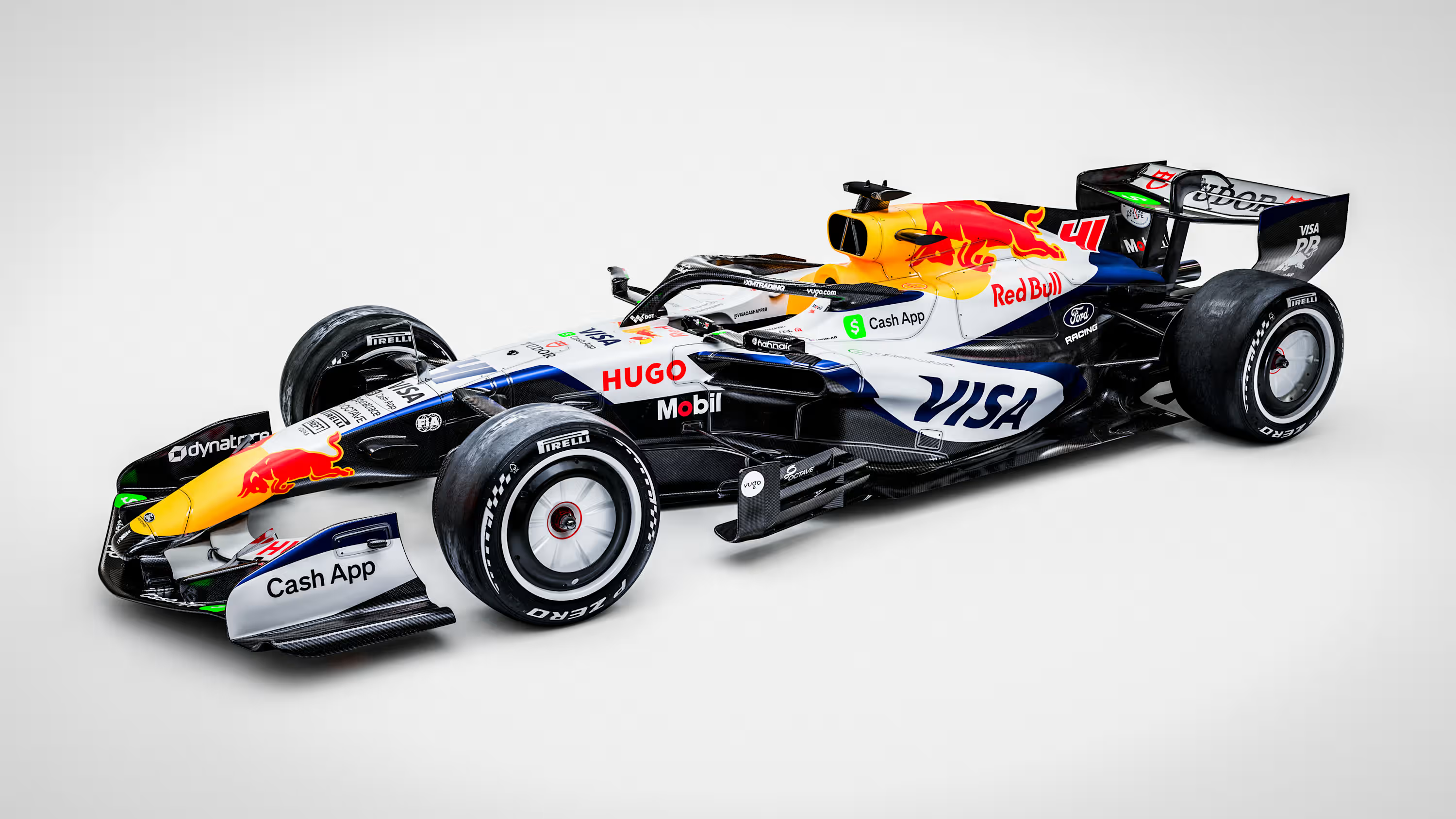
Der Frontflügel ist das erste Teil des Autos, das auf die Luft trifft. Er erzeugt selbst Abtrieb an der Vorderachse und formt die Strömung, die alles dahinter nutzt, vor allem die Verwirbelungen hinter den Vorderreifen. Diese Doppelrolle und seine Bedeutung für die aerodynamische Balance zwischen vorn und hinten sind der Grund, warum die Teams ihn so oft ändern.
Was sich 2026 geändert hat
Der Frontflügel von 2026 ist schmaler (laut FIA um 100mm) und einfacher, und er ist jetzt Teil der aktiven Aerodynamik: Seine Flaps wechseln zwischen einem Kurvenmodus (Corner Mode) mit viel Abtrieb und einem Geradenmodus (Straight Mode) mit weniger Luftwiderstand, gesteuert vom FIA-Standard-ECU und nur in festgelegten Aktivierungszonen erlaubt. Fällt das System aus, müssen die Flaps in den Kurvenmodus zurückkehren. Ziel der FIA waren weniger Luftwiderstand und weniger Outwash verwirbelter Luft, damit die Autos einander dichter folgen können.
Technisches Reglement der FIAAbschnitt C · Art. C3.10.1Ausgabe 21 · 2026-10-19
C3.10.1 · Front Wing Profiles
Hervorgehoben: der Raum, den das Reglement für diesen Bereich erlaubt (FIA-Anhang C2). Zum Drehen ziehen. RV-FW-PROFILES · RV-FW-STRAKE · RV-FW-PYLON · RV-FW-SM-CL-FAIRING · RV-FW-SM-MID
Einfach erklärt
Regelt die Elemente des Frontflügels. Sie müssen in RV-FW-PROFILES passen (den 3D-Raum, in den sie passen müssen), mit höchstens drei getrennten Elementen und Schlitzabständen von 5 bis 15 mm dazwischen. Für jeden Abschnitt gelten strenge Form- und Krümmungsregeln, und an der Hinterkante des hintersten Elements darf ein Gurney (eine kleine Abrisskante) von bis zu 10 mm Höhe angebracht werden.
“” is exempt from C3.2.4 (b) but must:
a. lie in its entirety within RV-FW-PROFILES.
b. comprise of up to three, non-intersecting, simply connected volumes.
c. have up to three sections in any .
d. when viewed from above, fully obscure RS-FW-PROFILES.
In any Y-Plane:
e. the rearmost point of every section must be visible when viewed from below.
f. except for the rearmost section, the rearmost point of every section must not be visible when viewed from above.
g. assessing each section independently, within 40mm of the rearmost point of each section:
i. a line tangent to any part of the section visible from below must have a positive slope. The slope of this line will be considered in the Y-Plane.
ii. no part of the section visible from above may be more than 10mm distant from the section visible from below, if outboard of Y = 400, or 15mm if inboard of Y = 400.
h. contain:
i. no concave radius of curvature visible from below.
ii. no concave radius of curvature less than 50mm visible from above.
Furthermore:
i. when measured against a vertical plane normal to RS-FW-SECTION, contain no normal to any point on the surface that subtends an angle greater than 30°. For volumes thicker than 0.5mm in their entirety (measured normal to the surface on any Y-Plane), compliance with this Article may be determined prior to application of any necessary to demonstrate compliance with C3.3.1 (a).
j. compliance with (i) is not required for surfaces that lie exactly on or Y = 675.
k. At all points along the span, the minimum distance between adjacent Front Wing Profiles volumes must be between 5mm and 15mm when measured with a spherical gauge.
l. The rearmost point of every individual Y-section, when projected in Z onto a plane through , must produce a single tangent continuous curve with no radius of curvature less than 200mm.
Once the Front Wing Profiles bodywork is fully defined, up to 10mm in height may be fitted to the trailing edge of the upper surface of the rearmost section. These Gurneys are considered to be part of the Front Wing Profiles and must satisfy the provisions of this Article except for (g) and (h) and, for the inner extremity of the innermost Gurney and outer extremity of the outermost Gurney, (i).
C3.10.10 · Front Wing Adjuster SystemVerwandte Artikel
Einfach erklärt
Definiert den beweglichen Frontflügel. Ein primärer und ein sekundärer Flap drehen sich um feste Achsen. Gesteuert vom FIA-ECU wechseln sie innerhalb von 400 ms zwischen zwei festen Stellungen, dem Kurvenmodus (Corner Mode) und einem flacher angestellten Geradenmodus (Straight Mode), mit bis zu zwei Aktuatoren mit Positionssensoren. Der Geradenmodus ist nur im Stand oder in einer Aktivierungszone erlaubt, und bei einem Defekt kehrt der Flügel in den Kurvenmodus zurück.
The “” is defined as follows:
a. “FW Primary Flap”, if fitted, must:
i. be a continuous portion of , excluding the forwardmost volume.
ii. rotate about the “Primary Axis”, which must pass through Point A and Point B and be fixed relative to the forwardmost volume of Front Wing Profiles.
b. “”, if fitted, must:
i. be a continuous portion of only the rearmost volume of Front Wing Profiles.
ii. rotate about the “”, which must pass through Point C and Point D and be fixed relative to either the Primary Flap if fitted, or the forwardmost volume of Front Wing Profiles.
c. Both FW Primary Flap and FW Secondary Flap must include any fitted and any parts of Front Wing Auxiliary Components that are rigidly attached to the respective volumes.
d. “Point A” and ”Point B” must lie:
i. within the volume of FW Primary Flap.
ii. no more than 25mm from the forwardmost point of FW Primary Flap at their respective Y positions.
e. “Point C” and ”Point D” must lie:
i. within the volume of FW Secondary Flap.
ii. no more than 25mm from the forwardmost point of FW Secondary Flap at their respective Y positions.
f. Point A and Point C must lie inboard of Y = 150.
g. Point B and Point D must lie between Y = 475 and Y = 675.
With Front Wing Profiles positioned to comply with Article C3.10.1, up to two pairs of rotation surfaces (four in total) must be defined as follows:
h. “Primary Rotation Surfaces”, which must:
i. use the Primary Axis as their axis of revolution.
ii. pass through Point A for the first surface and Point B for the second surface.
iii. extend over the complete chord of FW Primary Flap.
i. “Secondary Rotation Surfaces”, which must:
i. use the Secondary Axis as their axis of revolution.
ii. pass through Point C for the third surface and Point D for the fourth surface.
iii. extend over the complete chord of FW Secondary Flap.
j. Over their intersection with the FW Primary and Secondary Flaps at their original design position (defined in accordance with Article C3.10.1), no surface of rotation may have a normal which forms an angle greater than 30 degrees to the Y-Axis.
Compared to the position of Front Wing Profiles defined in Article C3.10.1, adjustment not controlled by the is only allowed when the car is stationary and by the use of a tool, and in accordance with the Sporting Regulation and must:
k. not result in a decrease in incidence of the tangent lines defined in Article C3.10.1 (g) (i).
l. result in a maximum deviation for any point of Front Wing Profiles no greater than:
i. 30mm for FW Primary Flap.
ii. 60mm for FW Secondary Flap.
Any adjustment of Front Wing Profiles controlled by the FIA Standard ECU must:
m. be about one of the Primary Axis or Secondary Axis only.
n. when commanded, switch to one of two fixed positions defined as follows:
i. a “” position, that conforms to a position defined in (k) and that remains identical following any operation to its position beforehand.
ii. a “Straight Mode” position that, when compared to the Corner Mode position, results in a decrease in incidence of FW Primary Flap and/or FW Secondary Flap. Furthermore, except when limited by a physical stop defined in (u), the magnitude of decrease must remain constant.
o. have a maximum transition time between the two fixed positions that does not exceed 400ms, measured from the instant at which the command to change mode is issued by the FIA Standard ECU until the position sensor(s), connected to the FIA Standard ECU, confirm that the commanded fixed position has been reached.
p. be driven by up to two actuators, across both sides of the car.
q. be measured by position sensors, one for each of the actuators defined in (p), which:
i. are mechanically linked to Front Wing Profiles.
ii. output analogue signals calibrated over the actuator travel.
iii. are connected to the FIA Standard ECU as specified by the FIA.
r. be symmetrical about .
Furthermore:
s. Irrespective of whether the adjustment is controlled by the FIA Standard ECU, any fitted FW Primary Flap and FW Secondary Flap must:
i. except for Front Wing Fishplates, Front Wing Adjuster Fairing and any fitted Gurneys, remain in their entirety within RV-FW-PROFILES.
ii. retain the geometric relationship between all elements of FW Primary Flap, except when adjusting about the Secondary Axis only.
iii. retain the geometric relationship between all elements of FW Secondary Flap.
iv. conform with all bodywork regulations except for Article C3.2.4 (b), Article C3.10.11 (g) (i) and sub-clauses (b) to (l) of Article C3.10.1.
t. Except for a failure of the Front Wing Adjuster System, or during the transition between Corner Mode and Straight Mode, FW Primary Flap and FW Secondary Flap can only have the two positions defined in (n).
u. Physical Stops must be provided to prevent both FW Primary Flap and FW Secondary Flap from being rotated external to RV-FW-PROFILES.
v. The design is such that failure of the system will result in it returning to its Corner Mode position.
w. FW Primary Flap and FW Secondary Flap may only be in a when the car is stationary or fully inside an as defined by Article B7.1.1 (d).
Fasst Frontflügelelemente, Endplatte, Pylon und optionalen Strake zur Front Wing Assembly zusammen. Überstehende Reste werden zuvor entfernt, Übergangsradien bis 10 mm sind erlaubt. Sie muss ein einziges Volumen sein, der Pylon muss von unten verdeckt sein, und jeder Strake mehr als 715 mm vor der Vorderachslinie muss von oben verdeckt sein.
“Front Wing Assembly” results from the of the following components:
a. .
b. Front Wing Endplate.
c. Front Wing Pylon.
d. Front Wing Strake, if fitted.
Before trimming is applied, any Front Wing Profiles remaining outboard of Front Wing Endplate and any Front Wing Pylon remaining below Front Wing Profiles must be discarded.
A , no greater than 10mm, may be applied along the intersections between the remaining component parts.
Once fully defined, Front Wing Assembly must:
e. be a single volume, with no overlapping regions.
f. when viewed from below, fully obscure Front Wing Pylon.
g. when viewed from above, fully obscure Front Wing Strake forward of = −715, if fitted.
Für dieses Bauteil wurden bis zum gewählten Event keine Änderungen erfasst.
Bauteil 02 / 22
Frontflügel-Endplatte
Warum Teams das entwickeln
Die Endplatten schließen die äußeren Enden des Frontflügels ab und bestimmen, wie die Luft nahe den Vorderreifen geführt wird. Sie sind ein zentrales Werkzeug, um die Verwirbelungen der Vorderreifen zu steuern, die sich auf Unterboden, Seitenkästen und Heck des Autos auswirken.
Was sich 2026 geändert hat
Mit dem schmaleren Frontflügel ist die Endplatte 2026 als Kombination aus Endplattenkörper, äußerer und innerer Fußplatte und optionaler Diveplane definiert, jeweils in einem eigenen Referenzvolumen. Auch die Absicht der Regeln hat sich geändert: Laut formula1.com sollen die neuen Frontflügel und Unterboden-Leitbleche verhindern, dass Luft um die Vorderräder nach außen gedrückt wird, denn das erzeugt Turbulenzen für das nachfolgende Auto.
Technisches Reglement der FIAAbschnitt C · Art. C3.10.6Ausgabe 21 · 2026-10-19
C3.10.6 · Front Wing Endplate
Hervorgehoben: der Raum, den das Reglement für diesen Bereich erlaubt (FIA-Anhang C2). Zum Drehen ziehen. RV-FWEP-BODY · RV-FWEP-OFP · RV-FWEP-IFP · RV-FWEP-DIVEPLANE
Einfach erklärt
Die Frontflügel-Endplatte besteht aus Endplattenkörper, beiden Fußplatten und der optionalen Diveplane, miteinander verschmolzen, mit Übergangsradien bis 40 mm zwischen Körper und Diveplane und 10 mm an anderen Stellen. Sie muss ein einziges Volumen sein, von der Seite gesehen mindestens 10 mm dick, und die Referenzflächen RS-FWEP-TOP und RS-FWEP-SIDE abdecken.
“Front Wing Endplate” results from the of the following components:
a. Front Wing Endplate Body.
b. Front Wing Outboard Footplate.
c. Front Wing Inboard Footplate.
d. Front Wing Endplate Diveplane, if fitted.
Before trimming, any Front Wing Endplate Body remaining below Front Wing Inboard Footplate must be discarded.
A , no greater than 40mm, may be applied along the intersections between Front Wing Endplate Body and Front Wing Diveplane. A Fillet Radius, no greater than 10mm, may be applied along the intersections between the remaining component parts.
Once fully defined, Front Wing Endplate must:
e. be a single, simply connected volume, with no overlapping regions.
f. be no less than 10mm thick (being the minimum distance when measured normal to the surface), if visible from the side.
g. when viewed from above, fully obscure RS-FWEP-TOP:
h. when viewed parallel to the Y-Axis from inboard, fully obscure RS-FWEP-SIDE and Front Wing Endplate Diveplane.
C3.10.2 · Front Wing Endplate BodyVerwandte Artikel
Einfach erklärt
Der Front Wing Endplate Body muss in RV-FWEP-BODY passen (den 3D-Raum, in den er passen muss), mit bis zu zwei Abschnitten in jedem senkrechten Längsschnitt. Konvexe Krümmungen müssen mindestens 5 mm, konkave mindestens 100 mm Radius haben.
“Front Wing Endplate Body” must:
a. lie in its entirety within RV-FWEP-BODY.
b. have up to two sections in any .
Front Wing Endplate Body must contain:
c. no convex radius of curvature less than 5mm.
d. no concave radius of curvature less than 100mm.
C3.10.3 · Front Wing Outboard FootplateVerwandte Artikel
Einfach erklärt
Die äußere Fußplatte des Frontflügels muss in RV-FWEP-OFP passen (den 3D-Raum, in den sie passen muss), mit bis zu zwei Abschnitten in horizontalen Schnitten unter 160 mm Höhe und in weiter hinten liegenden Querschnitten. Keine Krümmung darf enger als 5 mm sein, und konkave Krümmungen, die von unten sichtbar sind oder mehr als 825 mm von der Mittellinie entfernt liegen, müssen mindestens 50 mm haben.
“Front Wing Outboard Footplate” must:
a. lie in its entirety within RV-FWEP-OFP.
b. below Z = 160, have up to two sections in any Z-Plane.
c. rearwards of = −425, have up to two sections in any .
Front Wing Outboard Footplate must contain:
d. no radius of curvature less than 5mm.
e. no concave radius of curvature less than 50mm visible from below.
f. no concave radius of curvature less than 50mm outboard of Y = 825mm.
C3.10.5 · Front Wing Endplate DiveplaneVerwandte Artikel
Einfach erklärt
Die optionale Diveplane an der Frontflügel-Endplatte muss sowohl in einen Quader von 300 x 325 x 50 mm als auch in RV-FWEP-DIVEPLANE passen (den 3D-Raum, in den sie passen muss). Konvexe Krümmungen müssen mindestens 5 mm, konkave mindestens 50 mm Radius haben.
“Front Wing Endplate Diveplane” must:
a. lie in its entirety within:
i. an axis aligned cuboid of the following dimensions [X, Y, Z] = [300, 325, 50].
ii. RV-FWEP-DIVEPLANE.
Front Wing Endplate Diveplane must contain:
b. no convex radius of curvature less than 5mm.
c. no concave radius of curvature less than 50mm.
Für dieses Bauteil wurden bis zum gewählten Event keine Änderungen erfasst.
Bauteil 03 / 22
Nase
Warum Teams das entwickeln
Die Nase trägt den Frontflügel und enthält die vordere Crashstruktur. Ihre Form bestimmt außerdem, wie viel Luft unter ihr hindurch zum Unterboden strömt, sodass schon kleine Änderungen an Breite und Unterseite das ganze Auto beeinflussen können.
Was sich 2026 geändert hat
Die wichtigste Änderung für 2026 betrifft die Sicherheit: Die FIA führte eine zweistufige Frontcrashstruktur ein, damit die Nase bei einem ersten Aufprall seltener abbricht und das Auto bei einem zweiten nicht ungeschützt bleibt. Die Nase muss in ihrem Referenzvolumen bleiben und Krümmungsregeln einhalten, die ihre Seiten glatt halten.
Technisches Reglement der FIAAbschnitt C · Art. C3.7.1Ausgabe 21 · 2026-10-19
C3.7.1 · Nose
Hervorgehoben: der Raum, den das Reglement für diesen Bereich erlaubt (FIA-Anhang C2). Zum Drehen ziehen. RV-NOSE · RV-CAMERA-2
Einfach erklärt
Die Nase muss in RV-NOSE passen (den 3D-Raum, in den sie passen muss) und von oben gesehen RS-NOSE vor der Linie X_A = 0 abdecken. Ihre Flächen müssen glatt sein, ohne konkave (hohle) Krümmungen in irgendeinem Querschnitt und mit Mindestradien in der Draufsicht von 45 mm und 20 mm. Kameras in Position 2 und bestimmte Befestigungshalter sind ausgenommen.
“Nose” must:
a. lie in its entirety within RV-NOSE.
b. when viewed from above, fully obscure RS-NOSE ahead of = 0.
Nose , must be Tangent Continuous, and in any must:
c. contain no concave radius of curvature.
d. between = −950 and XA = 0, have a section that when viewed from above:
i. is tangent to the Z-Axis at its outermost extremity.
ii. contains no radius of curvature less than 45mm at XA = 0.
iii. contains no radius of curvature less than 20mm forward of XA = 0.
Furthermore, the following will be exempt from the above:
e. Cameras in Position 2.
f. Mounting brackets defined in Article C8.16.7.
Für dieses Bauteil wurden bis zum gewählten Event keine Änderungen erfasst.
Bauteil 04 / 22
Vorderradaufhängung
Warum Teams das entwickeln
Die Vorderradaufhängung steuert, wie die Vorderreifen beim Bremsen, in Kurven und über Bodenwellen Kontakt zur Strecke halten, und sie hält das Auto auf einer stabilen Fahrhöhe, damit der Unterboden arbeiten kann. Ihre Querlenker liegen direkt im Luftstrom, deshalb formen die Teams auch die Verkleidungen und platzieren die Lenker aus aerodynamischen Gründen.
Was sich 2026 geändert hat
Jedes Rad muss weiterhin über sechs Aufhängungselemente angebunden sein, mit abgedichteten Verkleidungen, durch die keine Luft strömt. Der Text von 2026 legt außerdem einige Layoutregeln fest, etwa die Abstände der vorderen Querlenkerbefestigungen. Erklärtes Ziel der FIA für den neuen Unterboden war, die Abhängigkeit von sehr steifen, sehr tiefen Abstimmungen zu verringern, was verändert, was die Teams von ihrer Aufhängung verlangen.
Technisches Reglement der FIAAbschnitt C · Art. C10.3Ausgabe 21 · 2026-10-19
C10.3 · Outboard suspension
Die gezeigte Form (gestrichelte Kanten) ist nur ein Anhaltspunkt: von PITWALL gezeichnet, um die Lage der Teile zu zeigen, keine Reglementgrenze.
Einfach erklärt
Bei fixierter Lenkung darf die Lage jedes Rads nur vom senkrechten Federweg abhängen, und der Sturz darf sich über 10 mm Federweg um höchstens 1 Grad ändern. Jeder Radträger braucht genau sechs Aufhängungselemente, an jedem Vorderrad eines davon mit der Lenkung verbunden, mit Anlenkpunkten innerhalb der Radtrommel und besonderen Abstandsregeln vorn.
C10.3.1 With the steering wheel rotation fixed, the position of each wheel centre and the orientation of its rotation axis must be completely and uniquely defined by a function of its principally vertical suspension travel, save only for the effects of reasonable compliance which does not intentionally provide further degrees of freedom.
Additionally, the angle subtended between the normal projection of the Z axis onto the =0 plane and the Z axis must not vary by more than 1 degree over 10mm of suspension travel with the steering wheel rotation fixed. Compliance must be demonstrated by CAD, using camber values of −3 degrees front and −1 degree rear.
C10.3.2 There must be six suspension members connecting each suspension upright to the .
Redundant suspension members are not permitted.
On the front axle, one suspension member per wheel must be connected to the steering system.
C10.3.3 Suspension members having shared attachment points will be considered by a virtual dissection into discrete members.
C10.3.4 The outboard attachment points of each suspension member (defined as the kinematic centre of rotation of the joint that allows relative rotation between a suspension member and its adjoining upright) must lie:
a. outboard of YW =0.
b. Above ZW = −100 for the front axle and above ZW = −40 for the rear axle.
c. Inside the Drum defined in Article C3.14.2.
Exceptionally, the outboard attachment point of a suspension member connected inboard, to the rockers defined in Article C10.4.1 and outboard, directly to another suspension member, may not satisfy the provisions of this Article, but must in any case:
d. lie outboard of YW =50.
e. be no more than 25mm from the load line of the suspension member it is attaching to.
f. together with the inboard attachment point of the same suspension member, lie on the same side of the suspension member it is attaching to when viewed from the front.
C10.3.5 On the front axle only, considering the six suspension members connected to an upright, but excluding the members connected inboard to the steering system or the rockers defined in Article C10.4.1, they must form 2 independent pairs of members each with their inboard attachment points separated in X by no less than 300mm and above Z=250mm. Furthermore to form a pair, each suspension member must also be accompanied by the suspension member with the closest outboard attachment point in Z .
C3.17 · Suspension and Driveshaft FairingsVerwandte Artikel
Einfach erklärt
An jedem Aufhängungselement müssen Verkleidungen angebracht sein, außer an solchen mit rundem Querschnitt. Außerdem müssen sie innen abgedichtet sein, sodass keine Luft durch sie hindurchströmen kann.
C3.17.1 “Suspension Fairings” must be fitted to all suspension members defined in Article C10.3.6, except for those of circular cross section. Furthermore, Suspension Fairings must be internally sealed to prevent any internal airflow.
Für dieses Bauteil wurden bis zum gewählten Event keine Änderungen erfasst.
Bauteil 05 / 22
Vordere Bremsbelüftung
Warum Teams das entwickeln
Die vordere Bremsbelüftung führt Kühlluft zu Bremsen und Rad und lässt die Wärme wieder hinaus. Weil sie direkt neben dem Vorderreifen sitzt, werden ihre Scoops und Deflektoren auch genutzt, um die Verwirbelungen des Reifens zu lenken. Sie wird daher sowohl für die Kühlung als auch für die Aerodynamik entwickelt.
Was sich 2026 geändert hat
2026 gilt die Bremsbelüftung als Radkarosserie: eine Trommel mit vorgeschriebener Form, ein Einlass-Scoop sowie vordere und hintere Deflektoren, jeweils auf ein festes Volumen begrenzt und im eigenen Koordinatensystem des Rads vermessen. Laut FIA ist ein Teil der Radkarosserie vorgeschrieben, um die Verwirbelungen hinter den Rädern zu verbessern, im Sinne ihres Ziels engerer Rennen.
Technisches Reglement der FIAAbschnitt C · Art. C3.14.2Ausgabe 21 · 2026-10-19
C3.14.2 · Drum
Bremsbelüftungen sind als Radkomponenten geregelt: Trommel, Scoop und Trommel-Leitbleche.
Die gezeigte Form (gestrichelte Kanten) ist nur ein Anhaltspunkt: von PITWALL gezeichnet, um die Lage der Teile zu zeigen, keine Reglementgrenze.
Einfach erklärt
Die Trommeln an Vorder- und Hinterrad müssen nach festen Formen gebaut werden, die die Referenzflächen RS-FWH-DRUM und RS-RWH-DRUM vorgeben. Jede braucht eine durchgehende aerodynamische Dichtung über 360 Grad zwischen Trommel und Achse, und zwischen Trommel und Felge dürfen flexible Dichtungen sitzen.
“Front Drum” and ”Rear Drum” , the latter being exempt from Article C3.2.4 (b), must:
a. be made to the geometry defined by RS-FWH-DRUM and RS-RWH-DRUM respectively.
Furthermore:
b. Drum Bodywork must be fitted with an , in the outboard of the two annotated volumes, between the Drum and the axle. This Aerodynamic Seal must be circumferential, continuous (around an arc of 360°), concentric about the axis, and uniform.
c. Drum Bodywork may be fitted with a flexible seal or seals, in the inboard of the two annotated volumes, between the Drum and the Wheel Rim.
C3.14.6 · Front Drum Front DeflectorVerwandte Artikel
Einfach erklärt
Der optionale Front Drum Front Deflector muss in einen Quader von 150 x 45 x 25 mm passen, der frei verschoben und um die Achsrichtung des Rads gedreht werden darf und unterhalb von Z_W = 0 bleibt. Er darf aus bis zu zwei getrennten Teilen bestehen, mit zwei Abschnitten pro Schnitt, und muss von innen durch die Front Lip verdeckt sein.
“Front Drum Front Deflector” , if present, must:
a. lie in its entirety:
i. within an axis aligned cuboid of the following dimensions [ , YW , ZW ] = [150, 45, 25], which may be freely translated along any axis, and rotated about the YW axis only.
ii. below ZW = 0.
b. comprise of up to two, non-intersecting, simply connected volumes.
c. have up to two sections in any XW , Y or ZW -Plane.
d. not be visible from inboard with the Front Lip present.
Furthermore,
e. Front Drum Front Deflector Bodywork is optionally fitted and exempt from Article C3.14.1 (b).
C3.14.7 · Front Drum Rear DeflectorVerwandte Artikel
Einfach erklärt
Der Front Drum Rear Deflector besteht aus einer festen Referenzfläche (RS-FWH-RDEF) und einer Vorderkante in RV-FWH-RDEF. Wo er von innen sichtbar ist, darf er höchstens 15 mm dick sein, und seine konkaven Krümmungen müssen mindestens 75 mm (vorderer Teil, von außen gesehen) bzw. 50 mm (hinterer Teil) Radius haben.
“Front Drum Rear Deflector” , which is exempt from Article C3.2.4, results from the of the following components:
a. RS-FWH-RDEF.
b. Deflector Leading Edge, which must:
i. lie in its entirety within RV-FWH-RDEF.
ii. contain no more than a single section in any X and ZW -Plane.
iii. obscure RS-FWH-TOP when viewed from inboard.
Front Drum Rear Deflector Bodywork must:
c. be no more than 15mm thick (being the minimum distance when measured normal to the surface), if visible from inboard.
Furthermore:
d. Compliance with (c) is not required within 5mm of the side-view boundary of Front Drum Rear Deflector when viewed from inboard.
Front Drum Rear Deflector must:
e. in any -Plane forward of XW = 150, contain no concave radius of curvature:
i. less than 75mm visible from outboard.
ii. visible from inboard.
f. in any XW -Plane rearward of XW = 150, contain no concave radius of curvature less than 50mm.
Die Scoops an Vorder- und Hinterrad müssen in RV-FWH-SCO bzw. RV-RWH-SCO passen (die 3D-Räume, in die sie passen müssen). Ihre Flächen müssen von innen vollständig sichtbar sein und dürfen nicht enger als mit 20 mm Radius gekrümmt sein, außer beim Abschnitt des hinteren Scoops hinter X_W = 0 im eigenen Koordinatensystem des Rads.
The “Front Scoop” and ”Rear Scoop” must:
a. lie in their entirety within RV-FWH-SCO and RV-RWH-SCO respectively.
Furthermore, Rear Scoop Bodywork rearwards of = 0:
b. is exempt from Article C3.2.4 (b).
Scoop must:
c. be fully visible from inboard.
d. contain no radius of curvature less than 20mm, except for regions of the Rear Scoop rearwards of XW = 0.
Für dieses Bauteil wurden bis zum gewählten Event keine Änderungen erfasst.
Bauteil 06 / 22
Vorderräder
Warum Teams das entwickeln
Räder und Reifen sind die einzige Verbindung des Autos zur Strecke. Die Felgen sind streng geregelt, aber wie die Luft um das Rad und durch es hindurch strömt, beeinflusst Luftwiderstand, Bremstemperaturen und die Verwirbelungen, mit denen der Rest des Autos zurechtkommen muss.
Was sich 2026 geändert hat
Die 2022 eingeführten 18-Zoll-Räder bleiben, aber die Reifen werden schmaler: laut FIA um 25mm vorn und 30mm hinten. Formula1.com berichtet, dass die Radabdeckungen aus Gewichtsgründen wegfielen, und die FIA strich die kleinen vorderen Radhäuser, die seit 2022 verwendet wurden. Die Felgen müssen aus Magnesiumlegierung bestehen und dürfen keine Elemente enthalten, die die Wärmeübertragung verändern sollen.
Technisches Reglement der FIAAbschnitt C · Art. C10.7.2Ausgabe 21 · 2026-10-19
C10.7.2 · Wheel rim dimensions
Hervorgehoben: der Raum, den das Reglement für diesen Bereich erlaubt (FIA-Anhang C2). Zum Drehen ziehen. TYRE-FRONT
Einfach erklärt
Legt die Felgenmaße fest, darunter einen Felgendurchmesser von 462,5 bis 463 mm und Reifenmontagebreiten von 315 mm vorn und 401,3 mm hinten. Die Felge ist ein einziges Rotationsprofil von mindestens 2,5 mm Dicke, mit begrenzten Bereichen, in denen Material entfernt werden darf. Zwischen ihren inneren und äußeren Hohlräumen darf keine Luft strömen, und linke und rechte Ausführung müssen identisch sein.
a. The Wheel Rim key dimensions are:
Front Wheel Rear Wheel Rim Diameter 462.5 / 463 462.5 / 463 Tyre Mounting Width 315 ± 0.5 401.3 ± 0.5 Lip External Diameter 496 ± 0.5 496 ± 0.5 Overall Width 334 ref. 420.3 ref.
Outboard Lip Thickness 8.5 ± 0.2 8.5 ± 0.2 Inboard Lip Thickness 10.5 ± 0.2 10.5 ± 0.2
b. The Wheel Rim must be a solid of rotation formed by revolving a single profile around the axis of rotation of the Wheel Rim. The profile must be tangent continuous with a minimum radius of curvature of 8mm in the area:
i. more than 80mm from the axis Y .
and
ii. outboard of =−36.
and
iii. inboard of; YW =−302 for the front rim and YW =−388 for the rear rim.
c. Once the revolved solid has been fully defined, material may be :
i. removed between YW =−210 and YW =−392.5 on the rear wheel and between YW =−188 and YW =−319 on the front wheel. Any new surface created must have no concave radius of curvature smaller than 6mm.
ii. removed in areas less than 80mm from the axis Y .
iii. added or removed to form features for mounting the inflation valve and TPMS sensors.
iv. removed on the outer flanges, between a radius of 238mm and a radius of 246mm from the axis Y and up to 1mm deep for wheel branding, logo, or part numbers.
v. added or removed to form features for mounting the disc described in Article C10.7.5 or closing panel described in C10.7.2.e.
d. No part of the front or rear Wheel Rim may lie within RV−F−RIM−MIN or RV−R−RIM−MIN respectively.
e. There must be no passage for air between the inboard and outboard cavities of the Wheel Rim.
Any closing panel may either be integrated into the rim or may be a separate piece. All separate closing panels must respect clauses (d), (j), and (k) of this Article. Closing panels which are not required to prevent airflow between the inner and outer cavities are not permitted.
f. The minimum Wheel Rim thickness is 2.5mm.
g. The minimum bead thickness is 4.0mm (measured from hump to outer edge of the lip).
h. The ETRTO standard bead profile is prescribed.
i. The design of the wheel must meet the general requirements of the tyre supplier for the mounting and dismounting of tyres including allowance for sensors and valves.
j. The Wheel Rim design cannot be handed between left and right designs.
k. Features intended to influence the heat transfer characteristics of the Wheel Rim are not permitted. F1 Teams are required to submit designs to the FIA for approval.
l. Design guidelines for the Wheel Rims are set out in FIA-F1-DOC-021. Any deviation from the guidelines must be agreed with the Tyre Supplier.
Der Reifenlieferant legt die Reifenspezifikationen gemeinsam mit der FIA fest, nach dem Zeitplan im FIA-Dokument FIA-F1-DOC-057. Danach dürfen sie nur mit Zustimmung der Formel-1-Kommission geändert werden; die FIA darf sie jedoch während der Saison aus Sicherheitsgründen ohne Vorankündigung ändern.
Tyre specifications will be determined by the tyre supplier, in agreement with the FIA, data will be divided into data blocks as defined in the document FIA-F1-DOC-057 and according to the timetable given in that document.
Once determined in this way, the specification of the tyres will not be changed without the agreement of the Formula One Commission.
Notwithstanding the above, the FIA may decide to change the specification during the Championship season for safety reasons without notice or delay.
Für dieses Bauteil wurden bis zum gewählten Event keine Änderungen erfasst.
Bauteil 07 / 22
Spiegel
Warum Teams das entwickeln
Spiegel sind ein Sicherheitsteil, sitzen aber neben dem Cockpit in sauberer, schneller Strömung. Die Teams formen die Spiegelgehäuse und ihre Streben so, dass sie die Luft möglichst wenig stören oder sie sogar zu den Seitenkästen leiten.
Was sich 2026 geändert hat
Die Spiegelfläche hat weiterhin eine feste Größe und muss dem Fahrer Sicht nach hinten und zu beiden Seiten geben. Neu für 2026 muss der Spiegelkörper eine seitliche Sicherheitsleuchte umschließen, die laut FIA den ERS-Status des Autos anzeigt, wenn es auf der Strecke stehen bleibt, damit die Streckenposten wissen, ob sie sich gefahrlos nähern können.
Technisches Reglement der FIAAbschnitt C · Art. C3.7.5Ausgabe 21 · 2026-10-19
C3.7.5 · Mirror
Hervorgehoben: der Raum, den das Reglement für diesen Bereich erlaubt (FIA-Anhang C2). Zum Drehen ziehen. RV-MIRROR-BODY · RV-MIRROR-ISTAY · RV-MIRROR-RSTAY
Einfach erklärt
Definiert die Spiegelkarosserie. Der Spiegelkörper muss in RV-MIRROR-BODY passen und eine seitliche Sicherheitsleuchte umschließen, die frei verschoben und um bis zu 5 Grad gedreht werden darf. Eine innere Strebe verbindet ihn mit dem Chassis, eine hintere Strebe (unter 50 mm hoch und 10 mm breit) mit dem Seitenkasten; zusammen müssen sie ein Volumen bilden, mit Übergangsradien bis 10 mm.
“Mirror Body” must:
a. lie in its entirety within RV-MIRROR-BODY.
b. fully enclose an individual instance of RV-LATERAL-SAFETY-LIGHT which may be freely translated along any axis, and rotated up to +/-5deg about any Z-axis only.
c. have an external surface coincident with the highlighted surface of RV-LATERAL-SAFETY- LIGHT.
“Mirror Inner Stay” Bodywork must:
d. lie in its entirety within RV-MIRROR-ISTAY.
e. intersect Mirror Body and Mid Chassis.
“Mirror Rear Stay” bodywork must:
f. lie in its entirety within RV-MIRROR-RSTAY.
g. intersect Mirror Body and Sidepod.
h. in any , measure less than:
i. 50mm in Z.
ii. 10mm in Y.
“Mirror” results from the of the following components:
i. Mirror Body.
j. Mirror Inner Stay.
k. Mirror Rear Stay.
A , no greater than 10mm, may be applied along the intersections between the remaining component parts.
Once fully defined, Mirror must:
l. be a single volume with no overlapping regions.
Jedes Auto braucht zwei symmetrische Spiegel, die dem Fahrer Sicht nach hinten und zu beiden Seiten geben. Jede Spiegelfläche liegt in RV-MIRROR-BODY und ist ein Rechteck von 200 x 50 mm (plus bis zu 2 mm), mit Eckradien bis 10 mm, ohne konkave Bereiche und ohne Krümmung enger als 400 mm. Die FIA kann CAD-Daten anfordern und das Spiegelvolumen aus Sicherheitsgründen verschieben.
C14.2.1 All cars must have two mirrors positioned symmetrically about the car’s centre plane and mounted so that the driver has visibility to the rear and both sides of the car.
C14.2.2 The reflective surface of each mirror must satisfy the following conditions:
a. It must be contained within RV−MIRROR−BODY and not be obstructed by the Mirror Body, either towards the driver or in the rearward direction.
b. Its four edges must project orthogonally onto the edges of a vertical rectangle which is 200mm wide and 50mm high (+2mm/−0mm for both dimensions), with a radius of up to 10mm applied to each corner.
c. Over its whole area it must:
i. not contain any concave parts.
ii. be tangency continuous.
iii. not have any normal radius of curvature less than 400mm.
d. When cut by any Z−Plane and before any radius is applied to the corners:
i. the normal to the curve at its inboard end must subtend an angle of between 24deg and 28deg to the X axis, pointing towards the plane.
ii. the angle between normals to the curve at its inboard and outboard ends must be greater than 8 degrees.
For the avoidance of doubt, any non−reflective parts of the mirror must be contained within the Mirror Body.
C14.2.3 F1 Teams will be required on request to supply the FIA with CAD data with regard to the visibility of their mirror arrangement, and the FIA will retain the right to modify the position of the volume defined in Article C3.6.4 (a) should it become apparent that the mirror position does not meet the safety requirements.
Für dieses Bauteil wurden bis zum gewählten Event keine Änderungen erfasst.
Bauteil 08 / 22
Cockpit-Anbauteile
Warum Teams das entwickeln
Dieser Bereich umfasst Oberseite und Flanken der Überlebenszelle, den Überrollbügel über dem Kopf des Fahrers und eine eventuelle Fahrerkühlung. Der Überrollbügel bildet zugleich den Lufteinlass des Motors, und die Karosserie rund um das Cockpit beeinflusst die Luft, die zur Motorabdeckung und zum Heckflügel strömt.
Was sich 2026 geändert hat
Für 2026 erhöhte die FIA die Lasten für den Überrollbügel von 16G auf 20G und verschärfte den seitlichen Eindringschutz, mit mehr als doppelt so viel Schutz neben dem Tank. Der Halo bleibt ein Standardteil, das nach einer FIA-Spezifikation von bestimmten Herstellern gefertigt wird.
Technisches Reglement der FIAAbschnitt C · Art. C12.4.2Ausgabe 21 · 2026-10-19
C12.4.2 · Secondary Roll Structure (Halo)
Teile im Cockpitbereich: der Halo (sekundäre Überrollstruktur) und die Verkleidung des Überrollbügels.
Hervorgehoben: der Raum, den das Reglement für diesen Bereich erlaubt (FIA-Anhang C2). Zum Drehen ziehen. RV-ROLL-HOOP · RV-DRI-COOL · RV-CH-FRONT · RV-CH-MID · RV-CH-FRONT-MIN
Einfach erklärt
Der Halo (Secondary Roll Structure) gehört nicht zur Überlebenszelle. Er muss symmetrisch zur Fahrzeugmittellinie sein, mit der vorderen Befestigungsachse bei X = -975 und Z = 660 und den hinteren Montageflächen bei Z = 695. Gebaut wird er nach FIA-Norm 8869-2018 von einem von der FIA bestimmten Hersteller, und die FIA hält Halos verschiedener Hersteller auf ähnlicher Masse.
The , which is not considered part of the , must be positioned symmetrically about the car centre plane with its front fixing axis at X = −975 and Z=660. The mounting faces for the rearward fixings must lie on the plane Z=695.
The Secondary Roll Structure must be made to standard FIA8869−2018 and supplied by an FIA designated manufacturer. Details of the structure and its mountings may be found in the document FIA-F1-DOC-115.
The FIA will take the appropriate measures to ensure that Secondary Roll Structures supplied by different FIA designated manufacturers are of similar mass.
Die Karosserie des Überrollbügels muss lediglich vollständig im Referenzvolumen RV-ROLL-HOOP liegen (dem 3D-Raum, in den sie passen muss). Sie ist von der allgemeinen Karosserieregel C3.2.4 ausgenommen.
“Roll Hoop” is exempt from Article C3.2.4, but must:
a. lie in its entirety within RV-ROLL-HOOP.
Für dieses Bauteil wurden bis zum gewählten Event keine Änderungen erfasst.
Bauteil 09 / 22
Unterboden-Leitbleche
Warum Teams das entwickeln
Die Unterboden-Leitbleche (Floor Boards) sind die senkrechten Bleche vorn am Unterboden, direkt hinter den Vorderrädern. Ihre Aufgabe ist es, die verwirbelte Luft hinter den Vorderreifen zu kontrollieren und die Luft entlang der Fahrzeugflanke zu Unterboden und Seitenkästen zu führen.
Was sich 2026 geändert hat
Klassische Bargeboards waren ab 2022 verboten. Das Reglement von 2026 bringt Leitbleche in diesem Bereich zurück, die FIA nennt sie aber nach innen leitende Bleche zur Kontrolle der Radverwirbelungen: Sie sollen die Verwirbelungen der Vorderreifen nach innen lenken, statt sie seitlich hinauszuwerfen, wo sie nachfolgende Autos stören. Ihre Form ist auf ein Referenzvolumen begrenzt, mit Vorgaben zu Winkeln und Krümmung.
Technisches Reglement der FIAAbschnitt C · Art. C3.5.5Ausgabe 21 · 2026-10-19
C3.5.5 · Floor Board
Das Reglement 2026 nennt sie Floor Boards; klassische Bargeboards sind seit 2022 verboten.
Hervorgehoben: der Raum, den das Reglement für diesen Bereich erlaubt (FIA-Anhang C2). Zum Drehen ziehen. RV-FLOOR-BOARD · RV-FLOOR-BRACE · RV-FLOOR-FOOT
Einfach erklärt
Das Floor Board muss in RV-FLOOR-BOARD passen (den 3D-Raum, in den es passen muss), mit bis zu drei Abschnitten in jedem Schnitt. Seine von der Seite sichtbaren Flächen mehr als 825 mm hinter der Vorderachslinie müssen nach hinten zeigen und mindestens 15 Grad zur Fahrzeuglängsachse stehen, ohne konkave Krümmung enger als 100 mm, ausgenommen rund um bis zu drei kleine Ausnahmepunkte.
“Floor Board” must:
a. lie in its entirety within RV-FLOOR-BOARD.
b. have up to three sections in any X, Y and .
Floor Board visible from the side must:
c. rearward of = 825, at any point, in any Z-Section have a:
i. normal with a positive X component.
ii. tangent that forms an angle of at least 15 degrees to the X-Axis.
d. contain no concave radius of curvature less than 100mm.
Furthermore:
e. compliance with (c) and (d) is not required within 35mm of up to three points, which must sit forward of XF = 1100 and be no closer than 50mm to each other.
Für dieses Bauteil wurden bis zum gewählten Event keine Änderungen erfasst.
Bauteil 10 / 22
Unterboden-Einlass
Warum Teams das entwickeln
Die Vorderseite des Unterbodens, einschließlich Vorderkante und Bib unter der Nase, bestimmt, wie viel Luft unter das Auto gelangt und wie sauber. Diese Luft kontrolliert in den Unterboden zu führen, ist der Ausgangspunkt für den Abtrieb, den der Unterboden erzeugt.
Was sich 2026 geändert hat
Von 2022 bis 2025 speiste der Unterboden zwei große Venturi-Kanäle (Ground Effect). Das FIA-Reglement von 2026 setzt auf einen teilweise flachen Unterboden mit weniger Ground Effect, sodass der Einlass einen schwächeren Unterboden versorgt. Leading Edge Device und Bib haben jeweils ein eigenes Referenzvolumen und eigene Formvorgaben.
Technisches Reglement der FIAAbschnitt C · Art. C3.5.7Ausgabe 21 · 2026-10-19
C3.5.7 · Floor Leading Edge Device
Hervorgehoben: der Raum, den das Reglement für diesen Bereich erlaubt (FIA-Anhang C2). Zum Drehen ziehen. RV-FLOOR-BIB · RV-FLOOR-LED · RV-BIB-STAY · RV-SLIP
Einfach erklärt
Das Floor Leading Edge Device muss in RV-FLOOR-LED passen (den 3D-Raum, in den es passen muss), mit bis zu fünf Abschnitten in jedem Querschnitt oder horizontalen Schnitt. Oberhalb von 60 mm Höhe muss es mindestens 4 mm dick sein, und seine konvexen Kanten dürfen nicht schärfer als mit 2 mm Radius sein.
“Floor Leading Edge Device” must:
a. lie in its entirety within RV-FLOOR-LED.
b. have up to five sections in any X and .
c. above Z = 60, be no less than 4mm thick when measured normal to Floor Leading Edge Device only.
Floor Leading Edge Device Aerodynamic Surfaces above Z = 60 must:
d. contain no convex radius of curvature less than 2mm
Der Floor Bib muss vollständig in RV-FLOOR-BIB liegen (dem 3D-Raum, in den er passen muss), und jede Fläche muss von oben oder von unten sichtbar sein. Von unten gesehen dürfen seine Flächen überhaupt keine konkaven (hohlen) Krümmungen haben, von oben gesehen keine engeren als mit 50 mm Radius.
“Floor Bib” must:
a. lie in its entirety within RV-FLOOR-BIB.
b. be fully visible from either above or below, such that any surface obscured from one direction is visible from the other.
Floor Bib must:
c. contain no concave radius of curvature:
i. visible from below.
ii. less than 50mm, if visible from above.
Für dieses Bauteil wurden bis zum gewählten Event keine Änderungen erfasst.
Bauteil 11 / 22
Unterboden
Warum Teams das entwickeln
Der Unterboden ist die größte aerodynamische Fläche des Autos und erzeugt einen großen Teil seines Abtriebs. Unter dem Auto beschleunigte Luft erzeugt Unterdruck, der das Auto nach unten zieht. Deshalb gestalten die Teams den Unterboden die ganze Saison über immer wieder neu.
Was sich 2026 geändert hat
Der Unterboden von 2026 ist schmaler und teilweise flach und ersetzt die geformten Venturi-Kanäle von 2022 bis 2025. Ziel der FIA war, den Ground Effect zu verringern und damit auch den Bedarf an sehr steifen, tief liegenden Autos, die zu Bouncing und Porpoising führten. Der Floor Body muss außerdem das Diffusorvolumen abdecken, der Diffusor wird also jetzt als Teil des Unterbodens geregelt.
Technisches Reglement der FIAAbschnitt C · Art. C3.5.1Ausgabe 21 · 2026-10-19
C3.5.1 · Floor Body
Hervorgehoben: der Raum, den das Reglement für diesen Bereich erlaubt (FIA-Anhang C2). Zum Drehen ziehen. RV-FLOOR-BODY · RV-PLANK
Einfach erklärt
Der Floor Body ist das Hauptteil des Unterbodens. Er muss vollständig in RV-FLOOR-BODY liegen (dem 3D-Raum, in den das Teil passen muss) und von unten gesehen das Motorvolumen RV-PU-ICE sowie das Volumen RV-DIFF komplett abdecken. Jeder horizontale Schnitt durch ihn darf höchstens zwei getrennte Abschnitte zeigen.
“Floor Body” must:
a. lie in its entirety within RV-FLOOR-BODY.
b. when viewed from below, fully obscure:
i. RV-PU-ICE
ii. RV-DIFF.
c. have up to two sections in any .
Der Main Floor besteht aus Floor Body, Floor Foot und Floor Sidewall, verschmolzen zu einem einzigen massiven Teil mit Übergangsradien bis 30 mm. Jede Fläche muss von oben oder unten sichtbar sein, und von der Seite gesehen muss er RS-FLOOR-SIDEWALL abdecken. Seine Flächen dürfen nicht enger als mit 25 mm Radius gekrümmt sein, außer in einigen kleinen, aufgelisteten Zonen.
“” results from the of the following components:
a. Floor Body.
b. Floor Foot.
c. Floor Sidewall.
A , no greater than 30 mm, may be applied along the intersections between the remaining component parts.
Once fully defined, Main Floor must:
d. be a single, simply connected volume, with no overlapping regions.
e. be fully visible from either above or below, such that any surface obscured from one direction is visible from the other.
f. when viewed from the side, fully obscure RS-FLOOR-SIDEWALL.
Main Floor must:
g. contain no radius of curvature less than 25mm, except for regions:
i. within 5mm of the plan-view-boundary of Main Floor, when viewed from above or below.
ii. within 45mm of a single point that lies in RV-FLOOR-SPHERE.
iii. of convex curvature, visible from above, and within 10mm of the load application points defined in Article C3.18.6.
iv. within 5mm of the Fillet Radii permitted as part of the Main Floor Trim and Combination, where the radius of curvature must be no less than 5mm.
Der Floor Fence muss sowohl in einen Quader von 450 x 40 x 200 mm als auch in RV-FLOOR-FENCE passen (den 3D-Raum, in den er passen muss). Jede Fläche muss von oben oder unten sichtbar sein, mit höchstens zwei Abschnitten in jedem senkrechten Längsschnitt. Auf den letzten 100 mm darf seine Hinterkante nicht mehr als 5 Grad von der Fahrzeuglängsachse abweichen.
“Floor Fence” must:
a. lie in its entirety within:
i. an axis aligned cuboid of the following dimensions [X, Y, Z] = [450, 40, 200]
ii. RV-FLOOR-FENCE.
b. be fully visible from either above or below, such that any surface obscured from one direction is visible from the other.
c. have up to two sections in any .
Furthermore,
d. when considering a section formed by the intersection with any Z-Plane, within 100mm of the rearmost point of the section, a line tangent to any part of the section visible from the side must not form an angle greater than 5 degrees, when measured against the X-axis.
1) Compared to its launch car, Williams’ FW45 gets an updated floor with a new winglet/cutout ahead of the rear tyres to improve load. The geometry of the dive plane of the front wing endplates has been revised. A revised rear wing features new winglet and pillar extensions.…
Inhalte von X werden erst nach einem Klick geladen
Bauteil 12 / 22
Unterbodenkante
Warum Teams das entwickeln
An der Unterbodenkante trifft die Luft unter dem Auto auf die Luft, die an seiner Flanke herabströmt. Die Teams formen die Kante, ihre Seitenwände und kleine Winglets so, dass keine Außenluft unter den Unterboden dringt, damit dessen Unterdruck erhalten bleibt.
Was sich 2026 geändert hat
Der schmalere Unterboden von 2026 rückt seine Kante näher an die Fahrzeugmitte. Das Reglement definiert jetzt eigene Teile für Floor Sidewall, Floor Corner und Floor Winglet, und das Floor Winglet ist Pflicht, mit nur kleinen erlaubten Anpassungen bei Drehung und Höhe. Wie beim übrigen Unterboden ist das Ziel eine geringere Abhängigkeit vom Ground Effect.
Technisches Reglement der FIAAbschnitt C · Art. C3.5.3Ausgabe 21 · 2026-10-19
C3.5.3 · Floor Sidewall
Hervorgehoben: der Raum, den das Reglement für diesen Bereich erlaubt (FIA-Anhang C2). Zum Drehen ziehen. RV-FLOOR-SIDEWALL · RV-FLOOR-CORNER · RV-FLOOR-FENCE · RV-FLOOR-SPHERE
Einfach erklärt
Regelt die Floor Sidewall, die senkrechte Seitenwand des Unterbodens. Sie muss vollständig in RV-FLOOR-SIDEWALL liegen (dem 3D-Raum, in den sie passen muss). In jedem senkrechten Längsschnitt sind höchstens zwei Abschnitte erlaubt, mehr als 100 mm über der Referenzebene auch in jedem horizontalen Schnitt höchstens zwei.
“Floor Sidewall” must:
a. lie in its entirety within RV-FLOOR-SIDEWALL.
b. have up to two sections in any .
c. above Z = 100, have up to two sections in any Z-Plane.
Die Floor Corner muss vollständig in RV-FLOOR-CORNER liegen (dem 3D-Raum, in den sie passen muss) und ist von der allgemeinen Karosserieregel C3.2.4 ausgenommen. Sie darf bis zu 3 Abschnitte in jedem Querschnitt, bis zu 4 in jedem senkrechten Längsschnitt und bis zu 2 in jedem horizontalen Schnitt haben.
“Floor Corner” is exempt from Article C3.2.4, but must:
a. lie in its entirety within RV-FLOOR-CORNER.
b. have up to 3 sections in any .
c. have up to 4 sections in any Y-Plane.
d. have up to 2 sections in any Z-Plane.
Ein Floor Winglet ist Pflicht. Es besteht aus einer festen Referenzfläche (RS-FLOOR-WINGLET), einem einteiligen Winglet-Profil in RV-FLOOR-WINGLET und einem tragenden Halter, der von unten verdeckt ist. Das fertige Winglet darf um bis zu 5 Grad gedreht und um bis zu 10 mm nach oben oder unten verschoben werden, muss aber in RV-FLOOR-WINGLET-ENVELOPE bleiben.
“Floor Winglet” , which is exempt from Article C3.2.4, must be fitted and results from the of the following components:
a. RS-FLOOR-WINGLET.
b. “Winglet Profile”, which must:
i. lie in its entirety within RV-FLOOR-WINGLET.
ii. contain no more than a single section in any X, Y and .
c. A single Hanger, which must:
i. when viewed from below, be fully obscured by RS-FLOOR-WINGLET.
Furthermore, Winglet Profile must:
d. contain no concave radius of curvature less than 20mm.
Once Trimmed and Combined, Floor Winglet and the annotated surface ‘TRIM-SURFACE’ may only be modified together, and in the following order:
e. Rotated by ±5 Degrees about a Y-aligned axis that passes though the point [X , ZR] = [295, 200]
f. Translated by ±10mm in Z.
Furthermore, Floor Winglet may be:
g. trimmed below the annotated surface ‘TRIM-SURFACE’ in RS-FLOOR-WINGLET.
Once fully defined, Floor Winglet must:
h. have up to two sections in any Z-Plane below the annotated surface ‘TRIM-SURFACE’ in RS- FLOOR-WINGLET.
i. except for C3.5.8(c), lie in its entirety within RV-FLOOR-WINGLET-ENVELOPE.
Für dieses Bauteil wurden bis zum gewählten Event keine Änderungen erfasst.
Bauteil 13 / 22
Seitenkästen
Warum Teams das entwickeln
Die Seitenkästen beherbergen die Kühler und die seitlichen Crashstrukturen. Ihre Einlässe liefern Kühlluft, und ihre Außenform leitet Luft zum Heck des Autos und auf die Oberseite des Unterbodens. Bei ihrer Entwicklung wägen die Teams deshalb Kühlung, Luftwiderstand und Strömung gegeneinander ab.
Was sich 2026 geändert hat
Der Seitenkasten muss weiterhin in einem Referenzvolumen mit Mindestkrümmungen liegen und einen festen Abstand zu den neuen Unterboden-Leitblechen halten. Die neuen Antriebseinheiten und die nach innen leitenden Bleche vor den Seitenkästen verändern Strömung und Kühlbedarf, mit denen die Seitenkästen umgehen müssen. Außerdem verschärfte die FIA den seitlichen Eindringschutz.
Technisches Reglement der FIAAbschnitt C · Art. C3.8.1Ausgabe 21 · 2026-10-19
C3.8.1 · Sidepod
Hervorgehoben: der Raum, den das Reglement für diesen Bereich erlaubt (FIA-Anhang C2). Zum Drehen ziehen. RV-SIDEPOD · RV-PU-ERS
Einfach erklärt
Der Seitenkasten muss in RV-SIDEPOD passen (den 3D-Raum, in den er passen muss) und mehr als 50 mm Abstand zum Floor Board halten. Konvexe Krümmungen müssen mindestens 50 mm, konkave mindestens 100 mm Radius haben; engere Grenzen gelten nahe der seitlichen Crashstruktur (10 mm) und am Seitenkasten-Einlass (5 mm).
“Sidepod” must:
a. lie in its entirety:
i. within RV-SIDEPOD.
ii. more than 50mm from Floor Board.
Sidepod must contain:
b. no convex radius less than 50mm.
c. no concave radius less than 100mm.
Furthermore, compliance with:
d. (b) and (c) is not required within 20mm of the upper Side Impact Structure, where the radius of curvature must not be less than 10mm.
e. (b) is not required within 25mm of the C3.16.9, where the convex radius must not be less than 5mm.
Für dieses Bauteil wurden bis zum gewählten Event keine Änderungen erfasst.
Bauteil 14 / 22
Motorabdeckung
Warum Teams das entwickeln
Die Motorabdeckung umhüllt Antriebseinheit und Getriebe und leitet Luft zum Heckflügel und hinten auf die Oberseite des Unterbodens. Eine engere Abdeckung, oft Coke-Bereich genannt, bedeutet weniger Luftwiderstand und sauberere Strömung zum Heck, lässt aber weniger Platz für die Kühlung.
Was sich 2026 geändert hat
Für 2026 wurde keine große Änderung an der Motorabdeckung angekündigt. Sie muss in ihrem Referenzvolumen mit Mindestkrümmungen bleiben. Die Teams mussten die neuen Antriebseinheiten von 2026, die weit mehr elektrische Leistung nutzen, darunter unterbringen.
Technisches Reglement der FIAAbschnitt C · Art. C3.8.2Ausgabe 21 · 2026-10-19
C3.8.2 · Engine Cover
Hervorgehoben: der Raum, den das Reglement für diesen Bereich erlaubt (FIA-Anhang C2). Zum Drehen ziehen. RV-EC
Einfach erklärt
Die Motorabdeckung muss in RV-EC passen (den 3D-Raum, in den sie passen muss) und von der Seite gesehen RS-EC abdecken. Im Querschnitt müssen konvexe Krümmungen mindestens 75 mm und konkave mindestens 50 mm Radius haben, mit Ausnahmen nahe den seitlichen Crashstrukturen, der CCU-Antenne und der Mittellinie. Mehr als 55 mm vor der Hinterachslinie ist keine ebene, nach vorn gerichtete Fläche erlaubt.
“Engine Cover” must:
a. lie in its entirety within RV-EC.
b. have up to two sections in any Z-Plane.
c. when viewed from the side, fully obscure RS-EC.
Engine Cover , in any outboard of Y = 5, must contain:
d. no convex radius of curvature less than 75mm.
e. no concave radius of curvature less than 50mm.
Furthermore, when considering Aerodynamic Surfaces only:
f. compliance with (d) and (e) is not required:
i. within 20mm of the upper and lower Side Impact Structures, where the radius of curvature, measured independent of direction, must not be less than 10mm.
ii. within 20mm of the CCU Antenna, defined in Article C8.5.4, where the radius of curvature, measured independent of direction, must not be less than 5mm.
iii. inboard of Y = 25, where the radius of curvature, in any X-Plane, must not be less than 25mm.
g. rearward of X = −300 and below ZR = 350, the X component of any normal to the surface visible from the side must not be negative.
h. there must be no surface parallel to an X-Plane ahead of = −55.
1) Compared to its launch car, Williams’ FW45 gets an updated floor with a new winglet/cutout ahead of the rear tyres to improve load. The geometry of the dive plane of the front wing endplates has been revised. A revised rear wing features new winglet and pillar extensions.…
Inhalte von X werden erst nach einem Klick geladen
Bauteil 15 / 22
Kühlschlitze
Warum Teams das entwickeln
Kühlschlitze sind Öffnungen in der Karosserie, durch die heiße Luft aus Seitenkästen und Motorabdeckung entweicht. Mehr davon zu öffnen kühlt die Antriebseinheit besser, kostet aber Luftwiderstand und Abtrieb. Deshalb bringen die Teams verschiedene Varianten für heiße und kühle Rennen mit.
Was sich 2026 geändert hat
Im Text von 2026 werden Kühlschlitze als Öffnungen (Apertures) geregelt: Jede Art von Öffnung darf nur in einem festgelegten Bereich der Karosserie liegen, hat eine Höchstfläche pro Seite, und die Luft darf nur in der angegebenen Richtung ausströmen. Eine große Änderung an den Kühlöffnungen wurde nicht angekündigt; der Hauptunterschied ist der Kühlbedarf der neuen Antriebseinheiten.
Technisches Reglement der FIAAbschnitt C · Art. C3.16Ausgabe 21 · 2026-10-19
C3.16 · Apertures
Kühlschlitze sind als Öffnungen in der Karosserie geregelt.
Hervorgehoben: der Raum, den das Reglement für diesen Bereich erlaubt (FIA-Anhang C2). Zum Drehen ziehen. RV-BW-APERTURE
Einfach erklärt
Öffnungen (Apertures) sind Ausschnitte in der fertigen Karosserie. Jede muss in ein quaderförmiges Referenzvolumen passen, das sich in Grenzen verschieben und drehen lässt, unter einer Höchstfläche pro Seite bleiben, darf keine anderen Öffnungen überlappen und Luft nur in der angegebenen Richtung durchlassen. Die Tabelle beginnt mit einem 750-mm²-Einlass in der Nase, mindestens 1100 mm vor der Vorderachslinie.
Once the Final Assembly and Wheel Assembly have been fully defined, the apertures listed in the following table may be applied. “” shall be interpreted as mathematical surfaces bound by their peripheries and can only be defined after their respective has been translated and rotated. Unless otherwise stated, each aperture may only be applied once, and must:
a. lie in its entirety within the stated Aperture RV. Unless otherwise stated, each individual “Aperture RV”:
i. is an axis aligned cuboid that is bounded by a single internal diagonal extending from [0,0,0] to the stated co-ordinates.
ii. may be freely translated in space.
iii. may be rotated about [0, 0, 0] within the prescribed limits. [X° Limit, Y° Limit, Z° Limit]. Any rotation must be applied before any translation.
All Aperture RVs are referenced to the except for the Wheel Bodywork Aperture RVs which are referenced to the .
b. be a simply connected surface.
c. be fully coincident with the surface of the stated Bodywork component and any permitted or applied to the stated Bodywork component.
d. have a surface area no greater than the stated area, per side of the car.
e. unless otherwise stated, and with only the corresponding Bodywork group and Fillet or Edge Radius defined in (c) present, be fully visible from the given direction , with the Aperture surface assumed to be non-transparent.
f. respect all other stated criteria.
g. not overlap any other Aperture, except for C3.16.15.
h. except for regions of zero or incidental flow, which the FIA may request be demonstrated, only result in flux through the Aperture in the stated direction, when considered relative to the Bodywork. Furthermore, if no direction is stated, the flux direction will not be assessed.
(c) (a.i) / (a.iii) (d) (e) (f) (h) C3.16.1 Nose [15, 40, 20] 750 Front i. Must lie in its entirety forward of Nose [0°, ±10°, 0°] XF = −1100.
Die Hinterradaufhängung steuert, wie die angetriebenen Hinterreifen die Leistung auf die Strecke bringen und wie sich die Fahrhöhe am Heck verändert, was für den Unterboden sehr wichtig ist. Ihre Lenker und Verkleidungen liegen im Luftstrom nahe dem Diffusor, deshalb formen die Teams sie auch aerodynamisch.
Was sich 2026 geändert hat
Die Grundregeln sind dieselben wie vorn: sechs Elemente pro Rad, abgedichtete Verkleidungen und kinematische Grenzen dafür, wie sich das Rad bewegen darf. Das erklärte Ziel der FIA, mit dem neuen Unterboden die Abhängigkeit von steifen, tiefen Abstimmungen zu verringern, verschiebt die Kompromisse, die die Teams bei der Auslegung der Aufhängung eingehen.
Technisches Reglement der FIAAbschnitt C · Art. C10.3Ausgabe 21 · 2026-10-19
C10.3 · Outboard suspension
Die gezeigte Form (gestrichelte Kanten) ist nur ein Anhaltspunkt: von PITWALL gezeichnet, um die Lage der Teile zu zeigen, keine Reglementgrenze.
Einfach erklärt
Bei fixierter Lenkung darf die Lage jedes Rads nur vom senkrechten Federweg abhängen, und der Sturz darf sich über 10 mm Federweg um höchstens 1 Grad ändern. Jeder Radträger braucht genau sechs Aufhängungselemente, an jedem Vorderrad eines davon mit der Lenkung verbunden, mit Anlenkpunkten innerhalb der Radtrommel und besonderen Abstandsregeln vorn.
C10.3.1 With the steering wheel rotation fixed, the position of each wheel centre and the orientation of its rotation axis must be completely and uniquely defined by a function of its principally vertical suspension travel, save only for the effects of reasonable compliance which does not intentionally provide further degrees of freedom.
Additionally, the angle subtended between the normal projection of the Z axis onto the =0 plane and the Z axis must not vary by more than 1 degree over 10mm of suspension travel with the steering wheel rotation fixed. Compliance must be demonstrated by CAD, using camber values of −3 degrees front and −1 degree rear.
C10.3.2 There must be six suspension members connecting each suspension upright to the .
Redundant suspension members are not permitted.
On the front axle, one suspension member per wheel must be connected to the steering system.
C10.3.3 Suspension members having shared attachment points will be considered by a virtual dissection into discrete members.
C10.3.4 The outboard attachment points of each suspension member (defined as the kinematic centre of rotation of the joint that allows relative rotation between a suspension member and its adjoining upright) must lie:
a. outboard of YW =0.
b. Above ZW = −100 for the front axle and above ZW = −40 for the rear axle.
c. Inside the Drum defined in Article C3.14.2.
Exceptionally, the outboard attachment point of a suspension member connected inboard, to the rockers defined in Article C10.4.1 and outboard, directly to another suspension member, may not satisfy the provisions of this Article, but must in any case:
d. lie outboard of YW =50.
e. be no more than 25mm from the load line of the suspension member it is attaching to.
f. together with the inboard attachment point of the same suspension member, lie on the same side of the suspension member it is attaching to when viewed from the front.
C10.3.5 On the front axle only, considering the six suspension members connected to an upright, but excluding the members connected inboard to the steering system or the rockers defined in Article C10.4.1, they must form 2 independent pairs of members each with their inboard attachment points separated in X by no less than 300mm and above Z=250mm. Furthermore to form a pair, each suspension member must also be accompanied by the suspension member with the closest outboard attachment point in Z .
C3.17 · Suspension and Driveshaft FairingsVerwandte Artikel
Einfach erklärt
An jedem Aufhängungselement müssen Verkleidungen angebracht sein, außer an solchen mit rundem Querschnitt. Außerdem müssen sie innen abgedichtet sein, sodass keine Luft durch sie hindurchströmen kann.
C3.17.1 “Suspension Fairings” must be fitted to all suspension members defined in Article C10.3.6, except for those of circular cross section. Furthermore, Suspension Fairings must be internally sealed to prevent any internal airflow.
Für dieses Bauteil wurden bis zum gewählten Event keine Änderungen erfasst.
Bauteil 17 / 22
Hintere Bremsbelüftung
Warum Teams das entwickeln
Die hintere Bremsbelüftung kühlt die Hinterradbremsen und formt die Strömung nahe den Hinterreifen und dem Diffusor. Ihre Winglets und Deflektoren können lokalen Abtrieb erzeugen, deshalb werden sie für verschiedene Strecken angepasst.
Was sich 2026 geändert hat
Wie vorn ist die hintere Bremsbelüftung 2026 Radkarosserie, bestehend aus einer Trommel mit vorgeschriebener Form, einem Scoop und einem optionalen Rear Drum Deflector innerhalb festgelegter Volumen. Laut FIA verdoppelt sich 2026 die Energierückgewinnung beim Bremsen, was das Zusammenspiel von Bremsen und elektrischem System am Heck verändert.
Technisches Reglement der FIAAbschnitt C · Art. C3.14.2Ausgabe 21 · 2026-10-19
C3.14.2 · Drum
Bremsbelüftungen sind als Radkomponenten geregelt: Trommel, Scoop und Trommel-Leitbleche.
Die gezeigte Form (gestrichelte Kanten) ist nur ein Anhaltspunkt: von PITWALL gezeichnet, um die Lage der Teile zu zeigen, keine Reglementgrenze.
Einfach erklärt
Die Trommeln an Vorder- und Hinterrad müssen nach festen Formen gebaut werden, die die Referenzflächen RS-FWH-DRUM und RS-RWH-DRUM vorgeben. Jede braucht eine durchgehende aerodynamische Dichtung über 360 Grad zwischen Trommel und Achse, und zwischen Trommel und Felge dürfen flexible Dichtungen sitzen.
“Front Drum” and ”Rear Drum” , the latter being exempt from Article C3.2.4 (b), must:
a. be made to the geometry defined by RS-FWH-DRUM and RS-RWH-DRUM respectively.
Furthermore:
b. Drum Bodywork must be fitted with an , in the outboard of the two annotated volumes, between the Drum and the axle. This Aerodynamic Seal must be circumferential, continuous (around an arc of 360°), concentric about the axis, and uniform.
c. Drum Bodywork may be fitted with a flexible seal or seals, in the inboard of the two annotated volumes, between the Drum and the Wheel Rim.
Der optionale Rear Drum Deflector muss in RV-RWH-FDEF passen (den 3D-Raum, in den er passen muss), mit bis zu zwei Abschnitten in Schnitten unterhalb von Z_W = -170. Sein hinterster Abschnitt muss mindestens 50 mm lang sein, seine Hinterkante darf höchstens 5 Grad von der Fahrzeuglängsachse abweichen, und konkave Krümmungen müssen mindestens 50 mm haben.
“Rear Drum Deflector” must:
a. lie in its entirety within RV-RWH-FDEF.
b. have up to two sections in any , Y and ZW -Plane below ZW = −170.
c. in any ZW -Plane:
i. the rearmost section must contain at least two points 50mm apart.
ii. within 50mm of the rearmost point of the section, a line tangent to any part of the section visible from inboard must not form an angle greater than 5 degrees when measured against the X -axis.
Furthermore:
d. Rear Drum Deflector Bodywork is optionally fitted and exempt from Article C3.14.1 (b).
Rear Drum Deflector must:
e. contain no concave radius of curvature less than 50mm.
Furthermore:
f. compliance with (e) is not required within a single transition between one and two Z sections that is contained within two Z -Planes up to 10mm apart.
Die Scoops an Vorder- und Hinterrad müssen in RV-FWH-SCO bzw. RV-RWH-SCO passen (die 3D-Räume, in die sie passen müssen). Ihre Flächen müssen von innen vollständig sichtbar sein und dürfen nicht enger als mit 20 mm Radius gekrümmt sein, außer beim Abschnitt des hinteren Scoops hinter X_W = 0 im eigenen Koordinatensystem des Rads.
The “Front Scoop” and ”Rear Scoop” must:
a. lie in their entirety within RV-FWH-SCO and RV-RWH-SCO respectively.
Furthermore, Rear Scoop Bodywork rearwards of = 0:
b. is exempt from Article C3.2.4 (b).
Scoop must:
c. be fully visible from inboard.
d. contain no radius of curvature less than 20mm, except for regions of the Rear Scoop rearwards of XW = 0.
1) Ferrari have a fitted a new winglet to the pillar of the Halo on the SF-26. The Italian squad says the update "returns a small aerodynamic load benefit".2) In pursuit of improved flow to the rear of the VCARB 03, Racing Bulls make a small change to the profile of the…
Inhalte von X werden erst nach einem Klick geladen
R01Australien
Rear Corner
“Additional downforce is generated on the rear corner by the winglets around the suspension, at an efficiency suitable for the circuit characteristics.”
Geometrische ÄnderungenThe geometry of the winglets on the rear corner has been updated.
Der Diffusor ist der nach oben gezogene hintere Teil des Unterbodens. Er lässt die schnelle Luft unter dem Auto abbremsen und sich wieder mit der Luft dahinter vereinen. Das hilft, den Unterdruck unter dem Unterboden zu halten, und erzeugt so Abtrieb.
Was sich 2026 geändert hat
Das Reglement von 2026 hat keinen eigenen Diffusor-Artikel: Das Diffusorvolumen ist Teil des Floor Body. Die FIA beschreibt den neuen Diffusor als weniger leistungsstark, im Rahmen ihres Ziels, den Ground Effect und die steifen, tiefen Abstimmungen zu verringern, die ab 2022 zu Porpoising führten.
Technisches Reglement der FIAAbschnitt C · Art. C3.5.1Ausgabe 21 · 2026-10-19
C3.5.1 · Floor Body
Das Reglement 2026 hat keinen eigenen Diffusor-Artikel: Das Diffusorvolumen (RV-DIFF) gehört zum Floor Body.
Hervorgehoben: der Raum, den das Reglement für diesen Bereich erlaubt (FIA-Anhang C2). Zum Drehen ziehen. RV-FLOOR-BODY
Einfach erklärt
Der Floor Body ist das Hauptteil des Unterbodens. Er muss vollständig in RV-FLOOR-BODY liegen (dem 3D-Raum, in den das Teil passen muss) und von unten gesehen das Motorvolumen RV-PU-ICE sowie das Volumen RV-DIFF komplett abdecken. Jeder horizontale Schnitt durch ihn darf höchstens zwei getrennte Abschnitte zeigen.
“Floor Body” must:
a. lie in its entirety within RV-FLOOR-BODY.
b. when viewed from below, fully obscure:
i. RV-PU-ICE
ii. RV-DIFF.
c. have up to two sections in any .
Der Main Floor besteht aus Floor Body, Floor Foot und Floor Sidewall, verschmolzen zu einem einzigen massiven Teil mit Übergangsradien bis 30 mm. Jede Fläche muss von oben oder unten sichtbar sein, und von der Seite gesehen muss er RS-FLOOR-SIDEWALL abdecken. Seine Flächen dürfen nicht enger als mit 25 mm Radius gekrümmt sein, außer in einigen kleinen, aufgelisteten Zonen.
“” results from the of the following components:
a. Floor Body.
b. Floor Foot.
c. Floor Sidewall.
A , no greater than 30 mm, may be applied along the intersections between the remaining component parts.
Once fully defined, Main Floor must:
d. be a single, simply connected volume, with no overlapping regions.
e. be fully visible from either above or below, such that any surface obscured from one direction is visible from the other.
f. when viewed from the side, fully obscure RS-FLOOR-SIDEWALL.
Main Floor must:
g. contain no radius of curvature less than 25mm, except for regions:
i. within 5mm of the plan-view-boundary of Main Floor, when viewed from above or below.
ii. within 45mm of a single point that lies in RV-FLOOR-SPHERE.
iii. of convex curvature, visible from above, and within 10mm of the load application points defined in Article C3.18.6.
iv. within 5mm of the Fillet Radii permitted as part of the Main Floor Trim and Combination, where the radius of curvature must be no less than 5mm.
Für dieses Bauteil wurden bis zum gewählten Event keine Änderungen erfasst.
Bauteil 19 / 22
Beam Wing
Warum Teams das entwickeln
Von 2022 bis 2025 war der Beam Wing ein kleiner Flügel unterhalb des Hauptheckflügels, nahe dem Auspuff. Er arbeitete mit Diffusor und Heckflügel zusammen, um Luft unter dem Auto herauszuziehen, und die Teams änderten seine Größe, um Abtrieb und Luftwiderstand an jede Strecke anzupassen.
Was sich 2026 geändert hat
Die FIA strich den Beam Wing für 2026; der Heckflügel hat stattdessen jetzt drei Elemente. Im Reglement von 2026 gibt es keinen eigenen Artikel für den Beam Wing, Änderungen in diesem Bereich betreffen daher die untersten Heckflügelelemente und die Strömung um sie herum.
Technisches Reglement der FIAAbschnitt C · Art. C3.11.1Ausgabe 21 · 2026-10-19
C3.11.1 · Rear Wing Profiles
2026 gibt es keinen eigenen Beam-Wing-Artikel: Der Heckflügel darf bis zu drei Profile haben, das untere nennen die Teams Beam Wing.
Hervorgehoben: der Raum, den das Reglement für diesen Bereich erlaubt (FIA-Anhang C2). Zum Drehen ziehen. RV-RW-PROFILES · RV-RW-BRACE
Einfach erklärt
Regelt die Elemente des Heckflügels. Sie müssen in RV-RW-PROFILES passen (den 3D-Raum, in den sie passen müssen), mit höchstens drei getrennten Elementen und Schlitzabständen von 8 bis 12 mm dazwischen. Für jeden Abschnitt gelten Form- und Krümmungsgrenzen, und an der Hinterkante des hintersten Elements darf ein Gurney (eine kleine Abrisskante) von bis zu 10 mm Höhe angebracht werden.
“” must:
a. lie in its entirety within RV-RW-PROFILES.
b. comprise of up to three, non-intersecting, simply connected volumes.
c. when assessing each volume independently, contain no more than two sections in any Z-Plane and a single section in any X and Y -Plane.
d. in any , within 40mm of the rearmost point of the forwardmost section, a line tangent to any part of the section visible from below, must not form an angle greater than 10 degrees when measured against the X-axis.
e. in any Y-Plane, contain:
i. no concave radius of curvature visible from below.
ii. no concave radius of curvature less than 100mm visible from above.
Furthermore:
f. when measured against a Y-Plane, contain no normal to any point on the surface that subtends an angle greater than 20°, or greater than 45° for the region within RV-RW-NOTCH. For volumes thicker than 0.5mm in their entirety (measured normal to the surface on any Y-Plane), compliance with this Article may be determined prior to application of any necessary to demonstrate compliance with C3.3.1 (a).
i. compliance with (f) is not required for surfaces that lie exactly on or Y= 575.
g. at all points along the span, the minimum distance between adjacent Rear Wing Profiles volumes must be between 8mm and 12mm and will be measured with a spherical gauge.
Once the Rear Wing Profiles bodywork is fully defined, a of up to 10mm may be fitted to the trailing edge of the upper surface of the rearmost section. This Gurney is considered part of the Rear Wing Profiles and must satisfy the provisions of this Article except for (c), (e) and (f).
Für dieses Bauteil wurden bis zum gewählten Event keine Änderungen erfasst.
Bauteil 20 / 22
Heckflügel
Warum Teams das entwickeln
Der Heckflügel erzeugt einen großen Teil des Abtriebs an der Hinterachse und viel Luftwiderstand. Die Teams bringen unterschiedliche Heckflügel für Strecken mit viel Abtrieb und für solche mit wenig Luftwiderstand mit, weshalb er zu den am häufigsten überarbeiteten Teilen gehört.
Was sich 2026 geändert hat
Der Heckflügel von 2026 hat drei Elemente und ist Teil der aktiven Aerodynamik: Sein Flap wechselt zwischen Kurvenmodus (Corner Mode) und einem flacher angestellten Geradenmodus (Straight Mode), bewegt von einem einzigen Aktuator und gesteuert vom FIA-Standard-ECU, nur in Aktivierungszonen. Das ersetzt das DRS, das nur der Verfolger innerhalb einer Sekunde nutzen durfte. Die Ziele der FIA für die neuen Autos waren etwa 30% weniger Abtrieb und 55% weniger Luftwiderstand.
Technisches Reglement der FIAAbschnitt C · Art. C3.11.1Ausgabe 21 · 2026-10-19
C3.11.1 · Rear Wing Profiles
Hervorgehoben: der Raum, den das Reglement für diesen Bereich erlaubt (FIA-Anhang C2). Zum Drehen ziehen. RV-RW-PROFILES · RV-RW-PYLON · RV-RW-SM-FAIRING · RV-RW-NOTCH
Einfach erklärt
Regelt die Elemente des Heckflügels. Sie müssen in RV-RW-PROFILES passen (den 3D-Raum, in den sie passen müssen), mit höchstens drei getrennten Elementen und Schlitzabständen von 8 bis 12 mm dazwischen. Für jeden Abschnitt gelten Form- und Krümmungsgrenzen, und an der Hinterkante des hintersten Elements darf ein Gurney (eine kleine Abrisskante) von bis zu 10 mm Höhe angebracht werden.
“” must:
a. lie in its entirety within RV-RW-PROFILES.
b. comprise of up to three, non-intersecting, simply connected volumes.
c. when assessing each volume independently, contain no more than two sections in any Z-Plane and a single section in any X and Y -Plane.
d. in any , within 40mm of the rearmost point of the forwardmost section, a line tangent to any part of the section visible from below, must not form an angle greater than 10 degrees when measured against the X-axis.
e. in any Y-Plane, contain:
i. no concave radius of curvature visible from below.
ii. no concave radius of curvature less than 100mm visible from above.
Furthermore:
f. when measured against a Y-Plane, contain no normal to any point on the surface that subtends an angle greater than 20°, or greater than 45° for the region within RV-RW-NOTCH. For volumes thicker than 0.5mm in their entirety (measured normal to the surface on any Y-Plane), compliance with this Article may be determined prior to application of any necessary to demonstrate compliance with C3.3.1 (a).
i. compliance with (f) is not required for surfaces that lie exactly on or Y= 575.
g. at all points along the span, the minimum distance between adjacent Rear Wing Profiles volumes must be between 8mm and 12mm and will be measured with a spherical gauge.
Once the Rear Wing Profiles bodywork is fully defined, a of up to 10mm may be fitted to the trailing edge of the upper surface of the rearmost section. This Gurney is considered part of the Rear Wing Profiles and must satisfy the provisions of this Article except for (c), (e) and (f).
Definiert den beweglichen Heckflügel. Der RW Flap (die Elemente hinter dem vorderen, innerhalb von 530 mm ab der Mittellinie) dreht sich um eine Querachse. Nur das FIA-ECU darf ihn umschalten, innerhalb von 400 ms, zwischen Kurvenmodus (Corner Mode) und einem flacher angestellten Geradenmodus (Straight Mode), mit einem einzigen Aktuator. Der Geradenmodus ist nur im Stand oder in einer Aktivierungszone erlaubt; bei Defekten kehrt der Flap in den Kurvenmodus zurück.
The “” is defined as follows:
a. “” is constructed solely from and must:
i. exclude all the forwardmost volume.
ii. exclude all remaining volumes outboard of Y = 535.
iii. include all remaining volumes inboard of Y = 530.
iv. include any fitted and any parts of Rear Wing Auxiliary Components that are rigidly attached to any included volumes.
b. Adjustment of RW Flap is about a fixed axis of rotation, which must be aligned with the Y-Axis.
Furthermore, in , the axis of rotation must:
i. lie within RV-RW-PROFILES.
ii. at Y = 50, lie between the rearmost point and the mid-point of RW Flap, measured in the X-direction.
iii. between Y = 50 and Y = 530, when viewed from below, be fully obscured by RW Flap.
Any adjustment of RW Flap may only be controlled by the and must:
c. when commanded, switch to one of two fixed positions defined as follows:
i. a “Corner Mode” position, that exactly conforms to the position of Rear Wing Profiles defined in Article C3.11.1 and that remains identical following any operation to its position beforehand.
ii. a “Straight Mode” position that, when compared to the Corner Mode position, results in a decrease in incidence of RW Flap. Furthermore, the magnitude of decrease must always remain identical.
d. have a maximum transition time between the two fixed positions that does not exceed 400ms, measured from the instant at which the command to change mode is issued by the FIA Standard ECU until the position sensor, connected to the FIA Standard ECU, confirms that the commanded fixed position has been reached.
e. be driven by a single actuator.
f. be measured by a position sensor which:
i. is mechanically linked to the RW Flap.
ii. outputs analogue signals calibrated over the actuator travel.
iii. is connected to the FIA Standard ECU as specified by the FIA.
Furthermore:
g. Any adjustment of RW Flap must maintain:
i. the geometric relationship between all parts of RW Flap.
ii. compliance with all bodywork regulations except for Article C3.11.1.
h. Except for a failure of the Rear Wing Adjuster System, or during the transition between Corner Mode and Straight Mode, RW Flap can only have the two positions defined in (c).
i. The design is such that failure of the system will result in RW Flap returning to its Corner Mode position.
j. RW Flap may only be in a when the car is stationary or fully inside an as defined by Article B7.1.1 (d).
k. Physical stops must be provided to prevent RW Flap from being rotated beyond these limits.
Fasst Heckflügelelemente, Endplattenkörper, Strebe und Pylon zur Rear Wing Assembly zusammen. Flügelelemente und Strebe, die über die Endplatte hinausragen, werden entfernt, Übergangsradien bis 10 mm sind erlaubt, und das Ergebnis muss ein einziges Volumen ohne Überlappungen sein.
“Rear Wing Assembly” results from the of the following components:
a. .
b. Rear Wing Endplate Body.
c. Rear Wing Brace.
d. Rear Wing Pylon.
Before trimming is applied, any Rear Wing Profiles and Rear Wing Brace remaining outboard of Rear Wing Endplate Body must be discarded.
A , no greater than 10mm, may be applied along the intersections between the remaining component parts.
Once fully defined, Rear Wing Assembly must:
e. be a single volume, with no overlapping regions.
Für dieses Bauteil wurden bis zum gewählten Event keine Änderungen erfasst.
Bauteil 21 / 22
Heckflügel-Endplatte
Warum Teams das entwickeln
Die Endplatten schließen die Enden des Heckflügels ab und verhindern, dass Luft mit hohem Druck von oben auf die Unterdruckseite darunter überströmt. Ihre Form beeinflusst die Effizienz des Flügels und die Randwirbel, die er hinter sich lässt.
Was sich 2026 geändert hat
Die FIA vereinfachte die Heckflügel-Endplatten für 2026, und die Regeln begrenzen sie jetzt auf ein Referenzvolumen mit großer Mindestkrümmung. Außerdem sind laut FIA die Rückleuchten an den Endplatten homologiert und heller.
Technisches Reglement der FIAAbschnitt C · Art. C3.11.2Ausgabe 21 · 2026-10-19
C3.11.2 · Rear Wing Endplate Body
Hervorgehoben: der Raum, den das Reglement für diesen Bereich erlaubt (FIA-Anhang C2). Zum Drehen ziehen. RV-RWEP-BODY
Einfach erklärt
Der Rear Wing Endplate Body muss in RV-RWEP-BODY passen (den 3D-Raum, in den er passen muss), mit bis zu zwei Abschnitten in jedem senkrechten Längsschnitt. Von der Seite gesehen muss er RS-RWEP abdecken, und seine konkaven Krümmungen müssen mindestens 100 mm Radius haben.
“Rear Wing Endplate Body” must:
a. lie in its entirety within RV-RWEP-BODY.
b. have up to two sections in any
c. when viewed from the side, fully obscure RS-RWEP.
Rear Wing Endplate Body must:
d. contain no concave radius of curvature less than 100mm.
Für dieses Bauteil wurden bis zum gewählten Event keine Änderungen erfasst.
Bauteil 22 / 22
Heckstruktur & Auspuff
Warum Teams das entwickeln
Dieser Bereich umfasst das Heck des Autos rund um die Crashstruktur und den Auspuff. Seine Form bestimmt, wie die Strömung von Motorabdeckung und Unterboden auf den Heckflügel trifft, und er trägt den Auspuffaustritt.
Was sich 2026 geändert hat
Ohne Beam Wing strömt die Luft unter dem Heckflügel anders. Das Reglement von 2026 behält ein einzelnes, mittig angeordnetes Auspuffendrohr mit festgelegter Position, Durchmesserbereich und Winkel bei, und das Heck muss in seinem Referenzvolumen bleiben.
Technisches Reglement der FIAAbschnitt C · Art. C3.9.1Ausgabe 21 · 2026-10-19
C3.9.1 · Tail
Hervorgehoben: der Raum, den das Reglement für diesen Bereich erlaubt (FIA-Anhang C2). Zum Drehen ziehen. RV-TAIL · RV-TAILPIPE
Einfach erklärt
Die Heckkarosserie muss in RV-TAIL passen (den 3D-Raum, in den sie passen muss). Von unten gesehen muss sie bis 295 mm hinter der Hinterachslinie vom Floor Body verdeckt sein, und unterhalb von 450 mm Höhe darf sie bis zu drei Abschnitte in jedem horizontalen Schnitt haben.
“Tail” must:
a. lie in its entirety within RV-TAIL.
b. when viewed from below, be fully obscured by Floor Body forward of = 295.
c. below Z = 450, have up to three sections in any .
Das Auspuffendrohr muss in RV-TAILPIPE passen, mit einer Wandstärke von 0,5 bis 3 mm. Sein Austritt liegt 390 bis 400 mm hinter der Hinterachslinie und über 350 mm Höhe. Auf den letzten 370 mm ist es ein gerades Rundrohr mit 90 bis 130 mm Durchmesser, ein einzelnes Rohr auf der Mittellinie, um 0 bis 2,5 Grad nach oben geneigt.
“Exhaust Tailpipe” is exempt from Article C3.2.4 (a), but must:
a. lie in its entirety within RV-TAILPIPE.
b. have up to two sections in any Y and .
c. have a wall thickness of between 0.5mm and 3mm.
d. only have an exit whose entire circumference lies:
i. between = 390 and XR = 400.
ii. above Z = 350.
e. over its last 370mm, have a circular internal cross-section of a constant diameter between 90mm and 130mm.
f. remain unobstructed internally and in full compliance with the provisions of this Article after Final Assembly of all Bodywork groups and application of .
When considering both sides of the car, over its last 150mm it must:
g. comprise of a single tailpipe and a support.
i. The support is exempt from Article C3.2.4 and must lie in its entirety within an individual instance of RV-TAILPIPE-BRACKET.
ii. RV-TAILPIPE-BRACKET may have a free orientation in space but must intersect both Exhaust Tailpipe and Tail.
h. have an internal surface which is a right circular cylinder and has a single axis that:
i. lies on .
ii. forms an angle between 0.0 and 2.5° to the X-Axis (tail up).